RFI vs RFP vs RFQ: Choose the Right Procurement Request
November 23, 2026
RFI asks what capabilities are available, RFP asks how a supplier would meet a need, and RFQ asks for prices and terms for a defined scope. Choose from the uncertainty your team still needs to resolve. These are different sourcing questions, not a sequence that every purchase must follow.
Table of Contents
Choose the question suppliers need to answer
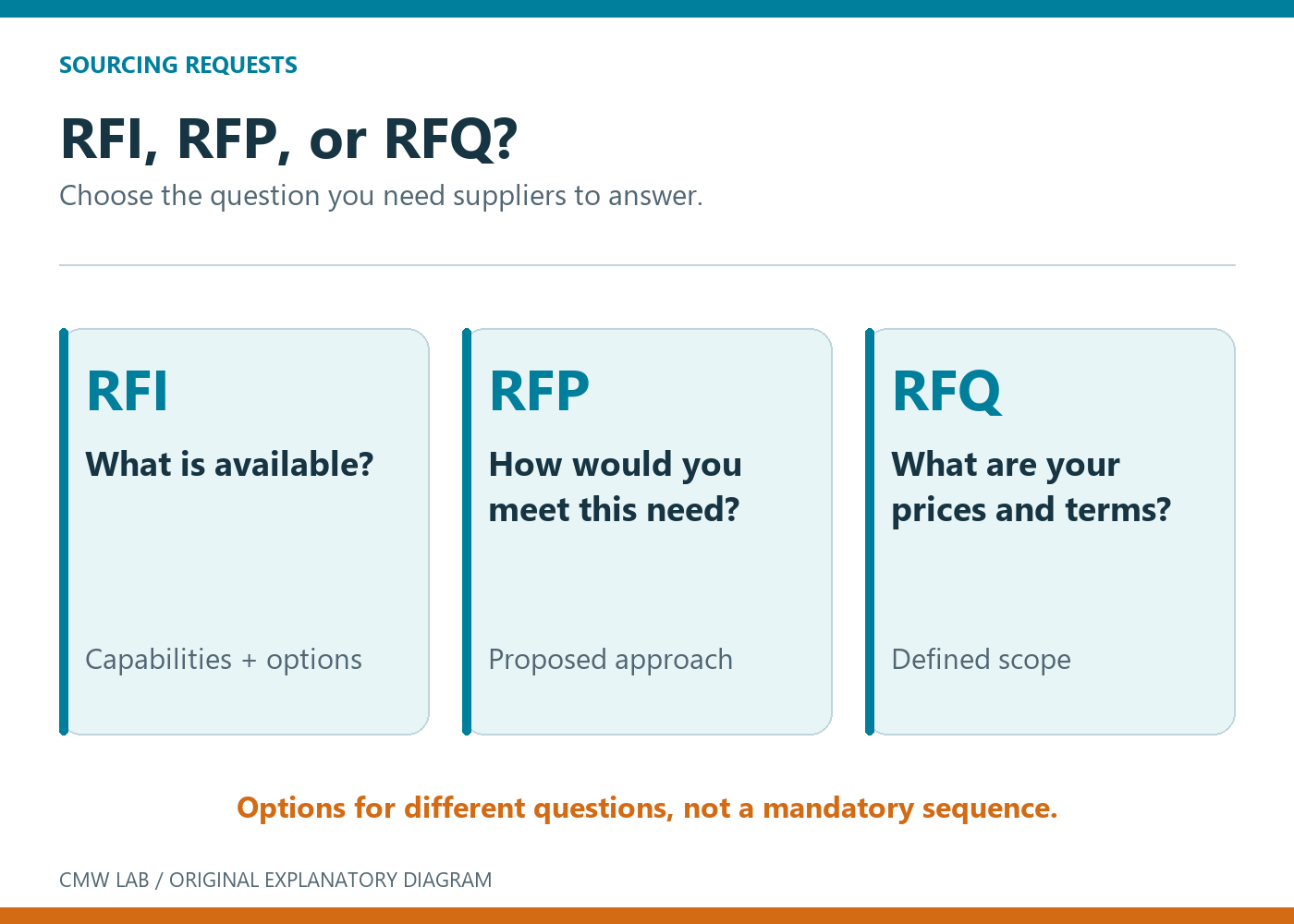
This guide uses the procurement meaning of the terms. Ivalua’s comparison describes their common distinction: exploring capabilities, evaluating proposals, and requesting pricing. The exact requirements and procedures depend on the organization’s sourcing rules and the particular request.
Choose RFI when a capability gap blocks the decision
Use an RFI when an information gap prevents a useful comparison. You may need to understand available service models, compatibility, delivery options, or supplier capabilities before specifying what to buy.
State what you want to learn and why. Ask questions that help close that gap rather than requesting a large generic company presentation. Identify which information is required, how responses will be reviewed, and what decision may follow.
An RFI can inform a later specification or shortlist. It does not need to lead automatically to an RFP, and collecting information is different from authorizing a purchase. Record the resulting requirement decisions so the next request does not start from an unexplained assumption.
Choose RFP when approaches need evaluation
Use an RFP when suppliers need to explain how they would achieve an outcome and the approaches may differ. Describe the need, constraints, required evidence, response structure, and evaluation criteria.
Distinguish requirements that must be met from areas where an alternative approach is welcome. If every supplier interprets the problem differently, an attractive proposal may be difficult to compare with the others. A common question set and an identified clarification process can help reviewers understand those differences.
The evaluation should explain how the proposed approach addresses the need. Price can matter alongside implementation, service coverage, support, or other relevant factors. Define the criteria before reviewing responses rather than changing the question to favor a particular proposal.
Choose RFQ when a defined scope needs quotations
Use an RFQ when the requirement is defined well enough for meaningful quotations. Specify the item or service, quantity or volume basis, required timing, relevant conditions, and how suppliers should present their response.
Comparable quotations depend on comparable scope. A lower headline price may exclude an item another quote includes. Ask suppliers to identify assumptions, exclusions, optional items, and deviations so the evaluation can explain what is actually being compared.
Document the permitted handling of incomplete or late responses and who resolves questions about the specification. A quotation request and a supplier selection decision are separate records; issuing the request does not itself establish the final order.
Pricing may appear in more than one type of response. The distinction is the decision the request supports, not a rule that one document can contain only one kind of information. Make the intended use and required response clear to suppliers.
Write one office-printing need as three possible briefs
Illustrative example: a team needs printing support across several offices. This fictional scenario shows how the remaining uncertainty affects the request; it is not a customer case or a product recommendation.
- Capabilities are unclear: an RFI could ask which service models, locations, and support arrangements suppliers can cover.
- The outcome is clear, but the approach is open: an RFP could invite different ways to meet the team’s volume and service requirements.
- The scope is specified: an RFQ could request quotations for an identified equipment and service package, using the same quantity and support assumptions.
The team should explain why it chose one route. If its needs are already well defined, repeating all three request types may add effort without resolving a real uncertainty. If important assumptions remain open, a price comparison alone may conceal different proposed services.
After the choice, prepare a comparable response package
Once the team has chosen an RFQ, the workflow should preserve the request version, responses, clarifications, and decision. The following is an original operating example rather than a prescribed procurement procedure.
- Prepare the package. Agree on scope, response fields, recipients, and timing. Evidence: the reviewed request version and its owner.
- Authorize release. Obtain the decision required to send the request. Evidence: who authorized release and what version they considered.
- Collect and clarify. Receive replies and handle specification questions. Evidence: supplier references, response versions, and clarifications.
- Compare responses. Identify differences in scope, assumptions, prices, and terms. Evidence: a comparison whose entries refer to the original replies.
- Record the next decision. Choose the authorized next action under the sourcing rules. Evidence: the decision, responsible person, and unresolved conditions.
If the team changes the requested support scope after replies arrive, identify which responses need clarification or revision. Preserve the earlier package so reviewers can understand why two quotations differ. Avoid comparing one supplier’s response to the old scope with another’s response to the new one without making that difference visible.
Reopen the comparison when the requirement changes
For each request, show the owner, current package version, response deadline, supplier replies, outstanding questions, and next decision. Keep links to the underlying evidence rather than recording only a final score or a “done” flag.
Separate request progress from the progress of each supplier response. The overall sourcing activity can remain open while one quotation is complete and another needs clarification. Define the completion condition for the request before using the tracker to report success.
For the surrounding business process, see the existing guide to procurement. An internal purchase request and its authorization belong to a different part of the route; the guide to purchase request approvals covers that topic.
Test a missing response, an incomplete quotation, a revised requirement, and an unavailable reviewer as well as the normal route. Check whether participants can identify the current package and explain the next decision. The tool should support the chosen sourcing procedure; its fields do not decide which request type the business needs.
A workflow tool can be evaluated against the chosen request and its evidence: assignments, response records, access, and change handling. The request type and sourcing decision remain business choices.

About the author
Pavel Grebeshkov
Pavel Grebeshkov has more than 15 years of experience in IT projects. His background includes CMO roles at CMW Lab and Familoop, bringing a marketing perspective to the needs of business software buyers and vendors.
He is the CEO of Softosaur, a platform for the B2B software and IT community. His articles on the CMW Lab blog focus on workflows, business processes, and the practical questions teams face when evaluating business software.