Source-to-Pay vs Procure-to-Pay: Scope and Handoff Example
November 23, 2026
Source-to-pay covers the wider lifecycle from a sourcing need to supplier payment. Procure-to-pay is the purchasing transaction within it, usually from requisition through order, receipt, invoice, and payment.
The practical design task is the handoff: which supplier decision, terms, authority, and fulfillment evidence must reach the people executing a purchase? Use the scope map and maintenance-service example below to write that record.
Table of Contents
Locate the purchasing transaction inside the wider lifecycle
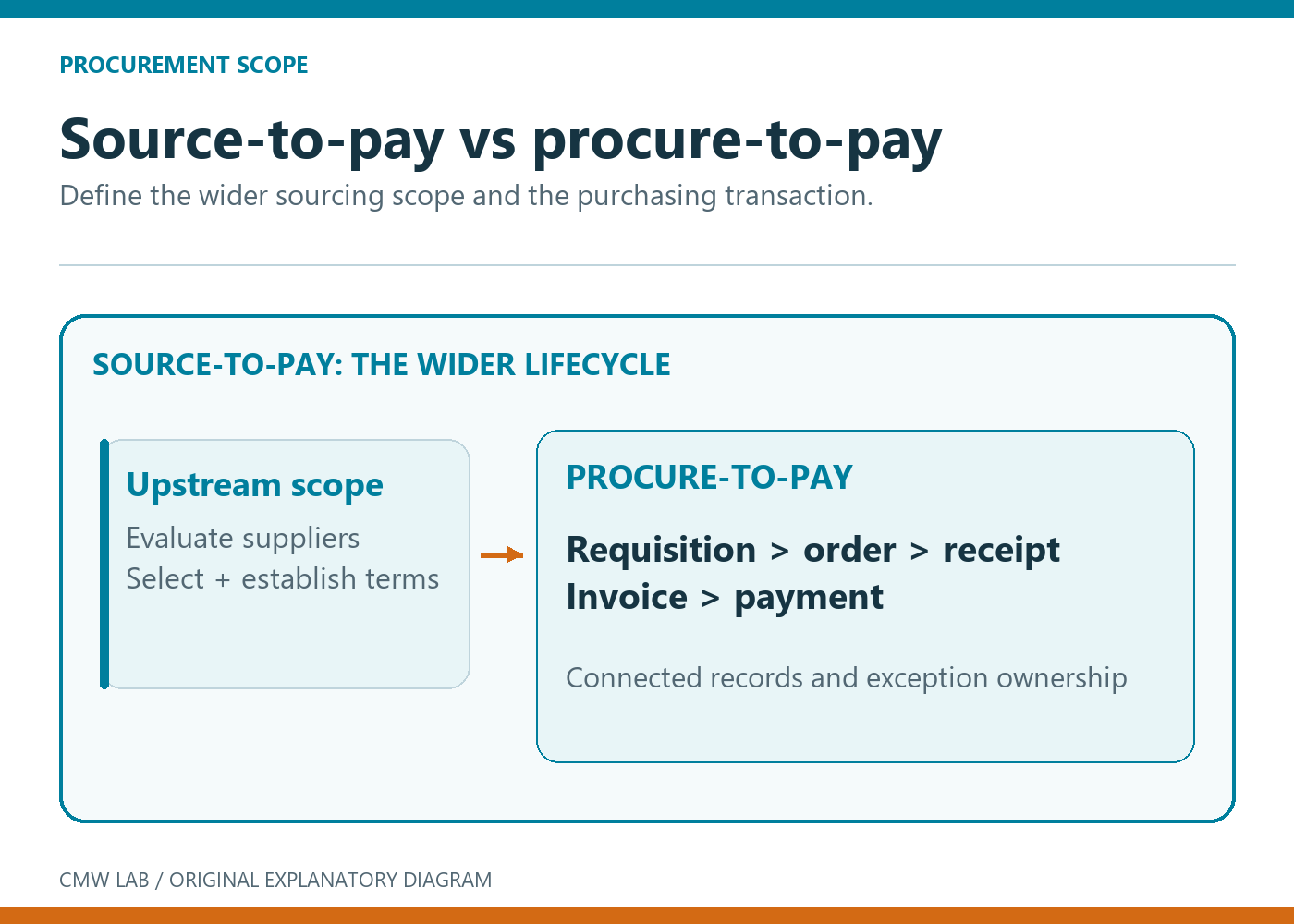
Organizations and software vendors draw some boundaries differently. Agree the start, finish, and ownership for your process rather than relying on an acronym alone. The comparison below is a practical scope guide, not a claim that every purchase requires a new sourcing event or contract.
Ivalua’s comparison describes S2P as the wider lifecycle and P2P as its purchasing and payment portion. Keep this distinction between processes separate from a software claim: a tool that coordinates requisition approval does not automatically provide a complete source-to-pay suite.
The boundary is visible in the information being exchanged: sourcing establishes supplier selection and applicable terms; the purchasing transaction uses them to create the order, confirm fulfillment, and coordinate invoice and payment work.
Follow a maintenance purchase across the boundary
Illustrative operating design: a company needs an office maintenance service. The example below shows scope and evidence, not a customer case, legal procedure, or ready-made product configuration.
- Establish the arrangement. In the sourcing work, the business defines locations, required tasks, and service expectations. Procurement compares suppliers against those requirements and records the selection and applicable terms. The responsible owner identifies who can request work under the arrangement and how changes will be handled.
- Execute an individual purchase. For an individual purchase, an employee submits a requisition referencing the selected supplier and service. An authorized reviewer checks the request. The buyer issues the order, and the receiving owner records whether the specified service was delivered. Finance then has the request, order, acceptance information, and invoice available for the applicable checks.
- Investigate an unconfirmed service. If the invoice describes work that the receiving owner has not confirmed, the process assigns an exception for investigation. It does not treat the order or the supplier’s invoice as evidence that the service was accepted. The invoice approval process guide covers that review in more detail.
- Carry a scope change back across the boundary. If the company later changes the service scope or supplier, the sourcing and agreement information must reach the buying process. Open orders may need separate review under the organization’s rules. Canceling a workflow request does not automatically cancel an external order or reverse an action already performed.
For the detailed review route, see the invoice approval guide.
Write the sourcing-to-purchasing handoff record
The following handoff record is an original design aid. Assign one owner to each unresolved item and preserve identifiers across systems. The right implementation may use several connected components.
| Handoff item | Evidence to pass | Question to resolve |
|---|---|---|
| Supplier identity | Approved supplier identifier and the relevant record version. | Which system owns the supplier data and distributes changes? |
| Applicable terms | Reference to the arrangement, its scope, and current validity. | How does the buyer know which terms apply to this request? |
| Purchasing authority | Required review and the person or role permitted to decide. | Who handles exceptions or an unavailable approver? |
| Receipt or acceptance | Record of the quantity or service confirmed by its responsible owner. | How are partial or disputed deliveries kept visible? |
| Transaction outcome | Order, invoice, and payment references with confirmed results. | Who investigates a rejected or uncertain system response? |
Separate the approval decision from the result of an integration. If a request to create an order times out, establish whether the external system already created it before recovery. Record the supported correlation or lookup method, the responsible person, and the conditions under which retry is safe.
Use the adjacent terms without moving the boundary
Source-to-contract (S2C) describes upstream sourcing and contracting work. It helps establish who the organization will buy from and on what terms. Contract management can continue after signature, so the relationship with purchasing is an ongoing exchange of information rather than a single file passed once.
Purchase-to-pay is commonly another name for procure-to-pay. Basware’s terminology guide uses those terms for the same buying and payment cycle. An internal team may use a narrower label; write its boundaries down before joining reports from different systems.
Accounts payable automation addresses invoice and payment-related work within that larger cycle. A working invoice route still depends on information about the purchase and what was received. A requisition approval is also different from confirmation that the supplier has been paid.
Choose the break in coordination to repair
Start with evidence of the failure. If buying requests are repeatedly returned for missing details, improve the intake and correction route. If purchases use outdated supplier terms, examine the sourcing-to-purchasing handoff. If invoices wait for service acceptance, identify who supplies that evidence and when.
Measure each stage with explicit timing boundaries. Elapsed time for sourcing and requisition-to-order time are different intervals. Report open exceptions and overdue work alongside completed transactions so unresolved cases do not disappear from a faster-looking average.
For the wider context, see what procurement includes. When assessing the workflow support for one handoff, identify which system owns each step, what must be integrated, and who resolves an uncertain result. A suite label alone does not establish those boundaries.
Test a sourcing-to-purchasing handoff and its unresolved conditions in CMW Lab.

About the author
Pavel Grebeshkov
Pavel Grebeshkov has more than 15 years of experience in IT projects. His background includes CMO roles at CMW Lab and Familoop, bringing a marketing perspective to the needs of business software buyers and vendors.
He is the CEO of Softosaur, a platform for the B2B software and IT community. His articles on the CMW Lab blog focus on workflows, business processes, and the practical questions teams face when evaluating business software.