Business Rules Engine and Workflow Engine – Difference
September 22, 2026
A purchase request can reach the right approver and still follow the wrong policy. It can also receive the right routing decision and then sit in an unassigned queue. These are different failures: one concerns decision logic; the other concerns execution. Understanding the distinction helps you decide what belongs in a business rules engine, what belongs in a workflow engine, and how the two should interact. A business rules engine evaluates facts against explicit rules to produce a decision or result. A workflow engine coordinates tasks, people, systems, and the state of a running process. They often work together: the rules engine determines an approval route, while the workflow engine assigns the review, waits for its completion, and handles exceptions. Neither component alone guarantees that the underlying policy or process is correct.
Key takeaways
Separate the decision to make from the work needed to carry it out.
A business rules management system includes capabilities around rule execution, such as authoring and maintaining rules.
Keep a small, stable branch in the workflow when a separate decision service would add more complexity than value.
For decision tables, specify how multiple matching rows are handled; row order can change the result.
Test boundaries, missing data, version changes, and failures before allowing a decision to advance a live process.
What is a business rules engine?
A business rules engine (BRE) is a software component that evaluates explicit conditions against supplied facts and produces results. For example, it can determine which approval route applies to a purchase request using its amount and supplier status. The result might be a route identifier, a calculated value, a validation message, or a classification. The engine executes the logic. A business rules management system (BRMS) is the broader environment for creating, storing, maintaining, and executing that logic. IBM describes authoring tools, a rule repository, and an execution engine as BRMS components. A product may package these functions together, but the engine and the management system are not interchangeable terms. See IBM’s BRMS overview.
Rules, policies, process logic, and decision models
A policy states an organizational requirement: purchases above a defined threshold need additional review. A business rule makes a part of that requirement executable: a request for at least $5,000 must use the procurement review route. Process logic says what happens next: create the review task, wait for a response, and return incomplete requests to their owners. A decision model organizes the inputs, rules, and dependencies needed to answer a business question. One decision may depend on another, such as classifying the supplier before selecting an approval route. A decision engine is a broader product term; depending on the system, it may combine explicit rules with scoring, optimization, or predictive models. Check the actual execution behavior instead of treating the label as a capability list.
Common rule types and representations
Validation: Is the amount present and within an accepted range?
Eligibility: Does this request qualify for a defined purchasing channel?
Routing: Which review group should receive the request?
Calculation: What total follows from approved quantities and unit prices?
Policy checks: Does the request meet an explicitly encoded internal requirement?
Pricing: Which agreed price schedule applies to this order?
Use a decision table when several inputs determine a result and reviewers benefit from seeing the combinations together. Use an expression for a concise calculation. A decision tree can explain a sequence of questions. A decision service exposes a defined decision through an interface so that more than one process or application can call it. The representation should make omissions and conflicts easier to find, not merely make the diagram smaller.
What is a workflow engine?
A workflow engine runs a defined flow of work and tracks each instance as it progresses. It creates tasks, routes work to people or services, waits for events, and handles outcomes according to the process design. In a purchasing process, it can coordinate request submission, review, corrections, order creation, and completion. A workflow is the design of the work; its engine is the software executing that design. The engine needs to know which request is waiting, which task is active, and which event can move that request forward. For a broader explanation of process execution, see our business process engine guide. Workflow engines also evaluate conditions. A gateway can route an approved request toward order creation and a rejected request toward closure. That does not mean every branch needs a separate rules engine. Extract a decision when its complexity, reuse, ownership, or rate of change makes separate management useful.
Business rules engine vs. workflow engine: key differences
The comparison below describes responsibilities, not mandatory product boundaries. One platform can provide both. Confirm which responsibilities a proposed implementation actually covers, including testing, versioning, access control, and failure handling.
Dimension
Business rules engine
Workflow engine
Main question
Given these facts, what result applies?
What work should happen next, and who or what performs it?
Typical inputs
Facts, parameters, and the selected rule version
Process data, task outcomes, events, and decision results
Typical outputs
A route, value, classification, or validation result
A task assignment, service call, state transition, or completed process
Change to isolate
A threshold, condition, calculation, or decision policy
A handoff, approval stage, timeout, or exception path
State
Can use stateless or stateful execution, depending on the engine and design
Tracks the progress of each running workflow instance
Failure to plan for
Invalid inputs, conflicting rules, no match, or unavailable evaluation
Unassigned tasks, failed integrations, expired waits, or stuck instances
Useful acceptance evidence
Expected results for normal, boundary, invalid, and overlapping cases
End-to-end execution including rejection, rework, timeout, and recovery
Do not use “stateless versus stateful” as an absolute dividing line. The official Drools rule-engine documentation describes both stateless and stateful KIE sessions. A rules engine can retain facts across interactions; that still does not make it a substitute for the full task and process lifecycle your application requires.
How rules and workflow engines work together
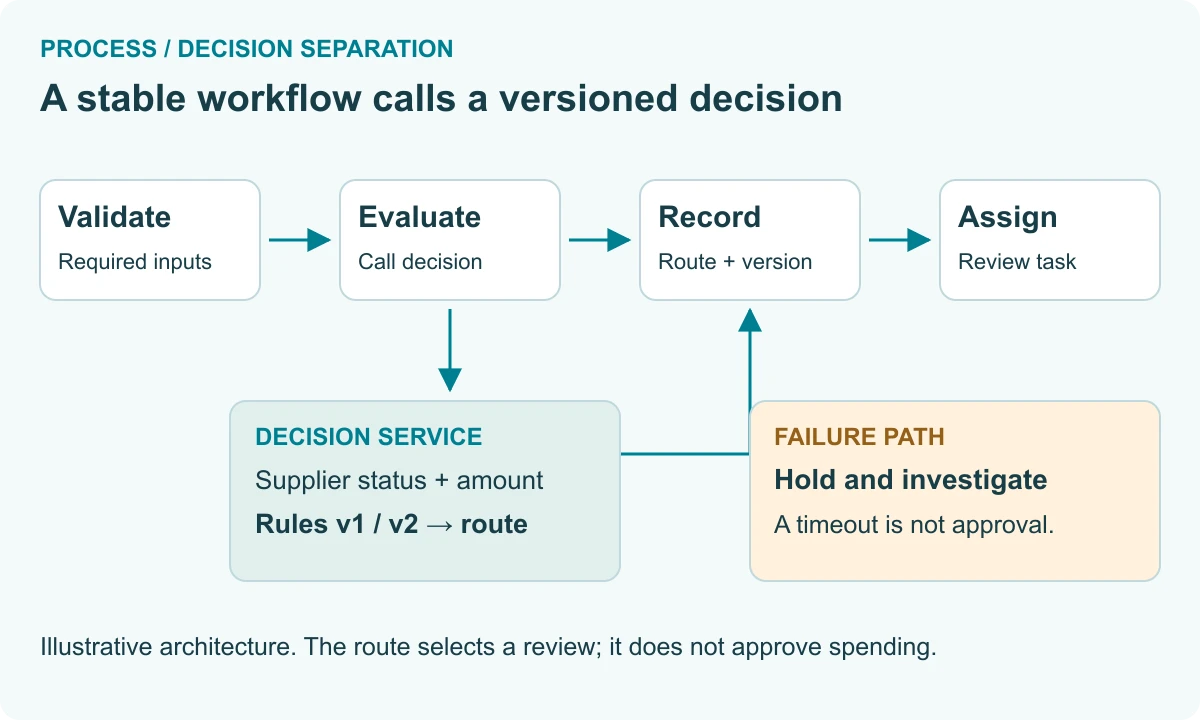
Start with a clear responsibility boundary. The workflow gathers and validates request data, calls the decision with a defined input set, records the result, and follows the corresponding route. The decision evaluates the supplied facts. The workflow remains responsible for assigning the resulting task and handling its completion.Separate decision evaluation from task execution. Record the returned route and rule version before advancing the process.
Define a decision contract
Specify input names, types, allowed values, units, and required fields. “Amount” is incomplete without a currency and an agreed treatment of taxes or conversion. Decide whether the call uses data captured at submission or current reference data. Different choices can produce different outcomes even when the rule itself has not changed. Define the output just as carefully. In the example below, it contains a route code, matched rule ID, policy version, and explanation code. Record these with the request identifier and evaluation time. The specific storage and logging mechanism depends on the implementation; this is a design recommendation, not a claim that every engine supplies it automatically.
Make failure behavior explicit
An unavailable decision service is not an approval. Send evaluation failures to a controlled hold or review path, with an owner and recovery action. Distinguish a valid “manual review” result from a timeout or malformed response. Otherwise, operational errors can be misreported as policy decisions. If a call is retried, prevent the retry from creating duplicate approval tasks. A useful design separates evaluation from side effects: evaluate, persist the accepted result, then create the task through a step that detects duplicate requests. If decision evaluation itself changes data, document that behavior and its recovery requirements before using it in a retryable integration.
Worked example: a purchase approval routing table
Illustrative example: the following policy, thresholds, test cases, and version history are invented for explanation. They are not a customer result, a recommended purchasing policy, or a product screenshot. The output selects a review route; it does not authorize spending or approve the request. Assume a single-currency process using USD. Before evaluation, require a numeric, nonnegative amount and a supplier status of either approved or unverified. A missing amount, negative amount, different currency, or unknown status produces a validation hold. Do not silently turn missing values into zero.
First matching row is different from first true condition
With a First hit policy, the first matching row determines the result. Every input condition in that row must match. The OMG Decision Model and Notation (DMN) 1.5 specification, section 8.2.11.1, distinguishes First from Unique and other hit policies. It also warns that First tables require care because their meaning depends on row order. Where possible, disjoint rules make a table easier to inspect. This deliberately overlapping example shows why order matters. Evaluate rows from top to bottom. “Any valid amount” means the input has already passed validation; it does not permit absent or invalid values.
Policy v1 — First hit policy; amounts in USD
Order / rule
Supplier status
Amount
Returned route
Reason
1 / R1
Unverified
Any valid amount
SUPPLIER_REVIEW
Supplier verification required
2 / R2
Either allowed status
At least $5,000
PROCUREMENT_REVIEW
Amount threshold reached
3 / R3
Approved
Below $5,000
MANAGER_REVIEW
Standard review route
An unverified supplier with a $6,000 request matches both R1 and R2. R1 wins because it appears first. Moving R2 above R1 would send that same request to procurement review instead. A visually small row move can therefore change policy behavior. A nonoverlapping alternative would restrict R2 to approved suppliers, removing this dependency for these inputs. A scoring model needs a different specification. “Take the first matching result” does not mean “add every matching score” or “choose the largest score.” If several rules contribute points, define aggregation, missing-input handling, and the final threshold separately. Do not label an ordered routing table a scoring model simply because it contains numbers.
Test the boundaries and the change
Suppose illustrative policy v2 raises the amount threshold from $5,000 to $7,500 while preserving supplier review precedence. R2 and R3 change together. The following expected results form a small regression test set that can be reproduced independently of a particular product.
Input
Expected v1
Expected v2
What it checks
Approved; $4,999.99
Manager review
Manager review
Just below the original threshold
Approved; $5,000
Procurement review
Manager review
Exact boundary and intended policy change
Approved; $7,500
Procurement review
Procurement review
Exact new boundary
Unverified; $6,000
Supplier review
Supplier review
Overlapping rules preserve supplier precedence
Unknown status; $100
Validation hold
Validation hold
Unrecognized input cannot use a default route
Approved; amount missing
Validation hold
Validation hold
Required data is enforced
Approved; -$1
Validation hold
Validation hold
Invalid numeric range is rejected
Approved; EUR 100
Validation hold
Validation hold
Currency assumptions are enforced
The stable workflow is: submit request, validate data, evaluate route, assign review, wait for the response, then proceed or return for correction. A threshold change can leave that sequence intact. If the organization instead introduces a second approval stage, the workflow must change too. Separating rules from processes does not eliminate genuine process changes.
Business rules management: lifecycle and governance
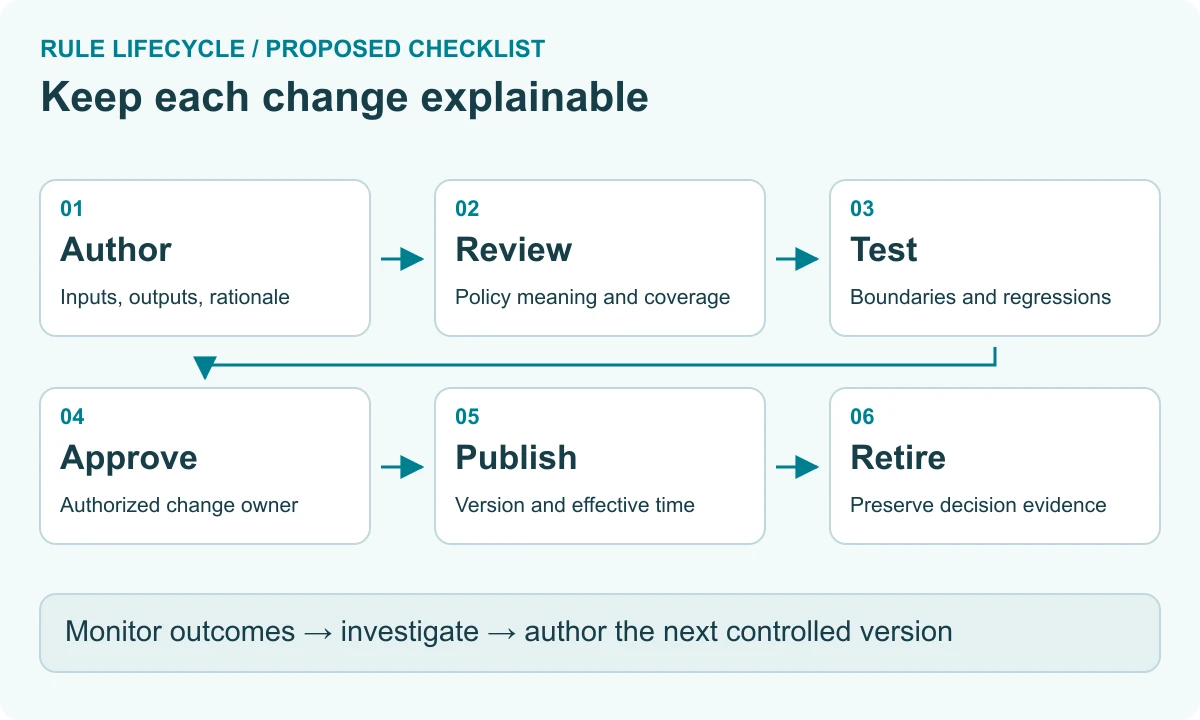
Use a lifecycle that makes each change traceable from a business requirement to a tested release. The sequence below is an editorial implementation checklist. It is not a prescribed standard or a claim about a particular platform feature.A proposed rule lifecycle links each version to its rationale, tests, approval, effective period, and retirement decision.
Author: name the decision, owner, inputs, outputs, and policy rationale.
Review: check whether the encoded conditions accurately express the requirement and cover relevant cases.
Test: run expected outcomes, exact boundaries, overlaps, invalid inputs, and representative historical cases that may be used for this purpose.
Approve: record who can authorize the change; separate authoring and approval where the risk warrants it.
Publish: activate a specific version with an effective time and a recovery plan.
Retire: prevent new use of superseded versions while retaining the evidence needed to explain past decisions.
Decide what happens to work already in progress
A request submitted under v1 may still be waiting when v2 becomes effective. Choose a policy explicitly: keep the version selected at submission, or reevaluate at a defined checkpoint. The correct choice depends on the business requirement. Never assume that deploying a new table should silently reroute every open request. Also define which data changes require reevaluation. If an approved-supplier request increases from $4,000 to $8,000 after routing, preserving the original result may be inappropriate. Record the relevant input snapshot, the version used, and any later reevaluation. Versioning rules without preserving their inputs is insufficient to explain a past result.
Monitor decision quality and process performance separately
Track evaluation failure rate = failed evaluation attempts / all evaluation attempts × 100. Count retries consistently and keep infrastructure failures separate from valid manual-review outcomes. Track manual-review rate = requests routed to manual review / successfully evaluated requests × 100, with the included routes named. Neither metric alone proves that the policy is correct. For the workflow, measure elapsed time to complete the review, time waiting for an assignee, and rework frequency. A fast rules engine cannot compensate for an approval task with no owner. Our guide to workflow process mapping explains how to make those handoffs and delays visible.
Do you need a rules engine, a workflow engine, or both?
Start with workflow capabilities when the main problem is coordinating people, tasks, systems, and deadlines, and the branching logic is small and stable. A straightforward approved/rejected branch may be clearer inside the process than behind another service call. Prioritize rules management when decisions change frequently, the same logic appears in several applications, or policy owners need a controlled way to review and test combinations. A shared decision service can reduce duplicated logic, provided its availability and versioning are managed deliberately. Use both responsibilities together when a long-running process depends on changing or reusable decisions. They may live within one platform or across integrated services. Compare the operational cost of the boundary: additional calls, deployment coordination, monitoring, and recovery can outweigh the benefit for a very small decision. During evaluation, ask a vendor to demonstrate a changed threshold, an overlapping-rule test, a missing input, a service failure, and an in-flight request crossing a version change. Then trace the resulting task through rejection and correction. These demonstrations reveal more about fit than a diagram showing only the successful path. For related implementation criteria, see our workflow automation checklist.
A documented Comindware example: dependent field choices
Comindware Platform V6 documentation provides a smaller, concrete example of separating a data-selection rule from the surrounding work. In a business-trip request, selecting a country restricts the available cities. The documented model links countries to cities and uses the selected country to filter the city choices. The baseline would be a city selector that does not narrow its choices using the selected country. The documented change adds that filter. The functional result is a selector limited by the country-city relationship, subject to the documented access rules. This is a reproducible documentation example, not a measured customer outcome; it makes no claim about time saved or error reduction. See the official record-selection filtering example in the Russian-language knowledge base. The V6 expression-editor documentation also describes formulas, N3 expressions, and DMN tables. That supports a specific statement about available editing mechanisms. It does not establish conformance to every part of DMN 1.5 or guarantee every hit policy. Verify the required table behavior in the implementation you evaluate. For a purchasing workflow, apply the same design discipline: define the data relationship or decision separately, then verify how the process uses the result. Explore CMW Lab’s business process automation capabilities and bring a real routing table, its expected results, and its exception cases to a process discussion. That gives the demonstration a concrete acceptance target. How this guide was built: definitions and technical distinctions were checked against the primary sources linked above. The routing table, tests, lifecycle checklist, and diagrams are original illustrative material. Product statements are limited to the cited documentation; no customer performance figures or expert quotations are implied.
Frequently asked questions
What is the difference between a business rules engine and a workflow engine?
A business rules engine evaluates conditions to produce a result; a workflow engine coordinates the work that uses that result. For example, one can select an approval route while the other assigns the review task, waits for completion, and handles rejection. A single software platform may provide both capabilities.
Is a BRMS the same as a business rules engine?
No. A business rules engine executes rules, while a business rules management system includes the surrounding tools for maintaining them. Depending on the product, that environment may support authoring, repositories, testing, deployment, and governance. Evaluate those capabilities individually instead of assuming that an execution engine includes a complete management lifecycle.
Can a workflow engine run without a separate rules engine?
Yes. A workflow engine can handle straightforward conditions within its process design. A separate rules component becomes useful when decision logic is complex, reused, frequently changed, or owned and tested independently. The choice should reduce overall maintenance effort while preserving clear error handling, version behavior, and accountability for the resulting work.
What does first match mean in a decision table?
First match means the first row whose input conditions all match supplies the result. It does not mean the first individual condition that happens to be true. Because several rows can match, their order can change the outcome. Test overlapping cases and consider disjoint rules when they make the policy easier to understand.
How should you test a business rule before publishing it?
Test ordinary cases, exact boundaries, missing or invalid inputs, overlapping conditions, and expected differences from the previous version. Then test how the workflow uses the result, including failures and work already in progress. Keep the expected outputs with the rule version so later changes can be checked against an explicit baseline.