Workflow Management Software vs BPM Software – Selection Tips
November 22, 2026
Workflow management software coordinates a defined flow of tasks, decisions, and information. Business process management (BPM) software can support the wider work of modeling, running, measuring, and improving business processes. Their capabilities overlap: a product called a workflow tool may support several departments and integrations, while a BPM platform may include the same task-routing features.
Choose by the process you need to operate and the evidence a product can demonstrate. Neither label establishes implementation time, total cost, usability, or the ability to recover from a failed handoff. This guide explains how to compare the two approaches and test a shortlist against one real request.
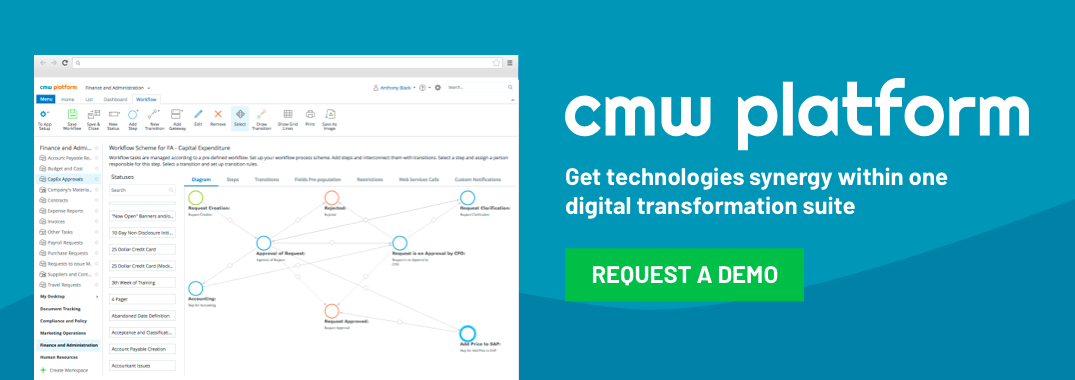
Table of Contents
Workflow Management and BPM: Start with the Scope
Workflow management asks how a work item moves: what starts it, who acts next, what information that person receives, and which outcome advances or closes it. For example, a repair request needs an owner, a priority, a decision about the required work, and a record of completion.
BPM adds a management cycle around the process. A process owner examines the current design, tests changes, monitors results, and decides what to improve. IBM’s BPM overview describes design, modeling, execution, monitoring, and optimization as parts of that lifecycle. Buying software does not establish those responsibilities for the organization.
Keep the practice separate from the product. Workflow software and business process management systems can both provide forms, assignments, routing, notifications, and reporting. Check the functions included in the proposed edition and implementation. A diagram editor alone does not establish that a process can run with the required data, permissions, and exceptions.
For the underlying concepts, see what workflow management involves. The distinction between a workflow and its wider business outcome is covered in workflow vs process.
Compare Demonstrated Capabilities
Use the following questions for products in either category. They are an evaluation guide, not a claim that every workflow application or BPM suite includes the listed capability.
| Requirement | Question to ask | Evidence to request |
|---|---|---|
| Task coordination | Can work reach a responsible person with the information needed to act? | A request moving through assignment, return, reassignment, and completion. |
| End-to-end visibility | Can the owner follow the outcome across departments? | One request identifier connecting its tasks, decisions, and final result. |
| Integration | What happens when another system rejects or does not confirm an action? | A failed exchange, its recovery owner, and a verified recovery path. |
| Process changes | Who may change the route, and what happens to work already running? | A controlled version change with its effect on an open request explained. |
| Measurement | Can the team distinguish waiting, rework, and completed outcomes? | Reports with defined timestamps, populations, and treatment of open items. |
| Operation and cost | What work and charges remain after initial setup? | Documented responsibilities for configuration, support, upgrades, and expansion. |
The distinction is therefore about the needs being addressed. A team may initially need reliable task routing. It may also need governance and measurement across the whole process. Those requirements can coexist in one implementation rather than forcing an immediate choice between two mutually exclusive categories.
Use Cases for Workflow Management Software over a BPM Tool
A focused workflow application can be a suitable starting point when the request type, participants, and completion rule are known, and the main problem is unreliable coordination. Replacing email tracking with a shared request, named owners, and a defined correction route can address that problem without beginning an organization-wide redesign.
A wider BPM initiative is useful when the team must also resolve process ownership, conflicting departmental measures, repeated redesign, or outcomes spanning several workflows and systems. That still calls for a manageable pilot. A large scope does not justify leaving individual task handoffs unclear.
Illustrative example: a facilities team receives repair requests by email. A coordinator assigns a technician, but requesters cannot tell whether a request is awaiting authorization, parts, or a completion check. The following is a fictional selection exercise, not a customer implementation.
For a workflow pilot, define the submission fields, assignment rule, authorization decision, return path for missing information, and completion evidence. Ask the shortlisted product to run an ordinary repair, an incomplete request, and a reassignment when the technician is unavailable.
For the wider process, identify who owns the service result. Agree how priority is set, how purchasing dependencies are handled, and when the requester is informed. Measure the time from initial submission to verified completion, alongside the age of open requests. Closing the authorization task is not the same as completing the repair.
If an approved request creates work in a maintenance system, test a missing confirmation. The process needs an owner who can establish whether the external record exists before attempting recovery. Describe that requirement in the trial; do not infer it from a general promise of integration.
Assess Setup Time, Cost, and User Experience
Setup effort depends on the route, data preparation, permissions, integrations, migration, and testing. A small workflow with an uncertain external interface can require more work than a larger process using established components. Request an implementation plan based on your pilot rather than assuming workflow software is always faster or cheaper.
Compare costs over the same period and usage assumptions. Include licensing, implementation, required connectors or services, support, upgrades, and the effort to change the process later. Confirm which items are included and who operates them. A lower initial quote does not establish the lower cost of an equivalent working solution.
Test usability with the people who will submit and handle requests. Can a requester understand a return reason? Can a substitute find the context? Can a process owner locate a delayed item? Separate the ease of completing daily work from the ease of configuring a new application.

The original Comindware process-design illustration retained from this article. Use a current demonstration to assess the interface and capabilities available today.
Choose with a Pilot and Clear Acceptance Criteria
Write the required outcomes before the demonstration. Include a normal completion, rejection, correction, absent owner, changed request, and relevant system failure. For each case, name the expected result and the person responsible for resolving an exception.
Record what the product demonstrated, what requires configuration, and what depends on another component. Review the findings with the process owner and the people doing the work. Choose the smallest implementation that meets the required controls and leaves a practical path for future improvement.
CMW Lab’s workflow builder describes visual steps, forms, data, and business rules. Bring your own request and exception cases to a trial to evaluate how those capabilities fit. Keep broader process ownership and change governance explicit as the implementation develops.