Purchase Order vs Invoice: Differences and a Partial-Delivery Example
November 23, 2026
A purchase order records what a buyer orders from a supplier; an invoice records what the supplier bills the buyer for. The documents can contain similar descriptions, quantities, and prices, but they answer different questions: what was ordered, and what is being charged?
Keep both questions separate from a third one: what goods or services were actually received? A matching document reference helps connect the records, but it does not establish that every billed item arrived or that payment has been authorized.
Table of Contents
Purchase Order vs Invoice at a Glance
A purchase order (PO) is issued by the buyer to communicate an order and its relevant details. An invoice is issued by the supplier to request payment under the applicable billing arrangement. Procurify’s comparison explains this buyer-versus-supplier distinction.
| Question | Purchase order | Invoice |
|---|---|---|
| Who issues it? | The buyer | The supplier or seller |
| What does it describe? | The goods or services being ordered and the relevant order terms | The goods, services, period, or billing stage being charged |
| When is it used? | Usually before fulfillment, after the buyer’s required internal decisions | At the billing stage specified by the arrangement |
| What identifies it? | A purchase order reference and its version | An invoice reference, often with a related PO reference |
| What must still be checked? | Whether the order details and authority are correct | Whether the charge is supported, accurate, and eligible for the next action |
Document names and fields vary between organizations. Define what your records mean rather than treating a file name as proof of its status. In particular, an order, an invoice, a receiving record, and a payment record are different pieces of evidence.
How the Documents Connect in a Workflow
In a PO-based purchasing route, a team identifies a need, obtains the required internal authorization, and issues the order to the supplier. Fulfillment and billing then produce additional records that refer back to that order.
The sequence and timing depend on the arrangement. Billing can relate to a delivery, service period, or another agreed stage. Use the relevant terms and evidence for that purchase instead of assuming every invoice must follow one identical delivery pattern.
A purchase requisition is an internal request to buy something; a purchase order communicates the resulting order to the supplier. The broader guide to procurement covers the surrounding process. This comparison focuses on the order and billing records that participants need to keep connected.
Example: An Order, a Partial Delivery, and an Invoice
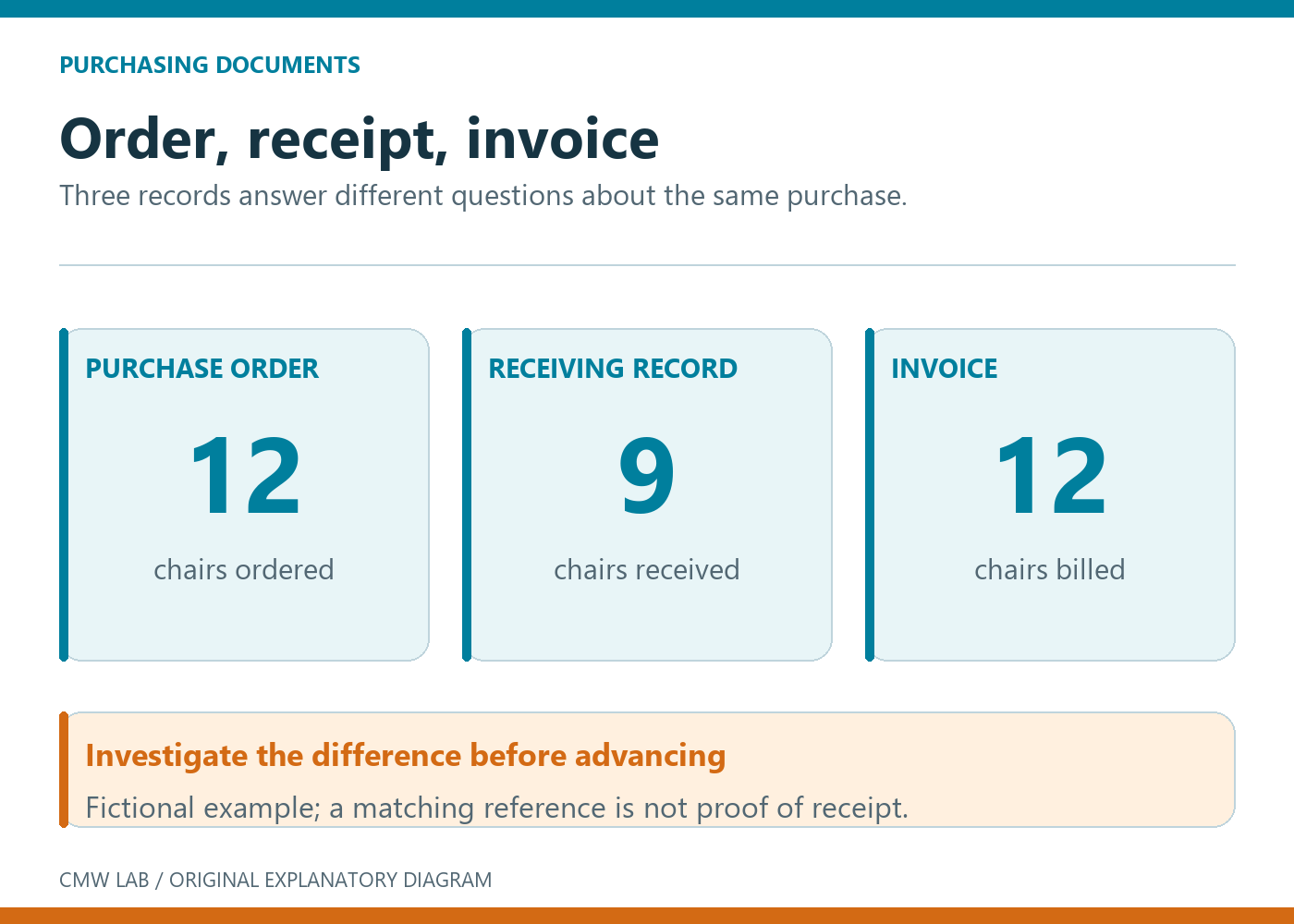
Illustrative example: an office team orders twelve chairs. Nine arrive in the first delivery, while an invoice lists twelve. This is a fictional checking exercise, not a customer case or a measured result.
| Record | Example information | What to investigate |
|---|---|---|
| Purchase order | Twelve chairs of the specified model, with the agreed terms | Which order version and line does the invoice concern? |
| Receiving record | Nine chairs received; three remain outstanding | Is this a partial delivery, an error, or another agreed arrangement? |
| Invoice | Twelve chairs billed against the order reference | Does the billing basis explain the difference from the receiving record? |
| Exception decision | The assigned owner records the explanation and permitted next action | Are the supporting records and any correction connected to this invoice? |
The PO and invoice may agree with one another while the delivery evidence differs. The team needs to establish whether the billing is consistent with the arrangement, whether another delivery is expected, or whether a correction is needed.
Record who resolves that question and which evidence they used. A status such as “quantity difference under review” is more informative than silently changing a received quantity to make the documents match. The authorized next action follows the organization’s rules for that case.
Keep Identifiers and Versions Distinguishable
The invoice number and PO number normally identify different records. Preserve both, together with the supplier and relevant line references. One order can be associated with several deliveries or invoices, so a shared PO number alone may not identify the precise item being reviewed.
If an order changes, retain a way to distinguish the earlier version from the revised one. A reviewer should be able to tell which terms applied to the invoice under review. Replacing an attachment without recording the change can make an earlier decision difficult to interpret.
Use a consistent link between records rather than relying only on similar file names. Where the data lives in several systems, establish which system owns the order, receiving record, invoice, and workflow status. The guide to systems of record explains that authority boundary.
Questions to Resolve Before Advancing an Invoice
- Identity: does the record identify the intended supplier, buyer, invoice, and related order where applicable?
- Scope: do the items, service period, quantities, and billing basis correspond to the relevant purchase?
- Evidence: is the required receipt, acceptance, or other supporting information available?
- Differences: who investigates a missing reference, changed order, duplicate submission, or unexplained amount?
- Decision: which authorized role determines the next action, and where is that outcome recorded?
These are workflow design questions, not a universal payment checklist. For example, a non-PO invoice may be a permitted exception in one organization and require a different route in another. Define the route explicitly so the absence of a PO is handled deliberately.
Separate Document Matching from Approval
Matching compares relevant records and identifies agreements or differences. Approval is a decision by a role permitted to authorize a specified action. A comparison that finds no difference does not automatically establish that every required decision has been made.
Likewise, an approval without a clear reference to the supporting records may not explain what was reviewed. State which checks and decisions are required for this request type and preserve the evidence needed to understand them.
For the detailed routing topic, see the existing invoice approval process guide. This article does not replace that implementation guide or a complete accounts payable procedure.
Test the Connections with Realistic Exceptions
When evaluating workflow support, start with one order and its related records. Test a normal case, a partial delivery, a changed order, a missing PO reference, and a repeated invoice submission. Check which person receives the exception and how the record explains its resolution.
CMW Lab’s workflow builder describes connecting steps with forms, data, and business rules. Use those capabilities as an evaluation starting point, then verify the required integrations, permissions, and exception behavior in the intended deployment.
Bring the documents and their difficult cases to a trial of CMW workflow software. The useful result is a traceable route from an identified record to an authorized next action.