A workflow model earns its place when people can use it to handle real work, including the request that arrives incomplete, the reviewer who is away, and the change that invalidates an earlier approval. A neat chain of boxes can hide all three. These four tips help turn a readable workflow chart into a model that a team can explain, test, and maintain.
An effective workflow model describes how work moves from a defined trigger to a verifiable outcome. It identifies the tasks, responsible roles, handoffs, decision rules, required information, and exception paths. A workflow chart makes those relationships visible; supporting specifications supply details that would overwhelm the diagram. Before automation, validate the model with realistic scenarios and confirm that its data, permissions, timing, and system behavior can be implemented.
By Pavel, CMW Lab blog author. Last reviewed: September 17, 2026.
Key takeaways
- A useful workflow model has a clear starting event and observable completion criteria.
- Every handoff needs a receiving role, required information, and an acceptance condition.
- Parallel work needs explicit dependencies, completion rules, and a plan for changes.
- Deadlines need a clock definition and an escalation action; a time label alone is insufficient.
- A model becomes ready for implementation when its important paths have expected test outcomes.
What makes a workflow model useful?
A useful model lets two people independently explain what happens next and reach the same answer. They should agree on who acts, which information is used, how a decision is made, and what proves that the work is complete. If the explanation relies on “someone usually sorts that out,” the model has an unresolved dependency.
Keep three things together: the diagram, a short specification of its tasks and rules, and the scenarios used to validate it. The diagram shows the route. The specification defines details such as allowed values and permissions. The scenarios demonstrate the intended behavior. Use a shared version identifier so the three do not drift apart.
This guide focuses on modeling quality. For visual conventions and page layout, see how to draw a readable workflow diagram. For the broader discovery exercise, start with mapping the process as it actually works.
Tip 1: Define the process boundary before adding detail
State the trigger, the outcome, and what is outside the model. “Manage content” is too broad to test. “Take a submitted article through review to verified publication or cancellation” gives the team a start, alternative endings, and a manageable scope.
Brainstorm with people who perform the work and ask what happens next at each step. Include awkward workarounds, missing information, queues, and informal approvals. Record the current process separately from the proposed one. Otherwise, a diagram can combine an existing manual workaround with a future automated step and describe a process that has never existed.
Challenge each activity after discovery: what outcome does it produce, who uses that outcome, and what would fail if the activity disappeared? A duplicate check may be waste, or it may be an independent control. Understand its purpose before removing it.
Use one level of detail on a diagram. “Complete editorial review” can be a task in an overview and a linked subprocess in a detailed model. Mouse clicks and screen fields normally belong in work instructions unless they change routing, accountability, or the evidence required to continue.
APQC’s Process Classification Framework organizes business processes into a hierarchy. It can help teams align process names and scope. The local sequence, handoffs, and exception rules still need to be discovered and defined for the organization.
Tip 2: Make roles, handoffs, and ownership explicit
Assign a responsible role to every task and define how a person receives that assignment. A lane labeled “Marketing” communicates a department, but it does not tell an implementation team whether work goes to a queue, a named owner, or a person selected from the request.
Describe each important handoff as a small contract: the sender, receiving role, information transferred, acceptance condition, and response when the handoff fails. For content review, “Send to reviewer” becomes “Assign the current asset version to the editorial reviewer with the brief, intended audience, and due time.”
Keep the process owner distinct from task performers. The process owner resolves gaps that cross departments and maintains the overall design. A performer completes a particular piece of work. A backup assignment rule handles absence; it should not depend on everyone knowing whom to message.
Rehearse an absence scenario. If the intended reviewer cannot receive work, does the request enter a monitored queue, move to a designated backup, or stop with an explicit exception? A task that exists but has no eligible recipient is still a failed handoff.
Tip 3: Model decisions, parallel work, and exception paths
Label decisions with conditions that the team can evaluate. “Looks good?” may be enough during brainstorming, but implementation needs permitted outcomes, required fields, and a route for missing or unexpected values. Keep the task that records a decision separate from the branch that uses it.
Model rejection, rework, cancellation, timeout, and failure when they change who acts next or whether work can continue. Smaller calculations can live in a linked rule specification. The diagram should reveal consequential behavior without becoming a wall of formulas.
Make parallel work conditional on real independence
Some activities can run concurrently because neither needs the other’s output. Planning a trade-show promotion and booking travel may overlap once the event is confirmed. The original article’s advice to look for parallel work remains useful, but concurrency also requires a clear point at which downstream work may begin.
For two required reviews, specify that both must approve the same version. If a writer revises the asset after one review, that earlier approval may no longer apply. Decide which checks must be repeated and what happens to review tasks still open on the old version.
In Business Process Model and Notation (BPMN), branching and synchronization have defined meanings. A parallel join waits for its required incoming flows; it cannot complete if it expects a mutually exclusive branch that never started. Use the BPMN element reference when translating the design into formal notation.
Give every exception a destination
An arrow labeled “Escalate” needs an owner and a recovery outcome. A reminder may leave the original task open; reassignment or cancellation may change who can act. Define which behavior is intended. A retry also needs a limit or a route to investigation, especially when the external action may already have succeeded.
Tip 4: Add data, timing, rules, and system events
Document the operational details that make the route work. For each task, identify required inputs, outputs, editable fields, access rules, and the event that allows the next step to start. Avoid making one status field stand for several unrelated facts such as approval, delivery, and payment.
For a service-level agreement (SLA) or internal target, define when the clock starts, whether it uses elapsed or business time, which calendar applies, and whether it pauses during rework. Then define what a breach causes. The phrase “two days” leaves all of those questions unanswered.
Give incoming requests a stable identifier. If the same submission or system event arrives twice, specify how the implementation recognizes it and avoids starting duplicate work. Also define how an external response is matched to the correct request and version.
Separate “command sent” from “outcome confirmed.” A publication request sent to a content system is not proof that the intended version is publicly available. The completion criteria should include the relevant evidence: a successful response, the resulting URL, and a check that the output matches the approved version.
For changing routing logic, keep a clear rule owner and version. The comparison of workflow and rules engines explains how task coordination differs from evaluating decision logic.
12-point workflow model review checklist
Use this original checklist to review one model version. Mark each row pass, unresolved, or not applicable, and link to the supporting evidence. An unresolved condition that affects authorization, routing, or completion should be addressed before the corresponding automation is released.
| Check | Question to answer | Evidence to retain |
|---|---|---|
| 1. Trigger | What creates one instance, and how are duplicates recognized? | Trigger definition and request identifier |
| 2. Outcome | What proves success, rejection, or cancellation? | End states and observable completion criteria |
| 3. Scope | Are adjacent processes and assumptions explicit? | Boundary statement and linked subprocesses |
| 4. Owner | Who maintains the process and resolves cross-team gaps? | Named process-owner role |
| 5. Assignment | Who receives each task, including during absence? | Assignment, queue, and backup rules |
| 6. Handoff | What must the receiving role get before starting? | Input fields, documents, and acceptance condition |
| 7. Decision | Are conditions complete, with invalid values handled? | Allowed outcomes and decision examples |
| 8. Parallel work | Which paths must finish, and must they use the same version? | Dependency and synchronization rules |
| 9. Rework | What is repeated when an input changes? | Return path and invalidated approvals |
| 10. Time | When does the clock run, and what happens when it expires? | Calendar, due-time rule, and escalation owner |
| 11. System failure | How are failed or uncertain external actions resolved? | Confirmation, retry, and recovery requirements |
| 12. Validation | Do realistic scenarios produce the expected outcomes? | Model version, test inputs, observed results, open issues |
Method: the checklist combines process-discovery, responsibility, execution, and verification questions. It is an editorial review aid, not a certification scheme or a statistically validated maturity score. Twelve checked boxes do not replace testing in the chosen system.
Before and after: a content publication workflow
Illustrative example: a team publishes a marketing asset after editorial and brand review. The process, roles, two-business-day review target, and version rules below are assumptions created for this guide. They are not a customer case or a measured performance claim.
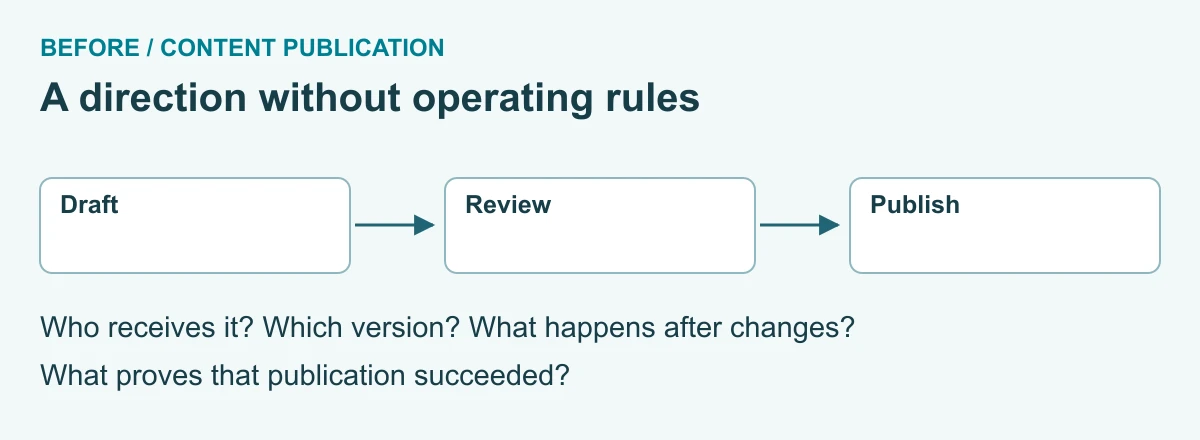
The initial chart says “Draft → Review → Publish.” It does not identify who coordinates the reviews, whether both are required, what happens after a revision, or whether “Publish” means an attempt or a confirmed result. Different team members can follow the same chart and produce different outcomes.
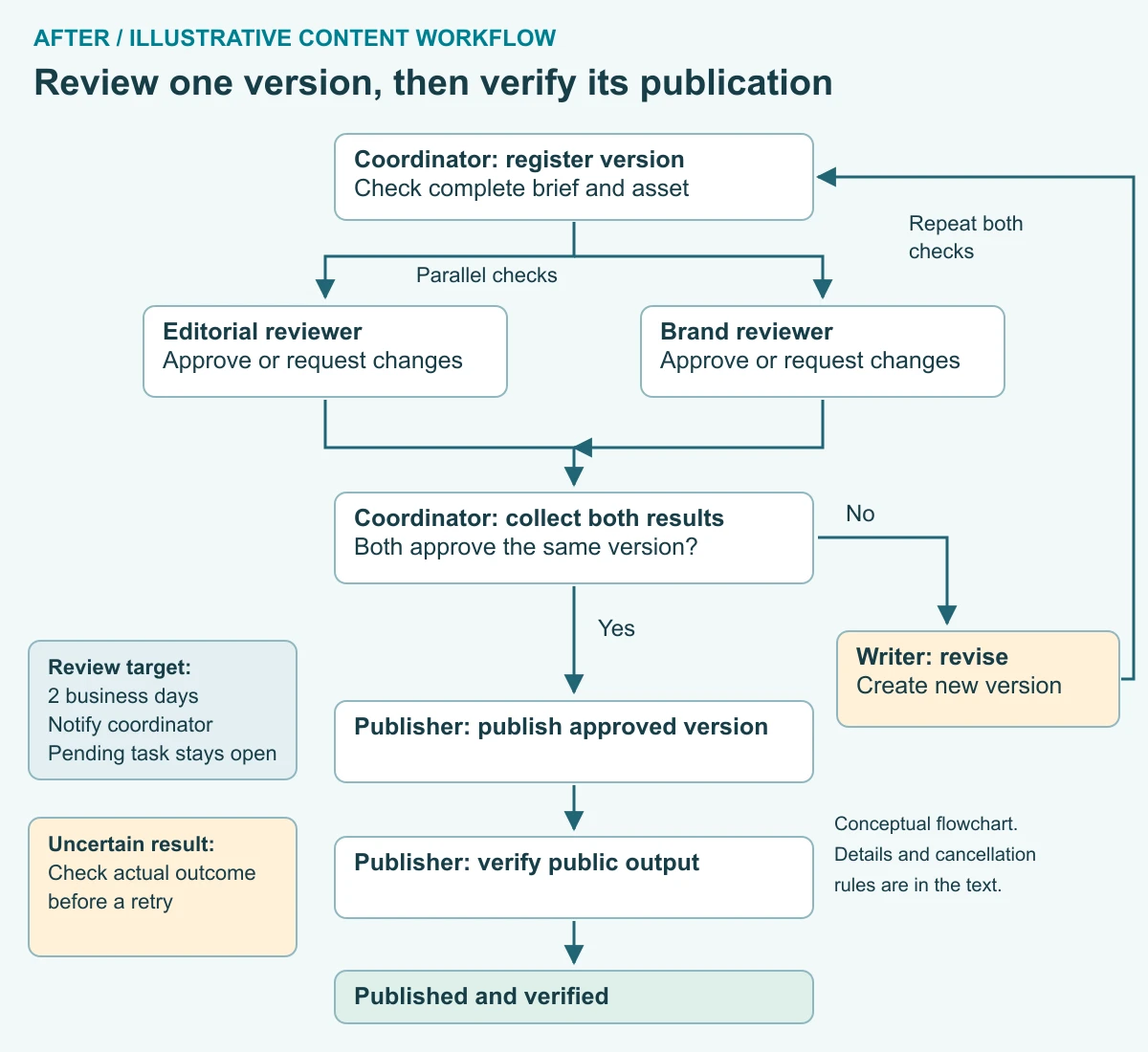
The revised model adds these rules:
- Intake: the writer submits an asset with its brief and version identifier. The coordinator checks completeness before assigning reviews.
- Review: editorial and brand reviewers work independently on that same version. Each records approved or changes requested. A monitored backup rule covers unavailable reviewers.
- Rework: the coordinator collects both review outcomes. If either requests changes, the writer creates a new version and both checks repeat. This deliberately trades some extra review work for a simple, auditable version rule.
- Publication: the publisher releases only the version that has both approvals, then verifies its public output. An uncertain or failed result stays unresolved until the publisher checks what happened.
- Timing: review time begins when both tasks are assigned and follows the team’s working calendar. At two business days, the coordinator receives an escalation; the pending review remains open. An unavailable reviewer follows the backup rule.
The diagram groups some detail into labeled activities to stay readable. Intake corrections, reminders, and publication recovery are specified in the text and implementation requirements. The team must also define cancellation and the retry policy before building the automation. The drawing is a testable design example, not an executable file.
Validate the version rule with concrete scenarios
Walk through these cases with the writer, coordinator, reviewers, and publisher. Record the model version and the expected result before configuring the workflow.
- Both approve version A: version A can enter publication.
- One requests changes: publication remains blocked; version B starts a new review cycle.
- An old approval arrives for version A after B exists: it cannot authorize publication of B.
- One reviewer misses the target: the coordinator handles the escalation; the missing approval is not assumed.
- The publication call times out: check whether publication occurred before retrying, to avoid duplicate output.
- The request is canceled: outstanding tasks close according to the agreed cancellation rule, and nothing is published.
Measure whether the revised process works
Measure review cycle time from review assignment to the final required outcome for one asset version. Track first-pass approval rate as initial versions approved by both reviewers without rework / initial versions with both review outcomes × 100. Keep versions still awaiting a result visible as open work.
For an illustrative cohort of 20 initial versions with completed reviews, 15 approved without rework gives 15 / 20 × 100 = 75%. This is a sample calculation, not a CMW Lab customer result. Compare equivalent cohorts before and after a change and monitor publication errors alongside speed.
Common modeling mistakes and how to fix them
| Mistake | Practical consequence | Correction |
|---|---|---|
| Drawing only the successful path | Rejected or incomplete work has no defined owner | Add the consequential exception routes and recovery outcomes |
| Using a department name as an assignment rule | A task can sit unclaimed | Define a queue, recipient rule, and monitored backup |
| Starting every activity in parallel | Work begins without required information or authorization | Check dependencies and specify the join condition |
| Keeping approvals after the underlying input changes | The approved and published versions can differ | Bind approvals to a version and define invalidation rules |
| Calling an attempted system action complete | Failed delivery can appear successful | Require confirmation and a recovery route for uncertainty |
| Mixing business outcomes with every interface click | The model becomes difficult to review and maintain | Separate process logic from linked work instructions |
From workflow model to executable automation
Choose notation according to the behavior you need to communicate. A simple flowchart can support an early workshop. OMG BPMN 2.0.2 provides formal process semantics when events, participants, branches, and synchronization must be explicit. A valid notation choice does not fill in missing business rules.
Translate the agreed model into the target system’s supported constructs. Configure the data model, forms, assignments, access rights, conditions, deadlines, and integrations. Then run the scenarios and inspect task state, stored results, and external output. Importing or saving a diagram is only one part of that work.
The current CMW Lab site presents CMW Tracker workflow management software with graphical workflow design, configurable forms, transition and validation rules, and time- or condition-based notifications. For BPMN modeling in the platform, the process-diagram documentation describes editing and publication. Confirm the intended product and version when moving from design to implementation.
First-party lesson: connect routing to the information it needs
The historical Hertz case published by CMW Lab describes capital expenditure requests, documents, and status information spread across spreadsheets and email. The change combined request data and collaboration in a workflow application, with approval routing based on the purpose and amount of the requested budget.
The case PDF, carrying a 2022 copyright notice, reports better visibility and faster CapEx processes, but supplies no comparable before-and-after cycle-time figures. It supports a qualitative lesson: routing design depends on consistent request data and access to the relevant context. It does not establish a percentage improvement or the customer’s current operating state.
For the next modeling session, bring one current workflow, the 12-point checklist, and a few failed or delayed cases. Use them to identify the missing decisions before evaluating automation. A useful demonstration should show the normal path, a changed input, an unavailable assignee, and a failed system action against the team’s expected outcomes.
How this guide was built: the four original themes of discovery, challenging assumptions, parallel work, and responsibility were retained and made testable. The checklist and content example are original explanatory material. Product statements were checked against current public pages and documentation; the historical case is identified separately.
Frequently asked questions
How detailed should a workflow model be?
A workflow model should contain enough detail to explain the decisions and handoffs required for its purpose. An overview can group internal tasks, while an implementation model needs explicit routing, inputs, assignments, and exceptions. Move interface instructions into supporting documentation unless they change process behavior. Use linked subprocesses when one diagram becomes difficult to review.
What information must every workflow model include?
Every useful workflow model needs a trigger, an outcome, activities, responsibility, and the conditions connecting them. Add the inputs, handoff requirements, and exception behavior needed to explain the actual process. For automation, also specify permissions, timing, system interactions, and verification evidence. Keep those details linked to the same model version.
When should a simple flowchart be replaced with BPMN?
Consider BPMN when informal symbols no longer communicate the process behavior precisely enough. Typical triggers include parallel synchronization, participant messages, boundary events, or complex exception handling. A small sequence may remain clearer as a simple flowchart. If execution is planned, verify the chosen engine’s supported BPMN constructs and configuration requirements.
How do you validate a workflow model with process participants?
Validate the model by walking through realistic cases with people who perform and receive the work. Include normal completion, rework, missing inputs, absence, cancellation, and system failure. For each case, ask who acts next, which data is available, and what proves completion. Record disagreements as specific design questions and retest after resolving them.
What makes a workflow model ready for automation?
A workflow model is ready for implementation when its scope, roles, inputs, rules, timing, and important exceptions are defined well enough to configure and test. Readiness for production comes later: the configured workflow must demonstrate the expected behavior in the target environment. A clear chart and a successful save do not establish that result.
A process diagram can look tidy and still describe the wrong behavior. A line crossing a pool boundary, an unnecessary parallel join, or a timer with the wrong interrupting behavior can change who waits, what continues, and when work ends. Learning BPMN means understanding those consequences as well as recognizing the symbols.
Business Process Model and Notation (BPMN) is a standard visual language for describing business processes and their interactions. Events show what happens, activities show work, and gateways control branching and synchronization. Pools, lanes, flows, and data elements add responsibility and context. BPMN supports both communication and executable process modeling, but a diagram becomes runnable only when its behavior and implementation details are supported and configured in an execution environment.
By Pavel, CMW Lab blog author. Last reviewed: September 17, 2026.
Key takeaways
- BPMN means Business Process Model and Notation; it is a notation standard, not a complete management method or software product.
- Use sequence flows within a process and message flows between separate participants.
- An exclusive gateway chooses a route; a parallel gateway creates or synchronizes concurrent paths.
- A boundary timer can interrupt an activity or start additional work while that activity continues.
- Validate both the diagram and the implemented behavior, including rejection, timeout, and recovery paths.
What BPMN is and when to use it
Use BPMN when people need a shared, precise description of a process: its trigger, work, decisions, participants, and possible outcomes. It is particularly useful when a process crosses teams, waits for events, or needs exception handling. The same notation can support business discussions and technical design, provided the model is detailed enough for its intended purpose.
The Object Management Group (OMG) maintains BPMN. Its current formal specification page lists BPMN 2.0.2. This guide uses that specification as the notation baseline. Product announcements about AI modeling or orchestration do not, by themselves, introduce a new version of the standard.
A simple flowchart may be enough to explain a short sequence. BPMN earns its additional detail when readers must distinguish a choice from parallel work, a task from an event, or an internal handoff from communication with another participant. Define the process boundary before drawing; our process mapping guide provides a practical starting point.
Process, collaboration, and choreography views
A process view describes the work inside a participant. A collaboration view adds interactions among participants, usually through pools and message flows. A choreography focuses on the exchanges themselves rather than each participant’s internal sequence. Start with the view that answers the reader’s question; showing every perspective together usually makes a diagram harder to follow.
BPMN element families and symbol reference
The five basic categories in BPMN 2.0.2 are flow objects, data, connecting objects, swimlanes, and artifacts. Older introductory summaries often present four families and place data under artifacts. For a BPMN 2.0 reference, keep data distinct. Flow objects comprise events, activities, and gateways; swimlanes comprise pools and lanes.
The matrix below is an original practical reference to selected, commonly used elements, not an exhaustive catalog. Visual descriptions help readers recognize the shapes; the last column identifies a behavior to check. The normative baseline is section 7.3 and the relevant element clauses of the OMG specification.
| Element | Recognizable shape | Meaning | Check before using it |
|---|---|---|---|
| Start event | Circle with a thin border | Starts a flow in its scope | What triggers this instance? |
| Intermediate event | Circle with a double border | Catches or throws an event during the process | Is the process waiting, or sending something? |
| End event | Circle with a thick border | Ends the arriving flow, with behavior determined by its type | Should other active paths continue? |
| Task | Rounded rectangle; optional task-type marker | A unit of work at this modeling level | Who or what performs it? |
| Collapsed subprocess | Rounded rectangle with a small boxed plus marker | Contains hidden internal flow | Where is the detail maintained? |
| Call activity | Rounded rectangle with a thick border | Invokes a reusable callable element | Which definition and input/output contract apply? |
| Exclusive gateway | Diamond, optionally with an X | Selects one outgoing route at a split | Are conditions clear and a fallback deliberate? |
| Parallel gateway | Diamond with a plus | Starts concurrent paths or synchronizes incoming flows | Can every required incoming path arrive? |
| Inclusive gateway | Diamond with a circle | Selects one or more qualifying routes | Which routes are activated for each input case? |
| Event-based gateway | Diamond with a double circle and pentagon for the common exclusive pattern | Routes according to an event that occurs | Which messages or timers are being awaited? |
| Sequence flow | Solid line with a filled arrowhead | Orders flow nodes within a process | Does it stay inside the same pool and scope? |
| Message flow | Dashed line, open circle at its source, open arrowhead at its target | Shows communication between participants | Are the endpoints in different pools? |
| Data object / data store | Document shape / cylinder | Shows information used or produced / persistent data | What data is required, and where does it persist? |
| Pool / lane | Participant container / subdivision | Shows participant boundaries / organization of work | Is this a separate participant or a role within one? |
| Group / text annotation | Dashed grouping outline / open-sided text bracket | Adds context without directing execution | Have important rules been implemented elsewhere? |
Events: start, intermediate, and end
An event represents something that happens, not work someone performs. A task named “Review request” belongs in a rounded rectangle. A message arriving or a deadline being reached belongs in an event, with the appropriate trigger and position.
A message start event can represent a process beginning when a message arrives. A timer start event can represent a scheduled start. An intermediate catching message event waits for a message during an existing process; an intermediate throwing message event sends one. An unfilled envelope identifies a catching message event, while a filled envelope identifies a throwing one.
A timer in normal flow means the process waits at that point. A timer attached to an activity boundary has different behavior, explained below. A drawing of a clock alone does not tell you whether a task remains active, whether a reminder repeats, or which calendar defines the deadline.
A none end event ends the flow reaching it; it does not automatically cancel other active paths. A terminate end event, recognizable by its filled circular marker, terminates the remaining activity in its scope. Use it only when that broader effect is intended. This distinction matters when reviews or integrations run concurrently.
Tasks, subprocesses, and call activities
A task is atomic at the level being modeled. It can still involve many human actions, but those actions are not expanded in this diagram. Name it with a verb and an object, such as “Review request,” rather than an outcome such as “Approved.”
- User task: human work managed with software support, such as approving a request in an application.
- Manual task: work performed without the process engine managing its execution, such as a physical inspection recorded outside the workflow.
- Service task: work provided through a service or automated application capability.
- Script task: work carried out by a script in the execution environment.
An embedded subprocess contains internal flow belonging to its parent process. It may be expanded or collapsed; the small boxed plus indicates hidden detail. A thick border identifies a call activity, which can invoke a reusable process or global task. A double border is used for a transaction subprocess, not as a generic sign for “more detail.”
Choose a subprocess because the scope has a useful meaning: perhaps “Complete supplier checks” has its own internal sequence and error handling. Choose a call activity when the callable definition is intentionally reused. Before reuse, agree on inputs, outputs, version behavior, and failure handling. Reusing the shape without agreeing on those details does not create a reliable shared process.
Gateways: choosing, running in parallel, and waiting
A gateway controls divergence or convergence of sequence flow. It does not perform the decision work itself. A user task may collect an approval decision; the following exclusive gateway uses that recorded result to select a path.
Exclusive, parallel, and inclusive gateways
Use an exclusive gateway when exactly one route should be selected at the split. Define conditions precisely and make the default route intentional. “Approved” and “not approved” are clearer when the underlying field has defined values and missing data is handled before evaluation.
Use a parallel gateway when every outgoing path should start. At a converging parallel gateway, execution waits for the required incoming flows. Do not connect mutually exclusive alternatives to a parallel join that waits for both: one alternative cannot supply the arrival that never started.
An inclusive gateway can select more than one outgoing route according to conditions. Its synchronization behavior is more complex than counting drawn branches. Test each combination of activated paths, especially when loops or nested choices are involved.
Event-based gateway or data-based decision?
Use an event-based gateway when the next route depends on what happens, such as receiving a supplier response or reaching a timeout. In the common exclusive event-based pattern, the first event to occur determines the route. Use an exclusive data-based gateway when the facts are already available and conditions select the route.
The following selection tree is an editorial aid, not a BPMN diagram. Follow the first question that matches the behavior you need, then check the detailed element rules.
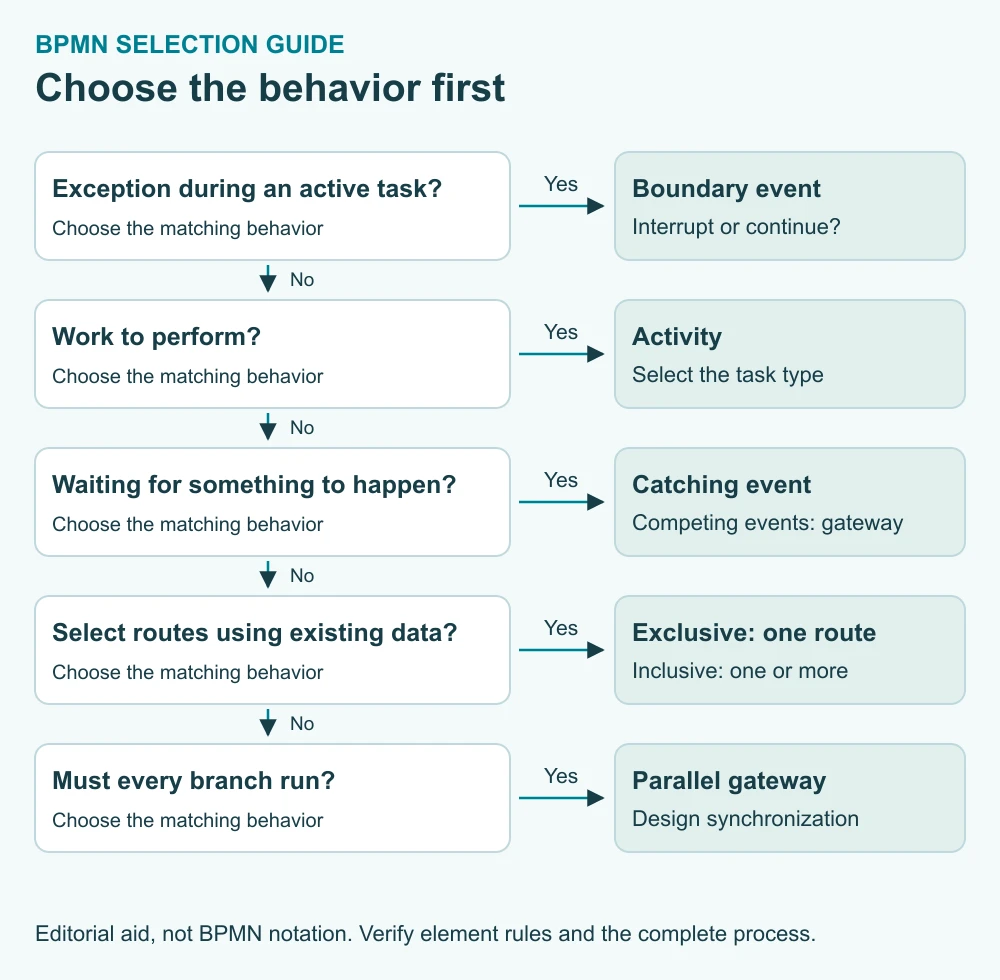
- Is this an exception while an activity is active? Consider a boundary event and decide explicitly whether it interrupts that activity.
- Is work being performed? Use an activity and identify the performer or implementation.
- Is the process waiting for something to happen? Use a catching event; use an event-based gateway when competing events determine the route.
- Are existing data selecting the route? Use an exclusive gateway for one route or an inclusive gateway for one or more.
- Must all branches run? Use a parallel split, then design any required synchronization.
Pools, lanes, messages, and sequence flows
A pool represents a participant. A lane partitions work within a process, often by role or department. An external supplier can be a separate pool, while a requester and procurement reviewer can be lanes inside the purchasing organization. A participant whose internal work is out of scope can be shown as a collapsed pool.
Sequence flows may cross lane boundaries within the same process. They must not cross pool boundaries. Message flows connect separate participants, not two tasks inside the same pool. Use an association for explanatory context and a data association for data movement; neither substitutes for the control flow that determines when work happens.
A lane label communicates organization, but it does not necessarily configure runtime permissions or task assignment. Likewise, a data object marked “Purchase request” identifies information without defining its fields, validation, access rights, or storage. Document and implement those details separately.
Boundary events, timers, and exceptions
A boundary event is attached to an activity and responds to a relevant occurrence while that activity is active. A solid event boundary denotes interrupting behavior; a dashed boundary denotes non-interrupting behavior where that event type permits it.
For an approval task, an interrupting boundary timer can cancel the current task and route work to an escalation owner. A non-interrupting timer can start a reminder path while the approval remains active. A boundary error event is interrupting; it is not a general-purpose marker for every technical failure.
Specify what “late” means: elapsed hours, business hours, a date, or a recurring schedule. Specify what happens to late responses after escalation. If an integration times out, decide whether to retry, investigate, or recover through another path. A label saying “Handle error” is incomplete without an owner and a defined recovery outcome.
Worked example: approval with an interrupting deadline
Illustrative model: a complete purchase request has already entered the process. The approver has 48 elapsed hours to review it. These are example assumptions, not a recommended policy or a measured customer result. A missing request field is handled before this model begins.
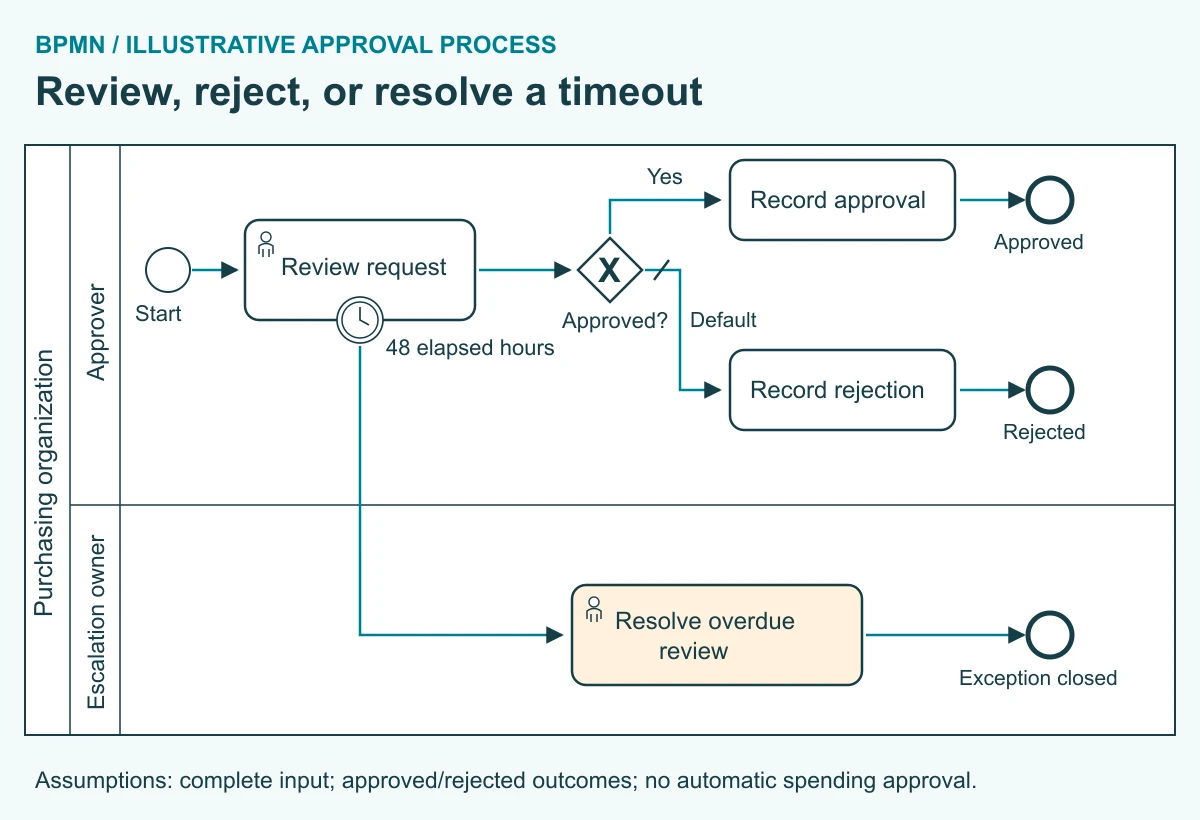
The approver completes “Review request.” An exclusive gateway then routes an approved request to “Record approval”; its default route leads to “Record rejection.” The form is assumed to allow only approved or rejected outcomes. A missing or unexpected result must be rejected by validation before the task completes.
If the timer fires first, it interrupts “Review request” and activates “Resolve overdue review” in the escalation-owner lane. That task closes the exception in this limited example; it does not silently approve the purchase. Normal completion and the timer path are alternatives, so no parallel join is required.
Compare this with a reminder-only requirement. Changing the boundary timer to non-interrupting would let the original review continue while a reminder path runs. That is a different process. Do not reuse the same implementation merely because the diagrams differ by a dashed border.
| Problematic model | Why it fails | Valid or clearer alternative |
|---|---|---|
| Sequence flow crosses from buyer pool to supplier pool | Violates the participant boundary | Use a message flow for the communication and local sequence flows inside each process |
| Message flow connects two lanes in one pool | Lanes are not separate participants | Use sequence flow for an internal handoff |
| Exclusive alternatives feed a parallel join that requires both | The unselected branch never arrives | Use an exclusive merge when the alternatives simply reconverge |
| Reminder requirement uses an interrupting timer | The task is canceled rather than left available | Use a permitted non-interrupting timer pattern and handle reminder completion |
| Ordinary completion uses a terminate end event without considering concurrent work | Other active work in scope can be terminated | Use a none end event if only the arriving flow should end |
The first two rows concern notation validity. The remaining rows concern mismatches between modeled behavior and the stated requirement; they are not blanket bans on those elements. This distinction keeps review focused on what the process must actually do.
From a BPMN diagram to an executable process
A diagram does not supply a working form, integration, authorization model, or operational log by itself. Execution requires supported elements, configured conditions, data mappings, task assignments, and implementation behavior. A successful import demonstrates that a tool accepted the file; it does not prove that every route works as intended.
Teams often distinguish descriptive, analytical, and executable levels of detail. Treat these as useful modeling purposes, not mandatory lifecycle stages through which every diagram must pass. A high-level communication model may be complete for its purpose without being ready to run.
For the approval example, test approval, rejection, timeout, an attempted response after timeout, an unavailable escalation assignee, and an invalid decision value. Confirm which task remains active, which result is recorded, and whether the process can finish. If completion and the timer occur almost together, verify the engine’s handling rather than guessing which action wins.
Keep decision rules maintainable as the process evolves. A frequently changing approval threshold may belong in a separately managed decision, while the workflow coordinates the resulting tasks. Our rules engine and workflow engine comparison explains that boundary.
BPMN modeling checklist
Use this checklist after a walkthrough with the people who perform the work. It combines notation checks with implementation questions; passing it is not a formal certification of BPMN conformance.
- Scope: one named process, a clear trigger, and explicit outcomes.
- Meaning: events describe occurrences, tasks describe work, and gateways describe routing or synchronization.
- Boundaries: sequence flows stay inside their process; message flows connect separate participants.
- Branches: conditions, defaults, merges, and joins match the possible paths.
- Exceptions: each timeout or failure has an owner, a recovery action, and a defined end or return path.
- Data: required inputs, permitted values, outputs, and access rules are specified.
- Execution: task assignment, integrations, supported constructs, and version behavior are verified in the target environment.
- Evidence: test cases, observed outcomes, and unresolved issues are recorded with the model version.
Measure the process, not the number of symbols
For the example, define review cycle time as completion time minus task-creation time for completed reviews. Track timeout rate = reviews interrupted by the deadline / reviews that ended by completion or timeout × 100, using a consistent reporting cohort. Report still-open reviews separately rather than treating them as successful.
Rework rate, waiting time, and exception-resolution time may reveal operational problems. A count of gateways or a shorter diagram does not demonstrate business improvement. Compare equivalent populations and record what changed in the process before attributing an improvement to automation.
Reading a public CMW Lab process diagram
The public CMW Lab invoice-processing diagram provides a useful exercise in reading markers. On its non-prepaid route, a parallel fork creates invoice-processing and paperwork-related paths, followed by a parallel join. The plus markers inside activity boxes indicate collapsed subprocess detail; the separate plus markers inside diamonds identify parallel gateways.
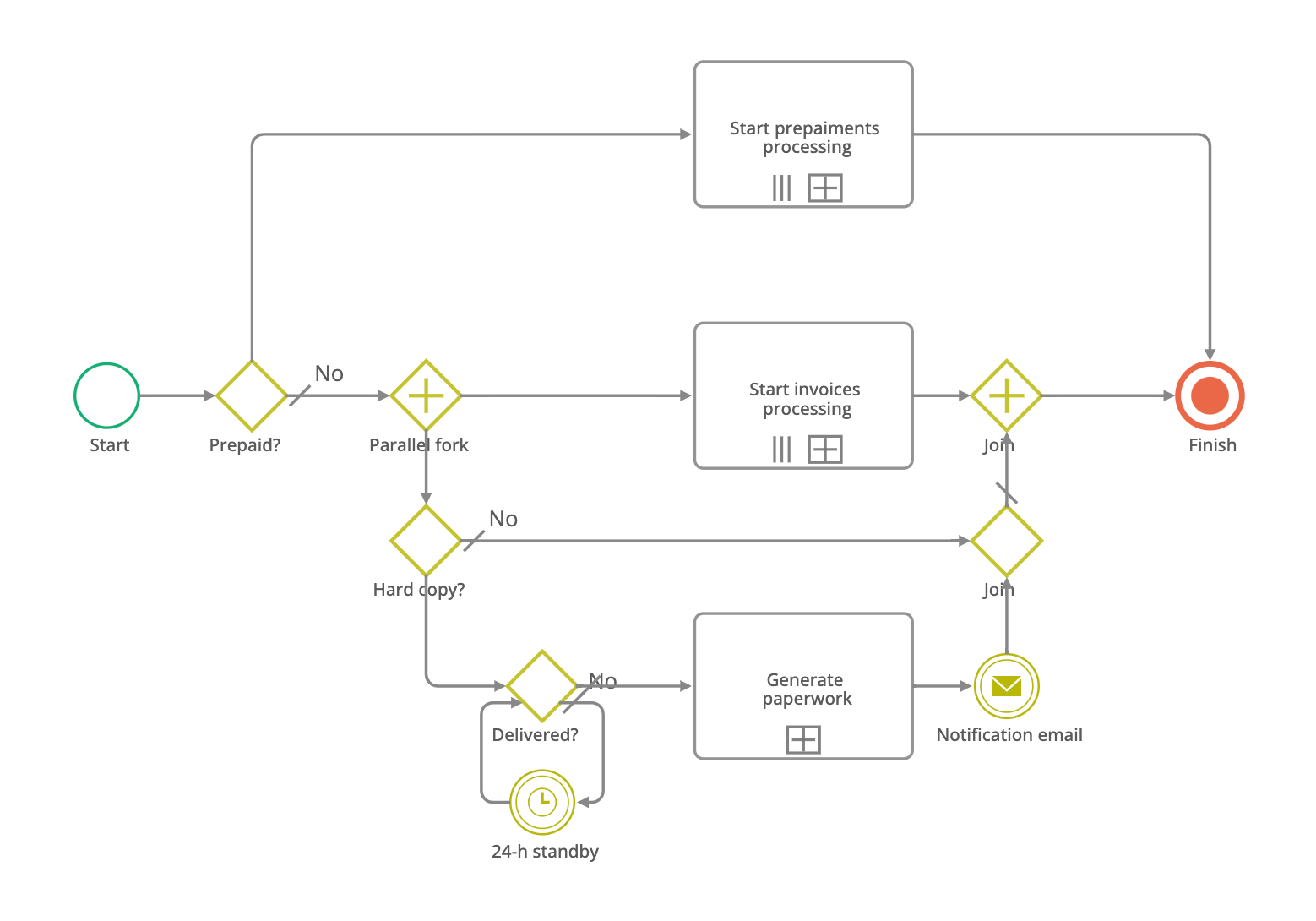
Its “24-h standby” timer appears in normal sequence flow around a delivery check. It therefore illustrates a wait before another check, not a boundary deadline attached to a review task. Those are different placements with different meanings. The image also uses a terminate marker at “Finish,” so a model review should check whether terminating all remaining work in that scope is intended.
This is a reading of a published first-party diagram, not a claim about customer performance or a validation of the complete deployed process. The image does not establish task permissions, retry limits, or measured service levels. Those implementation questions still need answers.
For a practical evaluation, bring one process, its exception cases, and the expected test outcomes to a discussion of CMW Lab’s BPMN modeling capabilities. Ask to see how the model, task assignments, data, and execution history connect. The process-diagram documentation in the Russian-language knowledge base provides the product-specific starting point for editing and publication.
How this guide was built: notation was checked against OMG BPMN 2.0.2, with a public CMW Lab diagram used for first-party analysis. The matrix, selection guide, approval example, and checklist are original explanatory material. No expert quotation or customer performance result is implied.
Frequently asked questions
What does BPMN stand for?
BPMN stands for Business Process Model and Notation. It is an OMG standard for describing business processes and interactions with defined graphical elements and semantics. It helps readers distinguish work, events, decisions, participants, and information. BPMN itself is neither a process-management methodology nor a complete software application.
How does BPMN work in practice?
A team defines a process boundary, models the work and possible outcomes, then validates the diagram against real scenarios. If the model will run in software, the team configures data, assignments, conditions, and integrations in the target environment. Testing must cover exceptions and recovery as well as the normal completion path.
How is BPMN different from a flowchart?
BPMN gives its elements more specific process semantics than an informal flowchart. For example, it distinguishes parallel work from an exclusive choice and a participant message from an internal sequence flow. A simple flowchart remains useful for a straightforward explanation; BPMN helps when those behavioral distinctions must be explicit and consistent.
Which KPIs should you use with BPMN?
Measure the modeled process rather than the notation. Useful measures can include cycle time, waiting time, rework rate, deadline misses, and exception-resolution time. Define the start and end timestamps, denominator, reporting cohort, and treatment of open cases. A lower symbol count does not establish that a process performs better.
What are common BPMN modeling mistakes?
Common mistakes include crossing pool boundaries with sequence flows, using message flows between lanes, confusing exclusive and parallel joins, and choosing the wrong interrupting behavior for a timer. Another is assuming a valid-looking diagram is executable without configuration. Review the intended behavior and test each important path in the implementation.
A purchase request can reach the right approver and still follow the wrong policy. It can also receive the right routing decision and then sit in an unassigned queue. These are different failures: one concerns decision logic; the other concerns execution. Understanding the distinction helps you decide what belongs in a business rules engine, what belongs in a workflow engine, and how the two should interact.
A business rules engine evaluates facts against explicit rules to produce a decision or result. A workflow engine coordinates tasks, people, systems, and the state of a running process. They often work together: the rules engine determines an approval route, while the workflow engine assigns the review, waits for its completion, and handles exceptions. Neither component alone guarantees that the underlying policy or process is correct.
By Pavel, CMW Lab blog author. Last reviewed: September 16, 2026.
Key takeaways
- Separate the decision to make from the work needed to carry it out.
- A business rules management system includes capabilities around rule execution, such as authoring and maintaining rules.
- Keep a small, stable branch in the workflow when a separate decision service would add more complexity than value.
- For decision tables, specify how multiple matching rows are handled; row order can change the result.
- Test boundaries, missing data, version changes, and failures before allowing a decision to advance a live process.
What is a business rules engine?
A business rules engine (BRE) is a software component that evaluates explicit conditions against supplied facts and produces results. For example, it can determine which approval route applies to a purchase request using its amount and supplier status. The result might be a route identifier, a calculated value, a validation message, or a classification.
The engine executes the logic. A business rules management system (BRMS) is the broader environment for creating, storing, maintaining, and executing that logic. IBM describes authoring tools, a rule repository, and an execution engine as BRMS components. A product may package these functions together, but the engine and the management system are not interchangeable terms. See IBM’s BRMS overview.
Rules, policies, process logic, and decision models
A policy states an organizational requirement: purchases above a defined threshold need additional review. A business rule makes a part of that requirement executable: a request for at least $5,000 must use the procurement review route. Process logic says what happens next: create the review task, wait for a response, and return incomplete requests to their owners.
A decision model organizes the inputs, rules, and dependencies needed to answer a business question. One decision may depend on another, such as classifying the supplier before selecting an approval route. A decision engine is a broader product term; depending on the system, it may combine explicit rules with scoring, optimization, or predictive models. Check the actual execution behavior instead of treating the label as a capability list.
Common rule types and representations
- Validation: Is the amount present and within an accepted range?
- Eligibility: Does this request qualify for a defined purchasing channel?
- Routing: Which review group should receive the request?
- Calculation: What total follows from approved quantities and unit prices?
- Policy checks: Does the request meet an explicitly encoded internal requirement?
- Pricing: Which agreed price schedule applies to this order?
Use a decision table when several inputs determine a result and reviewers benefit from seeing the combinations together. Use an expression for a concise calculation. A decision tree can explain a sequence of questions. A decision service exposes a defined decision through an interface so that more than one process or application can call it. The representation should make omissions and conflicts easier to find, not merely make the diagram smaller.
What is a workflow engine?
A workflow engine runs a defined flow of work and tracks each instance as it progresses. It creates tasks, routes work to people or services, waits for events, and handles outcomes according to the process design. In a purchasing process, it can coordinate request submission, review, corrections, order creation, and completion.
A workflow is the design of the work; its engine is the software executing that design. The engine needs to know which request is waiting, which task is active, and which event can move that request forward. For a broader explanation of process execution, see our business process engine guide.
Workflow engines also evaluate conditions. A gateway can route an approved request toward order creation and a rejected request toward closure. That does not mean every branch needs a separate rules engine. Extract a decision when its complexity, reuse, ownership, or rate of change makes separate management useful.
Business rules engine vs. workflow engine: key differences
The comparison below describes responsibilities, not mandatory product boundaries. One platform can provide both. Confirm which responsibilities a proposed implementation actually covers, including testing, versioning, access control, and failure handling.
| Dimension | Business rules engine | Workflow engine |
|---|---|---|
| Main question | Given these facts, what result applies? | What work should happen next, and who or what performs it? |
| Typical inputs | Facts, parameters, and the selected rule version | Process data, task outcomes, events, and decision results |
| Typical outputs | A route, value, classification, or validation result | A task assignment, service call, state transition, or completed process |
| Change to isolate | A threshold, condition, calculation, or decision policy | A handoff, approval stage, timeout, or exception path |
| State | Can use stateless or stateful execution, depending on the engine and design | Tracks the progress of each running workflow instance |
| Failure to plan for | Invalid inputs, conflicting rules, no match, or unavailable evaluation | Unassigned tasks, failed integrations, expired waits, or stuck instances |
| Useful acceptance evidence | Expected results for normal, boundary, invalid, and overlapping cases | End-to-end execution including rejection, rework, timeout, and recovery |
Do not use “stateless versus stateful” as an absolute dividing line. The official Drools rule-engine documentation describes both stateless and stateful KIE sessions. A rules engine can retain facts across interactions; that still does not make it a substitute for the full task and process lifecycle your application requires.
How rules and workflow engines work together
Start with a clear responsibility boundary. The workflow gathers and validates request data, calls the decision with a defined input set, records the result, and follows the corresponding route. The decision evaluates the supplied facts. The workflow remains responsible for assigning the resulting task and handling its completion.
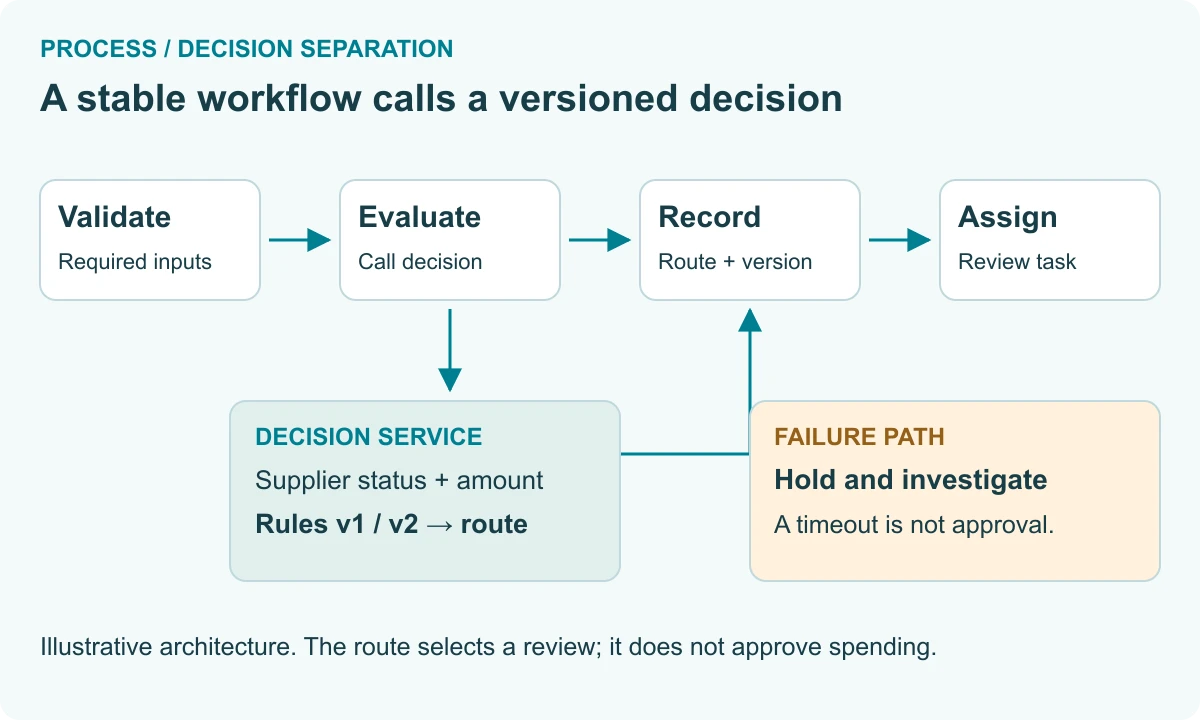
Define a decision contract
Specify input names, types, allowed values, units, and required fields. “Amount” is incomplete without a currency and an agreed treatment of taxes or conversion. Decide whether the call uses data captured at submission or current reference data. Different choices can produce different outcomes even when the rule itself has not changed.
Define the output just as carefully. In the example below, it contains a route code, matched rule ID, policy version, and explanation code. Record these with the request identifier and evaluation time. The specific storage and logging mechanism depends on the implementation; this is a design recommendation, not a claim that every engine supplies it automatically.
Make failure behavior explicit
An unavailable decision service is not an approval. Send evaluation failures to a controlled hold or review path, with an owner and recovery action. Distinguish a valid “manual review” result from a timeout or malformed response. Otherwise, operational errors can be misreported as policy decisions.
If a call is retried, prevent the retry from creating duplicate approval tasks. A useful design separates evaluation from side effects: evaluate, persist the accepted result, then create the task through a step that detects duplicate requests. If decision evaluation itself changes data, document that behavior and its recovery requirements before using it in a retryable integration.
Worked example: a purchase approval routing table
Illustrative example: the following policy, thresholds, test cases, and version history are invented for explanation. They are not a customer result, a recommended purchasing policy, or a product screenshot. The output selects a review route; it does not authorize spending or approve the request.
Assume a single-currency process using USD. Before evaluation, require a numeric, nonnegative amount and a supplier status of either approved or unverified. A missing amount, negative amount, different currency, or unknown status produces a validation hold. Do not silently turn missing values into zero.
First matching row is different from first true condition
With a First hit policy, the first matching row determines the result. Every input condition in that row must match. The OMG Decision Model and Notation (DMN) 1.5 specification, section 8.2.11.1, distinguishes First from Unique and other hit policies. It also warns that First tables require care because their meaning depends on row order. Where possible, disjoint rules make a table easier to inspect.
This deliberately overlapping example shows why order matters. Evaluate rows from top to bottom. “Any valid amount” means the input has already passed validation; it does not permit absent or invalid values.
| Order / rule | Supplier status | Amount | Returned route | Reason |
|---|---|---|---|---|
| 1 / R1 | Unverified | Any valid amount | SUPPLIER_REVIEW | Supplier verification required |
| 2 / R2 | Either allowed status | At least $5,000 | PROCUREMENT_REVIEW | Amount threshold reached |
| 3 / R3 | Approved | Below $5,000 | MANAGER_REVIEW | Standard review route |
An unverified supplier with a $6,000 request matches both R1 and R2. R1 wins because it appears first. Moving R2 above R1 would send that same request to procurement review instead. A visually small row move can therefore change policy behavior. A nonoverlapping alternative would restrict R2 to approved suppliers, removing this dependency for these inputs.
A scoring model needs a different specification. “Take the first matching result” does not mean “add every matching score” or “choose the largest score.” If several rules contribute points, define aggregation, missing-input handling, and the final threshold separately. Do not label an ordered routing table a scoring model simply because it contains numbers.
Test the boundaries and the change
Suppose illustrative policy v2 raises the amount threshold from $5,000 to $7,500 while preserving supplier review precedence. R2 and R3 change together. The following expected results form a small regression test set that can be reproduced independently of a particular product.
| Input | Expected v1 | Expected v2 | What it checks |
|---|---|---|---|
| Approved; $4,999.99 | Manager review | Manager review | Just below the original threshold |
| Approved; $5,000 | Procurement review | Manager review | Exact boundary and intended policy change |
| Approved; $7,500 | Procurement review | Procurement review | Exact new boundary |
| Unverified; $6,000 | Supplier review | Supplier review | Overlapping rules preserve supplier precedence |
| Unknown status; $100 | Validation hold | Validation hold | Unrecognized input cannot use a default route |
| Approved; amount missing | Validation hold | Validation hold | Required data is enforced |
| Approved; -$1 | Validation hold | Validation hold | Invalid numeric range is rejected |
| Approved; EUR 100 | Validation hold | Validation hold | Currency assumptions are enforced |
The stable workflow is: submit request, validate data, evaluate route, assign review, wait for the response, then proceed or return for correction. A threshold change can leave that sequence intact. If the organization instead introduces a second approval stage, the workflow must change too. Separating rules from processes does not eliminate genuine process changes.
Business rules management: lifecycle and governance
Use a lifecycle that makes each change traceable from a business requirement to a tested release. The sequence below is an editorial implementation checklist. It is not a prescribed standard or a claim about a particular platform feature.
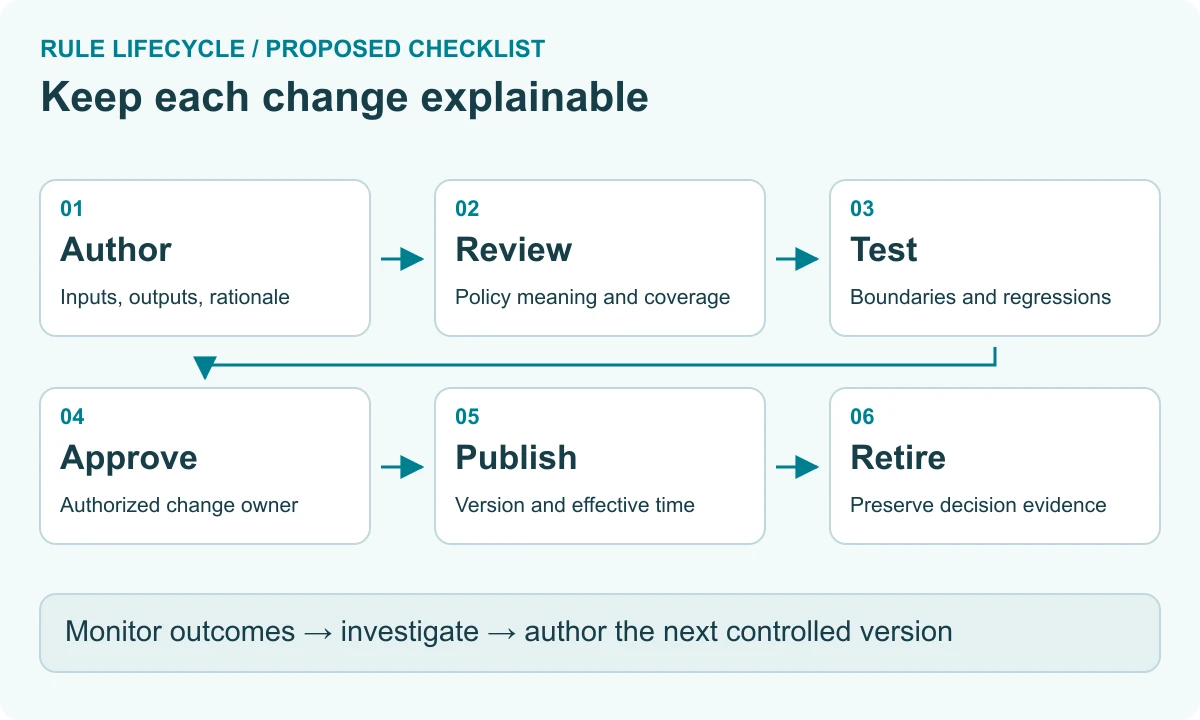
- Author: name the decision, owner, inputs, outputs, and policy rationale.
- Review: check whether the encoded conditions accurately express the requirement and cover relevant cases.
- Test: run expected outcomes, exact boundaries, overlaps, invalid inputs, and representative historical cases that may be used for this purpose.
- Approve: record who can authorize the change; separate authoring and approval where the risk warrants it.
- Publish: activate a specific version with an effective time and a recovery plan.
- Retire: prevent new use of superseded versions while retaining the evidence needed to explain past decisions.
Decide what happens to work already in progress
A request submitted under v1 may still be waiting when v2 becomes effective. Choose a policy explicitly: keep the version selected at submission, or reevaluate at a defined checkpoint. The correct choice depends on the business requirement. Never assume that deploying a new table should silently reroute every open request.
Also define which data changes require reevaluation. If an approved-supplier request increases from $4,000 to $8,000 after routing, preserving the original result may be inappropriate. Record the relevant input snapshot, the version used, and any later reevaluation. Versioning rules without preserving their inputs is insufficient to explain a past result.
Monitor decision quality and process performance separately
Track evaluation failure rate = failed evaluation attempts / all evaluation attempts × 100. Count retries consistently and keep infrastructure failures separate from valid manual-review outcomes. Track manual-review rate = requests routed to manual review / successfully evaluated requests × 100, with the included routes named. Neither metric alone proves that the policy is correct.
For the workflow, measure elapsed time to complete the review, time waiting for an assignee, and rework frequency. A fast rules engine cannot compensate for an approval task with no owner. Our guide to workflow process mapping explains how to make those handoffs and delays visible.
Do you need a rules engine, a workflow engine, or both?
Start with workflow capabilities when the main problem is coordinating people, tasks, systems, and deadlines, and the branching logic is small and stable. A straightforward approved/rejected branch may be clearer inside the process than behind another service call.
Prioritize rules management when decisions change frequently, the same logic appears in several applications, or policy owners need a controlled way to review and test combinations. A shared decision service can reduce duplicated logic, provided its availability and versioning are managed deliberately.
Use both responsibilities together when a long-running process depends on changing or reusable decisions. They may live within one platform or across integrated services. Compare the operational cost of the boundary: additional calls, deployment coordination, monitoring, and recovery can outweigh the benefit for a very small decision.
During evaluation, ask a vendor to demonstrate a changed threshold, an overlapping-rule test, a missing input, a service failure, and an in-flight request crossing a version change. Then trace the resulting task through rejection and correction. These demonstrations reveal more about fit than a diagram showing only the successful path. For related implementation criteria, see our workflow automation checklist.
A documented Comindware example: dependent field choices
Comindware Platform V6 documentation provides a smaller, concrete example of separating a data-selection rule from the surrounding work. In a business-trip request, selecting a country restricts the available cities. The documented model links countries to cities and uses the selected country to filter the city choices.
The baseline would be a city selector that does not narrow its choices using the selected country. The documented change adds that filter. The functional result is a selector limited by the country-city relationship, subject to the documented access rules. This is a reproducible documentation example, not a measured customer outcome; it makes no claim about time saved or error reduction. See the official record-selection filtering example in the Russian-language knowledge base.
The V6 expression-editor documentation also describes formulas, N3 expressions, and DMN tables. That supports a specific statement about available editing mechanisms. It does not establish conformance to every part of DMN 1.5 or guarantee every hit policy. Verify the required table behavior in the implementation you evaluate.
For a purchasing workflow, apply the same design discipline: define the data relationship or decision separately, then verify how the process uses the result. Explore CMW Lab’s business process automation capabilities and bring a real routing table, its expected results, and its exception cases to a process discussion. That gives the demonstration a concrete acceptance target.
How this guide was built: definitions and technical distinctions were checked against the primary sources linked above. The routing table, tests, lifecycle checklist, and diagrams are original illustrative material. Product statements are limited to the cited documentation; no customer performance figures or expert quotations are implied.
Frequently asked questions
What is the difference between a business rules engine and a workflow engine?
A business rules engine evaluates conditions to produce a result; a workflow engine coordinates the work that uses that result. For example, one can select an approval route while the other assigns the review task, waits for completion, and handles rejection. A single software platform may provide both capabilities.
Is a BRMS the same as a business rules engine?
No. A business rules engine executes rules, while a business rules management system includes the surrounding tools for maintaining them. Depending on the product, that environment may support authoring, repositories, testing, deployment, and governance. Evaluate those capabilities individually instead of assuming that an execution engine includes a complete management lifecycle.
Can a workflow engine run without a separate rules engine?
Yes. A workflow engine can handle straightforward conditions within its process design. A separate rules component becomes useful when decision logic is complex, reused, frequently changed, or owned and tested independently. The choice should reduce overall maintenance effort while preserving clear error handling, version behavior, and accountability for the resulting work.
What does first match mean in a decision table?
First match means the first row whose input conditions all match supplies the result. It does not mean the first individual condition that happens to be true. Because several rows can match, their order can change the outcome. Test overlapping cases and consider disjoint rules when they make the policy easier to understand.
How should you test a business rule before publishing it?
Test ordinary cases, exact boundaries, missing or invalid inputs, overlapping conditions, and expected differences from the previous version. Then test how the workflow uses the result, including failures and work already in progress. Keep the expected outputs with the rule version so later changes can be checked against an explicit baseline.
By Pavel · CMW Lab blog author · Last reviewed: September 16, 2026
Workflow process mapping makes the path from a request to a result visible, including the people, decisions, systems, and exceptions involved. It matters because teams can test whether they understand the same process before changing or automating it. A useful map documents how work happens today, identifies evidence of delays or rework, and provides a shared basis for designing and validating a better workflow.
A purchase request can look simple in a procedure: submit, approve, order. Ask the requester, approver, and buyer to describe the last incomplete request, however, and three different processes may emerge. One person sees an unanswered email; another sees a request waiting for a cost center; the third has never received it. Business process mapping makes those differences discussable.
The value comes from what the team learns and changes, not from the number of boxes it draws. This guide explains how to scope a map, document the current workflow, validate exceptions, and turn the result into an improvement plan.
Key takeaways
- Map the current process before designing its replacement; keep the two versions visibly separate.
- Show ownership, decision criteria, and handoffs alongside the main sequence of activities.
- Choose the detail needed for the decision: a scope discussion and an executable workflow need different maps.
- Validate the map with actual cases, including incomplete, rejected, delayed, and canceled work.
- Measure changes with consistent boundaries and definitions; a cleaner diagram does not prove a faster process.
What is business process mapping?
Business process mapping is the practice of documenting how work moves from a defined trigger to a defined outcome. A process map is the resulting representation. It can show activities, participants, inputs and outputs, decisions, and the movement of information or materials. Workflow mapping focuses attention on how individual pieces of work move through that process.
An as-is map describes current practice, including workarounds. A to-be map describes an intended future process. Neither label establishes that the process is correct: the current map needs evidence, while the future map needs testing. If a team silently replaces an awkward current step with an ideal one, it loses the baseline needed to explain the proposed change.
A useful map answers four practical questions: What starts the work? Who is responsible next? What determines the route? What proves that the work is finished? Supporting notes should identify the data and systems involved. A box labeled “Handle request” answers none of these questions; “Buyer checks supplier and cost center” is a more actionable activity.
Key benefits of workflow process mapping
Workflow process mapping as a learning tool
Mapping exposes the difference between a written procedure and the way people complete work. Ask participants to walk through a recent case while showing the records they used. The exercise can reveal an approval performed in a chat, an unofficial spreadsheet, or an exception that only one experienced employee knows how to resolve.
That knowledge helps with onboarding and continuity, but the map needs an owner and a review date. A new employee should be able to identify the next responsible role and the correct escalation route. If doing so still requires finding the person who originally drew the diagram, the handoff information is incomplete.
Workflow mapping can lead to optimizing efficiency
A map makes delays and rework easier to investigate. Separate time spent doing a task from time spent waiting for it. An approval may take five minutes of effort while a request waits two days in a queue. Removing a data-entry step will not necessarily resolve that queue.
Treat apparent bottlenecks as hypotheses until case data supports them. Annotate the step with the observed delay, the evidence period, and the affected request type. This connects the proposed improvement to a specific problem instead of assuming that fewer boxes always mean better performance.
Improved communication between employees engaged in a process
Handoffs often need more explanation than activities. Specify what the sender provides, what the receiver accepts, and what happens when the information is incomplete. For example, procurement can require a cost center and a delivery location before accepting a request, while the requester remains responsible for correcting missing information.
A swimlane process map places activities in lanes for their responsible roles or teams. Crossing a lane boundary makes a handoff visible. It does not, by itself, define access permissions, authority to approve, or accountability for the whole process; document those separately.
Process map, flowchart, BPMN, or value stream map?
These terms describe related tools with different purposes. A flowchart can be a process map; Business Process Model and Notation (BPMN) adds standardized modeling semantics. A value stream map emphasizes the flow of materials and information, including the relationship between work and waiting. Choose a technique according to the question you need to answer.
| Technique | Best question to start with | What to add before implementation |
|---|---|---|
| SIPOC | Where does the process begin and end, and who supplies and receives its outputs? | Detailed sequence, owners, decisions, and exceptions. |
| Basic flowchart | What happens next, and where does the route change? | Responsibility, data requirements, timing, and consistent symbol definitions. |
| Swimlane map | Who performs each activity, and where does work cross team boundaries? | Handoff criteria, escalation, and decision authority. |
| BPMN model | How should events, branching, and coordination behave? | For execution: supported model elements, data, forms, assignments, integrations, and tests. |
| Value stream map | How do material and information flows affect delivery and elapsed time? | Reliable timing observations and a plan for the desired future flow. |
SIPOC stands for suppliers, inputs, process, outputs, and customers. ASQ’s SIPOC guidance uses it to establish a high-level view and process boundaries before deeper mapping. The Lean Enterprise Institute’s description of value stream mapping explains its focus on material and information flow. The comparison above is a practical selection guide, not a ranking or a claim that one notation replaces the others.
For BPMN, use the formal name Business Process Model and Notation. The OMG BPMN 2.0.2 specification defines the notation. For a visual introduction to its symbols, see our BPMN elements and symbols guide. A standards-based diagram still needs implementation details before a workflow engine can execute it correctly.
Start with a process scope canvas
Use this canvas before opening a diagram editor. The completed example is illustrative: it describes a proposed mapping exercise for purchase requests, not a CMW Lab customer implementation. Replace each answer with evidence from your own process.
| Field | Example answer | Question to resolve |
|---|---|---|
| Purpose | Understand why approved requests reach purchasing with missing information. | Which operational decision will this map support? |
| Start | An employee submits a purchase request. | Does the clock start at first submission or only when it is complete? |
| Finish | A purchase order is issued, or the request is rejected or canceled with a recorded reason. | Which terminal outcomes count as completion? |
| Roles | Requester, budget approver, buyer; procurement manager owns the process. | Who resolves an unassigned or disputed request? |
| Inputs and outputs | Item, quantity, cost center, location, need-by date; purchase order or closure record. | Which fields and documents are required at each handoff? |
| Systems and evidence | Request records, approval messages, purchasing system timestamps. | Can the records be joined using a stable request identifier? |
| Boundaries | Order issuance is included; receipt, invoice matching, and payment are outside this map. | Where does the next process take ownership? |
| Measures | Elapsed time, returns for missing data, approval-queue age. | Are definitions consistent across the baseline and pilot? |
The start and finish definitions deserve particular attention. If the baseline includes incomplete submissions but the future-state report starts only after validation, an apparent improvement may simply reflect a later start to the clock.
How to map and validate the current process
- Collect actual cases. Include ordinary completions and relevant variations such as returns, rejection, cancellation, and overdue work. Explain the selection period and avoid presenting a convenient sample as representative of every case.
- Trace the sequence. Record what each role did, which information was available, and which system or communication channel carried the handoff. Mark uncertain steps for follow-up.
- Label decisions with criteria. Replace “OK?” with a question such as “Required request data complete?” Name the yes and no routes and show where each route ends or rejoins.
- Separate current behavior from proposed fixes. Capture an undocumented workaround in the as-is map even if everyone agrees it should disappear. Put the change in a separate backlog.
- Walk the map with the people doing the work. Use a specific case to check the route, then test an exception. Ask the receiving team whether the handoff shown actually gives it enough information to proceed.
- Record ownership and unresolved gaps. Version the map, identify its accountable owner, and document open questions. Revisit it when the policy, system, or operating practice changes.
Validation is more than obtaining agreement in a workshop. Someone may remember a rule correctly while a system applies it differently. Compare the map with available records and investigate the difference. Where evidence is missing, label the uncertainty instead of converting a recollection into an established fact.
Keep detailed instructions close to the activity they explain without putting every field and click in the main diagram. A readable map can link to a task specification, a business-rule table, and an exception register. Our workflow diagram guide covers the visual organization of the sequence.
Worked example: an as-is and to-be purchase-request map
Illustrative baseline: an employee emails a request to a manager. The manager approves the spending and forwards it to a buyer. The buyer discovers missing delivery details, returns it to the employee, and waits for the corrected version. Several email threads now describe the same request, and the buyer must identify the approved version before issuing the order.
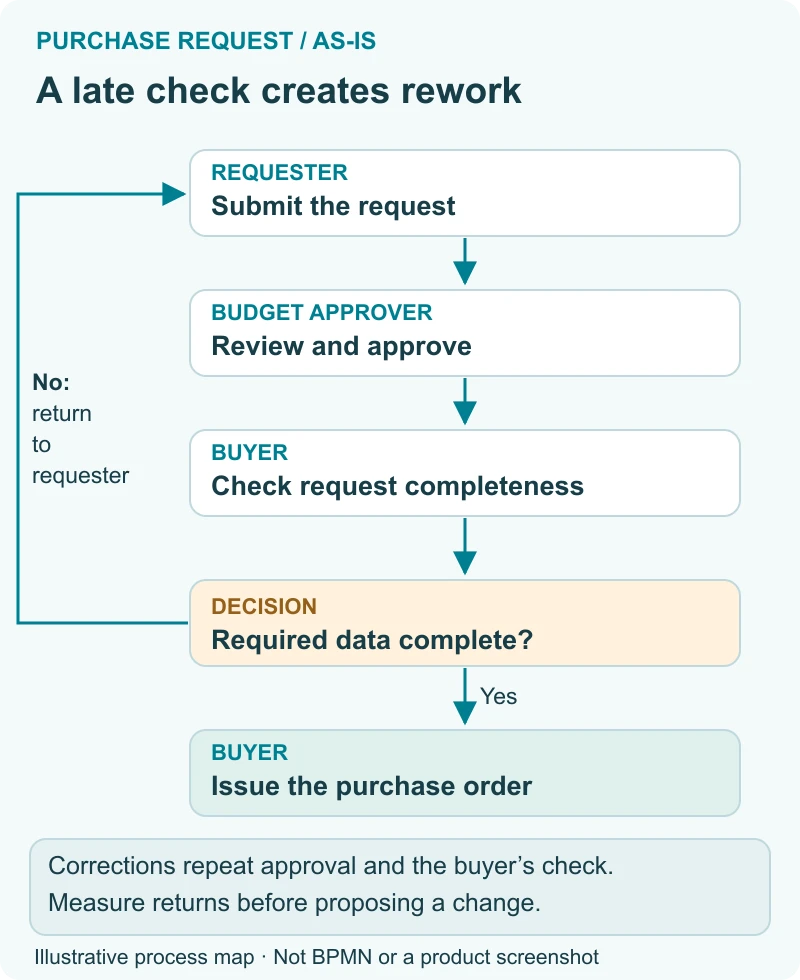
In this as-is sequence, the requester submits, the manager approves, and the buyer checks completeness. Complete requests proceed to order issuance. Incomplete requests return to the requester, then go through approval and the buyer’s check again. The map makes the repeated review visible; case records are still needed to determine its frequency and impact.
Proposed change: collect the required information in a single request record and check completeness before budget approval. Return incomplete requests to the requester with a reason. After approval, the buyer checks the approved details and issues the order. A material change to quantity, cost, or scope returns for approval under a defined rule.
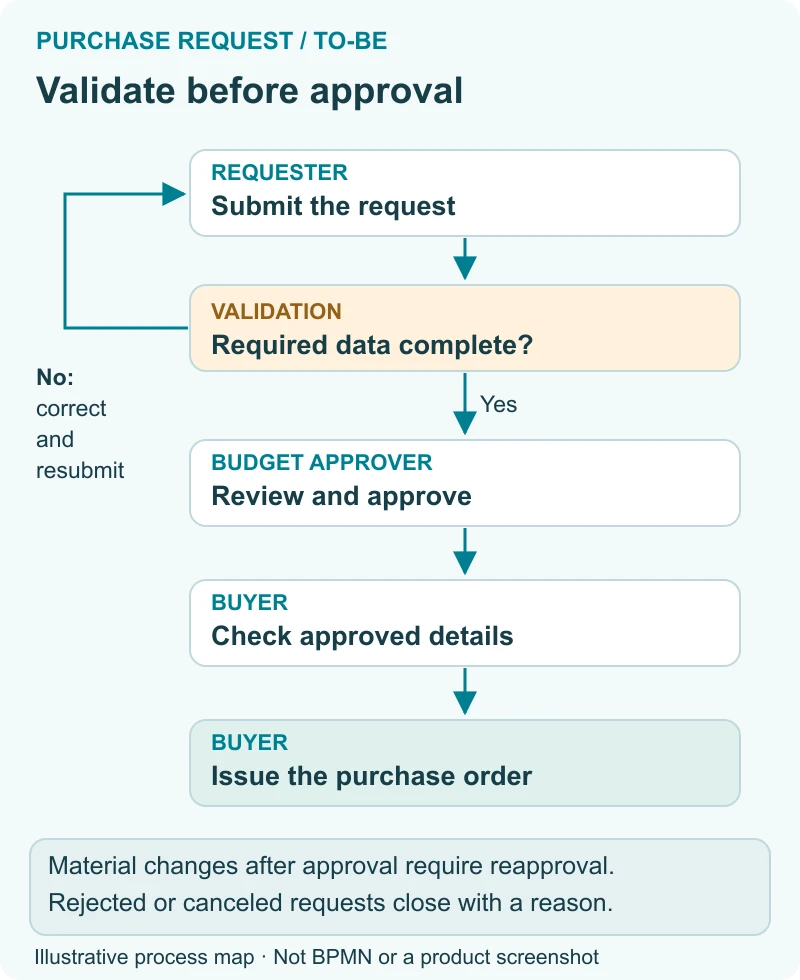
The future sequence is submit, validate completeness, approve, check approved details, and issue the order. Missing information loops back before approval. Rejected or canceled requests close with a reason. Material changes after approval take a separate reapproval route. These rules are part of the design even when the compact diagram summarizes them in a note.
The pilot must test more than the happy path. Try a missing cost center, an unavailable approver, a request changed after approval, and a cancellation after the buyer starts work. Define who owns each case and which actions remain allowed. Then compare the pilot with the baseline using the same request types and timing boundaries.
What a published CMW Lab process diagram reveals
A real public example on CMW Lab’s BPMN page includes a prepayment decision, an invoice-processing branch, a hard-copy decision, and a delivery check with a 24-hour wait. You can inspect the published process diagram to see those elements. It illustrates a model; it does not provide customer performance results or a complete operating policy.
The example is useful because its branches raise concrete mapping questions. What determines whether prepayment applies? Which work proceeds in parallel? Who follows up when delivery remains unconfirmed? The wait is visible, but the diagram alone does not establish a service-level agreement (SLA), an escalation owner, or a maximum number of retries.
Gateway choice also matters. In BPMN, a parallel split starts all outgoing paths; a parallel join synchronizes its incoming paths. This behavior is defined in OMG BPMN 2.0.2, section 10.6.4. Before implementation, test that every required incoming path can reach the join. A diagram can look balanced while a particular branch combination leaves work waiting.
Our practical recommendation is to review the map alongside a responsibility list and an exception table. For the delivery wait, specify the role that investigates, the evidence that confirms delivery, and the action when confirmation never arrives. Those are questions to resolve for your implementation, not features or policy details inferred from the public image.
Turn the map into an improvement backlog
Give each finding a location in the map, supporting evidence, an owner, a proposed change, and an acceptance test. “Improve procurement” is too broad. “Requests returned by the buyer for missing delivery location” identifies a condition the team can investigate and address.
For the worked example, the backlog might contain three distinct changes: introduce required request fields, define which post-approval changes require reapproval, and make aged approvals visible to their responsible owner. Each can be tested independently. A policy clarification may solve a problem before software changes are necessary.
When automation is appropriate, extend the map into a specification: record states, data fields, role assignments, decision rules, reminders, integration behavior, and audit evidence. Specify what happens when an integration fails or the same request arrives twice. Use the workflow automation implementation checklist to evaluate that next stage.
Measure the process and check the quality of the map
A map explains the flow; measurements test whether changing it helped. Define the unit of work, timestamp source, reporting period, and exclusions before comparing results. Track open work as well as completed cases so a growing queue does not disappear from the report.
- Elapsed time: finish timestamp minus first-submission timestamp. Report a median and a tail measure such as the 90th percentile when the sample supports it; explain business-hours versus calendar-time treatment.
- Return rate: requests returned at least once for missing or incorrect information ÷ requests assessed in the same cohort × 100%. Count a request once even if it is returned several times; report repeat returns separately.
- Touch time: the sum of active handling time for a request. Do not treat the entire interval between two system events as active work unless that interpretation has been validated.
- Queue age: measurement time minus the time an open request entered its current queue. Segment by priority or request type when different service commitments apply.
Illustrative calculation: if 30 of 120 assessed requests were returned at least once, the return rate is 30 ÷ 120 × 100% = 25%. If a comparable pilot cohort has 12 returns among 120 assessed requests, its rate is 10%: a reduction of 15 percentage points. These are hypothetical numbers showing the calculation, not CMW Lab customer results or a forecast.
Use the following checklist as a practical review aid. It is an original editorial checklist, not a certification standard or a guarantee that a model is executable.
| Check | Evidence to look for | Action if missing |
|---|---|---|
| Clear scope | Named trigger, outcomes, exclusions, and process owner. | Complete the scope canvas before adding detail. |
| Traceable activities | Verb-and-object labels linked to a responsible role and case evidence. | Walk through a recent case with the people doing the work. |
| Defined decisions | Conditions and destinations for each relevant outcome. | Resolve ambiguous rules with the policy owner. |
| Complete handoffs | Required inputs, receiving role, and acceptance criteria. | Agree on what makes a task ready to accept. |
| Exception coverage | Returns, rejection, cancellation, overdue work, and failure recovery where applicable. | Add a route or a linked exception specification. |
| Measurable change | Baseline and pilot use matching definitions and explain differences in case mix. | Fix the measurement design before claiming improvement. |
| Maintained version | Owner, review date, change record, and access to supporting specifications. | Assign maintenance responsibility and review triggers. |
Common process mapping mistakes and how to avoid them
Drawing the official procedure instead of observed work. Keep discrepancies visible. A workaround may reveal missing system support or an impractical policy; erasing it from the map hides the issue.
Using one diagram for every audience. A sponsor needs boundaries and outcomes, while an implementer needs precise decisions and recovery behavior. Connect overview and detailed maps instead of compressing everything into unreadable boxes.
Showing only successful completion. Rejected, withdrawn, duplicate, and stalled requests consume capacity too. Define their endpoints and ownership rather than leaving an arrow labeled “Exception” with nowhere to go.
Automating an unexplained step. Ask what purpose an approval or data field serves before reproducing it in software. Removing a control also needs an explicit decision from its accountable owner.
Treating an AI-generated map as evidence. An AI tool can help organize workshop notes or draft a diagram, but a plausible sequence does not establish how your organization works. Check each activity and rule against records and participants, protect confidential inputs, and retain a traceable version. This is a recommended validation practice, not a claim about any specific product’s AI capabilities.
Frequently asked questions
What is business process mapping?
Business process mapping documents how work moves from a defined trigger to an outcome. A useful map shows activities, responsibility, decisions, and handoffs, with supporting information about inputs, outputs, and systems. It helps teams understand current practice and evaluate improvements, but its accuracy depends on validation against actual work.
How does process mapping work in practice?
Start by agreeing on the process boundaries, owner, and purpose, then trace real cases through the people and systems involved. Draw the current sequence, record exceptions, and validate the result with participants and records. Keep proposed improvements in a separate future-state version and test them before treating them as the new operating process.
What is the difference between process mapping and BPMN?
Process mapping is the practice of representing a process; BPMN is a standardized notation that can be used for that representation. A basic flowchart may be enough to explain a short sequence. BPMN is useful when precise event, decision, and coordination behavior matters, although execution still requires platform configuration and testing.
Which KPIs should a process map support?
Select key performance indicators that address the problem being investigated, such as elapsed time, return rate, touch time, or the age of open work. Define the start and finish events, denominator, reporting period, and exclusions. Use the same definitions when comparing the current process with a pilot, and explain differences in request mix.
What are the most common process mapping implementation mistakes?
Common mistakes include mapping the ideal procedure instead of current work, leaving handoffs undefined, ignoring exceptions, and treating a diagram as a complete automation specification. Avoid them by validating actual cases, assigning responsible roles, recording decision criteria, and testing failure and recovery paths alongside normal completion before implementing the revised workflow.
How we built this guide: definitions and notation were checked against ASQ, the Lean Enterprise Institute, and OMG. The CMW Lab diagram is public first-party material. The scope canvas, checklist, purchase-request maps, and calculations are original editorial examples, not reported customer outcomes.
Use the map to make the next decision
A useful workflow map gives a team a shared, testable account of its work. Start with a bounded process, show the difficult cases, and connect each proposed change to evidence and an acceptance test. If your next step is to move from a validated model to an implemented workflow, explore CMW Lab’s BPMN modeling capabilities with your scope canvas and exception list in hand.
A department name is not a process map. “Sales” does not show who confirms an order, and “HR” does not tell you whether a new employee can work on the first day. Useful business process examples connect a specific trigger to a result that someone can verify.
A business process is a connected set of activities that turns an input or request into a defined business outcome. Examples include fulfilling a customer order, purchasing goods, onboarding an employee, resolving a service request, correcting a quality issue, and publishing approved content. To automate one, define its trigger, owner, decisions, data, exceptions, and completion evidence before selecting the tools that will move the work forward.
By Pavel, CMW Lab blog author. Last reviewed: September 15, 2026.
Key takeaways
- A useful process example names the trigger and the result, not just the department or software involved.
- Automation opportunities occur at specific steps: collecting data, routing work, applying rules, and confirming system actions.
- Every example needs an exception owner and a clear way to resume, reject, or cancel work.
- Measure the business outcome and its quality; a fast notification is not proof that the whole process improved.
- Use the six maps below as starting designs, then validate them against your organization’s actual work.
Business process examples at a glance
Business processes cross organizational boundaries. A purchase may involve the requester, procurement, receiving, accounts payable, and a supplier. A single team can own the overall outcome while several teams perform the work.
The table below preserves the industry view of process examples and makes the outcomes more explicit. These are illustrative examples, not a mandatory taxonomy. For a broader process inventory and common terminology, consult APQC’s Process Classification Framework.
| Business area | Process examples | A result to verify |
|---|---|---|
| Manufacturing | Order fulfillment, engineering change, quality issue resolution, maintenance. | The accepted product, approved change, or completed service is recorded. |
| Finance | Invoice handling, expense approval, capital expenditure approval. | A valid transaction or decision is recorded in the appropriate system. |
| Healthcare administration | Appointment scheduling, referral administration, equipment service requests. | The administrative request has a confirmed disposition and an accountable owner. |
| Banking operations | Customer onboarding, service inquiries, document collection. | The request reaches its authorized endpoint with the required evidence. |
| Travel | Trip approval, booking, itinerary changes, expense handling. | The traveler has a confirmed arrangement or a documented alternative. |
| Procurement | Purchase requisition, supplier selection, receipt and invoice matching. | The approved need is fulfilled and the supplier transaction is resolved. |
| Sales and marketing | Customer inquiry, quote approval, order handoff, content publication. | The customer commitment or approved communication is delivered. |
| HR and employee services | Hiring, onboarding, equipment requests, internal help desk. | The person receives the agreed decision, access, equipment, or support. |
How to read the six maps: each is an original, simplified design for a common process. It shows the normal sequence and calls out an exception and a measurement. The surrounding text supplies roles, data, and decisions. These are teaching examples, not customer-specific configurations or complete regulatory procedures.
1. Customer-facing process: inquiry to fulfilled order
Trigger: a customer submits an inquiry that can become an order. Outcome: the agreed goods or services are delivered and completion is recorded, or the inquiry is closed with a clear reason.
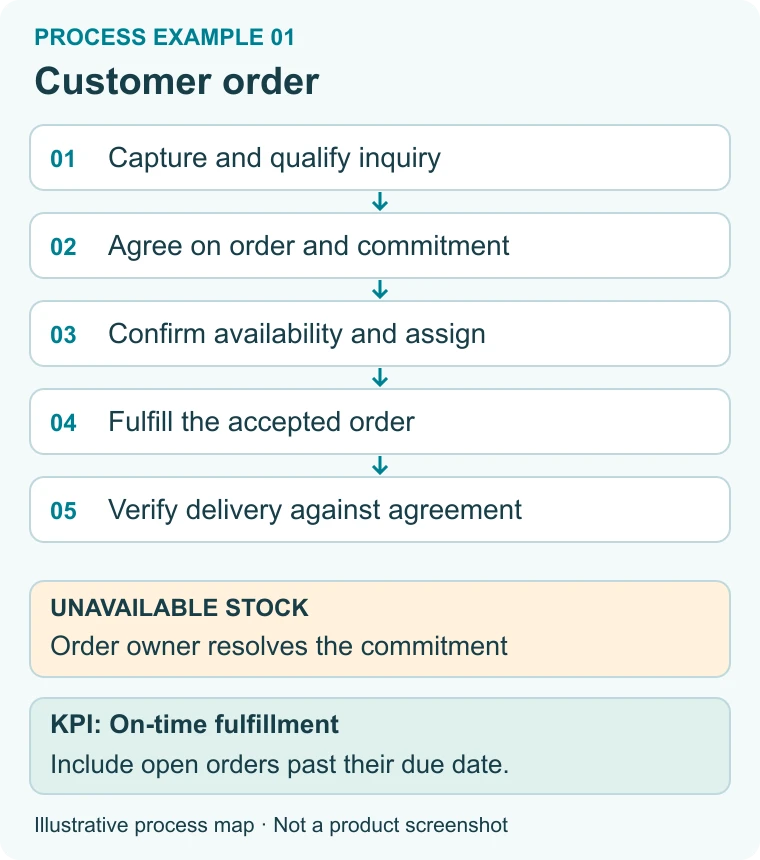
Roles and data: sales owns the inquiry and commercial agreement; operations owns fulfillment; the process owner resolves handoff problems. Connect the customer, inquiry, quote version, order, promised date, and fulfillment record using stable identifiers. Customer relationship management (CRM) software may hold the inquiry, while an enterprise resource planning (ERP) system manages the order and inventory.
Automation opportunities: assign inquiries by a defined territory or product rule, validate required fields, request approval for an exception to standard terms, and create fulfillment tasks after the customer accepts the agreement. Reuse the approved data instead of asking operations to retype an emailed quote.
Exception to design: stock becomes unavailable after the quote was prepared. Route the issue to an owner who can agree on a substitute, revised date, or cancellation with the customer. A system-generated order acknowledgment must not silently establish a delivery promise the business cannot meet.
KPI: on-time fulfillment rate = orders fulfilled by their agreed due time ÷ all orders whose agreed due time has passed in the defined cohort × 100. Keep open overdue orders in the denominator. If a customer agrees to a new date, retain the original promise and report changes separately so the measure cannot improve merely by moving deadlines.
2. Procurement process: purchase need to supplier payment
Trigger: an employee submits a purchase need. Outcome: the authorized purchase is received and the supplier payment is confirmed, or the request is rejected, canceled, or otherwise resolved through a defined path.
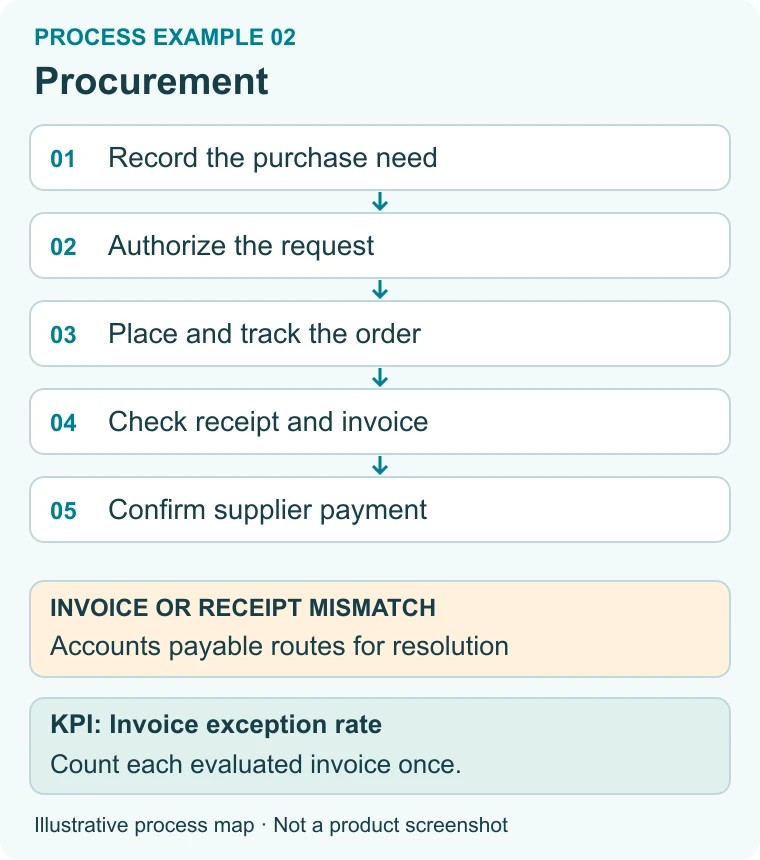
Roles and data: the requester explains the need; a budget owner authorizes it; procurement manages the supplier and order; receiving confirms delivery; accounts payable handles the invoice and payment status. Link the requisition, purchase order, receipt, invoice, and payment reference without treating them as the same record.
Automation opportunities: check completeness at intake, route requests using approved spending rules, notify receiving when an order is placed, and compare invoice data with the relevant order and receipt. The procurement management solution is the appropriate place to explore software support for this sequence.
Exception to design: the supplier sends an invoice for the full order after only part of the goods arrives. Record the discrepancy and assign its resolution. Do not use “invoice received” as evidence that the whole purchase is ready for payment. Partial receipts, credit notes, and canceled lines need explicit handling under the organization’s purchasing rules.
KPI: invoice exception rate = invoices routed for discrepancy resolution ÷ invoices first evaluated in the same period × 100. Count each invoice once in the denominator, even if it goes through several correction loops. Track unresolved exceptions by age so a lower rate cannot hide an old backlog.
3. Employee lifecycle process: hiring and onboarding
Trigger: an approved staffing need starts recruiting. Outcome: a selected candidate accepts the role and completes the organization’s onboarding requirements, or the hiring request reaches a documented closed state.
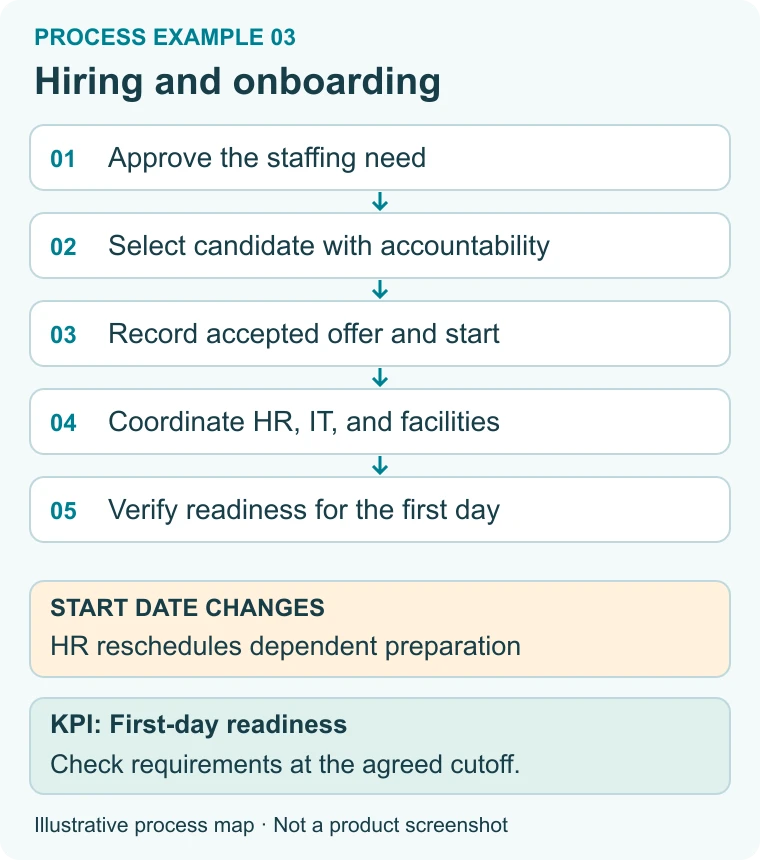
Roles and data: the hiring manager defines the role; HR coordinates recruiting and the offer; authorized decision-makers select the candidate; IT and facilities prepare the agreed resources. The onboarding record connects the accepted role, manager, location, start date, equipment, and approved access requirements.
Automation opportunities: coordinate interview scheduling, collect required information, generate assigned checklists after offer acceptance, and remind owners about incomplete preparation. Candidate selection remains a defined accountable decision. Keyword matching in a resume should not be presented as proof that a candidate is the best fit.
Exception to design: the start date changes after accounts or equipment have been requested. Update the dependent tasks and notify their owners. If the hire is canceled, confirm the disposition of prepared access and equipment. A completed HR form alone does not demonstrate that a person is ready to work.
KPI: first-day readiness rate = new starters with all defined day-one prerequisites confirmed by the cutoff ÷ all starters expected at that cutoff × 100. Define prerequisites before measuring. Separate delayed start dates from missing preparations instead of quietly removing difficult cases. For more detail, see the existing new-hire management guide.
4. Service operations process: request to resolution
Trigger: an employee or customer requests help. Outcome: the service is restored or the requested assistance is delivered and verified, with a recorded reason for any alternative closure.
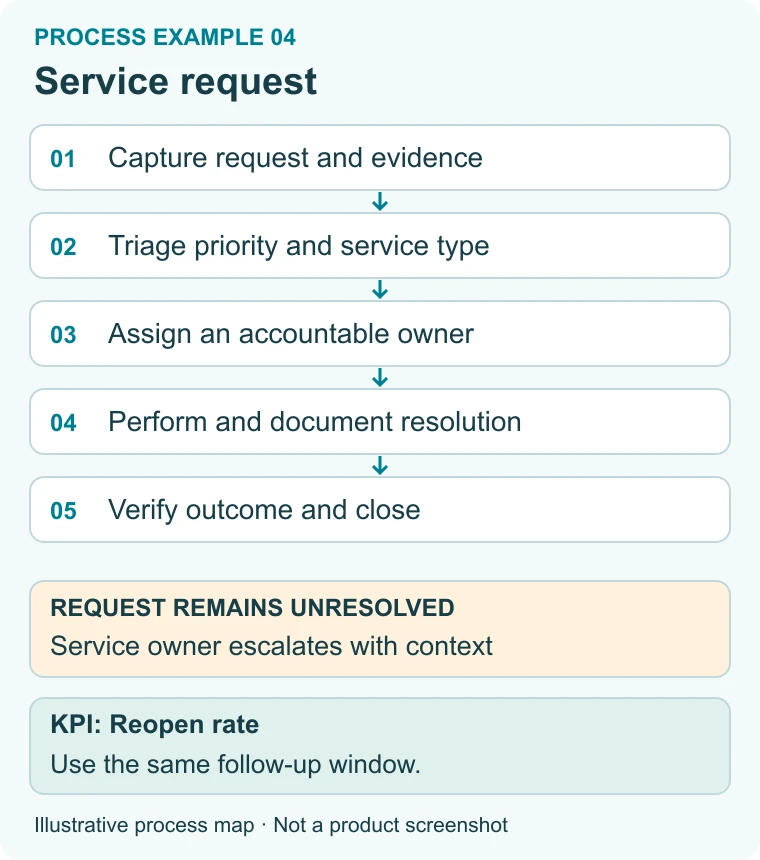
Roles and data: the service desk captures the affected service, symptoms, impact, requester, and relevant evidence. A resolver owns diagnosis or fulfillment; a service owner handles unresolved dependencies. Preserve a link between the original request, related incidents, and any follow-up work.
Automation opportunities: categorize straightforward requests, check required information, route work to the appropriate team, show the requester its status, and prompt for confirmation after a proposed resolution. Route uncertain classifications to a person instead of repeatedly moving the request between queues.
Exception to design: the resolver marks an issue fixed, but the requester reports that it persists. Define whether the record reopens or a linked follow-up is created, who owns it, and which clock continues. Otherwise, closing and recreating tickets can make performance look better while the person still lacks service.
KPI: reopen rate = requests reopened within a defined follow-up window ÷ closed requests with that full observation window available × 100. State the window, such as seven calendar days for an illustrative internal report. Do not compare yesterday’s closures with older closures that had more time to reopen.
5. Product and quality process: issue to verified corrective action
Trigger: a defect, recurring failure, or internal finding requires investigation. Outcome: an authorized owner verifies that the agreed action addressed the identified cause, or documents the reason for further work.
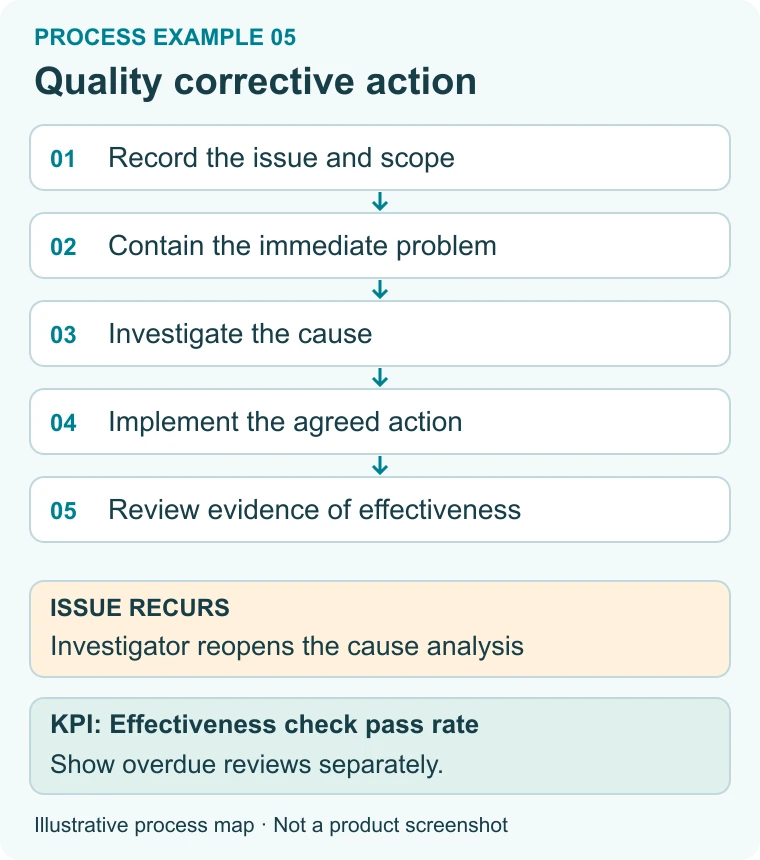
Roles and data: the reporter supplies the observation; an operational owner contains the immediate issue; a qualified investigator examines causes; the action owner implements the agreed change; a designated reviewer evaluates its effect. Connect the issue, affected items, investigation, actions, evidence, and review date.
Automation opportunities: create action assignments, track due dates, request supporting evidence, and schedule the effectiveness review. A workflow can make missing evidence visible. It cannot establish that the investigation reached the right conclusion merely because every task has a completed status.
Exception to design: the issue recurs during the agreed observation period. Return it to investigation with the earlier evidence intact. Record why the previous action was insufficient and whether immediate containment is needed again. This is a general operational example; industry-specific quality procedures require their own qualified review.
KPI: effectiveness pass rate = actions passing their first scheduled effectiveness review ÷ actions whose first effectiveness review was completed in the defined cohort × 100. Show overdue reviews alongside that rate. A high pass rate from a small, selectively completed subset does not describe the whole action program.
6. Marketing process: content request to verified publication
Trigger: an approved request for a campaign asset, article, or social post enters the content queue. Outcome: the approved version is published in the intended channel and checked, or the request is canceled with a reason.
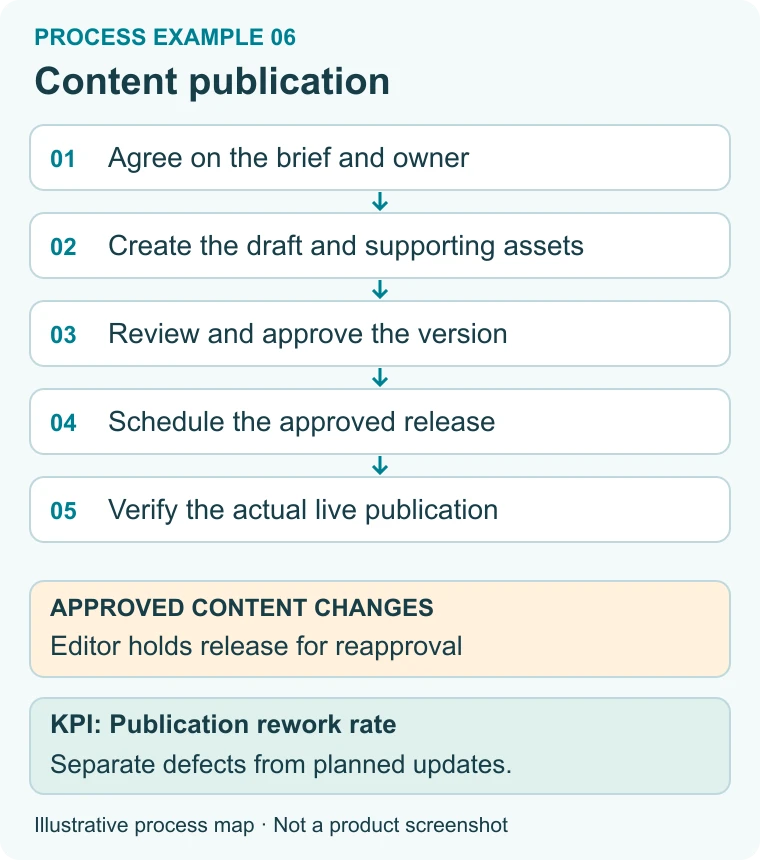
Roles and data: a requester supplies the purpose and audience; a content owner manages production; designated reviewers check the relevant claims and requirements; a publisher controls the channel and release time. Track the brief, asset version, approvals, destination, planned release, and actual public location.
Automation opportunities: assign work, collect review feedback in one place, remind reviewers of deadlines, and schedule an approved asset. The useful automation is the controlled handoff between stages, not an arbitrary rule to publish more frequently.
Exception to design: a fact or approved offer changes after scheduling. Hold the release and return the affected version for review. A successful scheduling action does not prove that the final page or post appeared correctly; verify the public result and record failures such as a broken link or missing image.
KPI: publication rework rate = released assets requiring a defined avoidable correction within the observation window ÷ released assets with that full window available × 100. Agree on what counts as a correction, and distinguish a planned content update from an avoidable publication defect.
How to model each example before automating it
Model the work at a level that allows another person to understand who does what and what evidence moves it forward. The maps in this guide summarize the sequence. A working design needs more detail before implementation.
- Observe a real instance. Follow an order, request, or issue through the current process. Record the actual handoffs, including email, spreadsheets, and work outside the main application.
- Define the boundary. Name the trigger and accepted completion evidence. Separate intermediate approvals from the outcome the requester needs.
- Assign responsibility. Name the process owner, each task owner, and the person who resolves an exception.
- Connect the data. Define identifiers, required fields, document versions, systems of record, and access appropriate to each role.
- Design alternate paths. Test missing information, rejection, cancellation, duplicates, unavailable participants, and failed system actions.
- Pilot and measure. Run a limited cohort, review actual outcomes, and revise the design before expanding it.
Business Process Model and Notation (BPMN) 2.0.2 is the Object Management Group’s specification for a shared process notation. Use its events, activities, and routing elements when a formal diagram helps stakeholders agree on behavior. These simplified maps are not executable BPMN models. The BPMN elements guide provides a separate introduction to the notation.
Choose automation step by step. Forms can standardize intake; a workflow engine can assign work and apply routing rules; an application programming interface (API) can exchange data with another system. Robotic process automation (RPA) can automate repetitive interactions with applications. These tools perform different jobs, so a diagramming tool and an execution tool should not be treated as interchangeable.
If AI is used to classify requests or extract document fields, define how uncertainty is handled and which output needs verification before it drives an action. The NIST AI Risk Management Framework provides a voluntary framework for managing AI risks. It does not certify a particular automation or eliminate the need to test it in context.
Measure the value of a process change
Separate business outcomes, elapsed time, hands-on effort, and cash costs. Automation may reduce manual handling without shortening a delay caused by an unavailable decision-maker. It may release staff capacity without reducing payroll expenditure.
| Measure | What to record | Common mistake |
|---|---|---|
| Business result | The accepted outcome, due date, and any open overdue work. | Counting a completed software task as a completed customer commitment. |
| Elapsed time | Start and finish timestamps, time zone, calendar, and paused-clock rules. | Comparing an old submission-to-finish clock with a new approval-to-finish clock. |
| Hands-on effort | Observed handling time for the same activities and comparable request types. | Adding overlapping durations or treating all waiting time as staff effort. |
| Quality | Returns, reopens, errors, or failed checks with a defined observation window. | Claiming improvement while ignoring the cost of correction. |
| Cost | Setup, operation, support, training, and realized changes in expenditure. | Reporting theoretical capacity value as cash savings or ROI. |
Illustrative before-and-after calculation: assume 300 comparable requests per month. Assume a pilot would reduce the selected handling time from 12 to 8 minutes per request. Estimated released capacity is 300 × (12 − 8) ÷ 60 = 20 staff hours per month.
At an assumed loaded labor rate of $40 per hour, that capacity has an estimated value of $800 per month before software, implementation, training, support, and correction costs. Every input here is a teaching assumption, not a customer result or a price quote. The calculation estimates effort capacity; it does not demonstrate cash savings or a positive return on investment.
Validate the handling times with comparable real requests, keep the original measurements, and check the quality metrics before claiming a benefit. For example, saving four minutes at intake is not an improvement if downstream teams spend longer correcting incomplete information.
CMW Lab customer evidence: coordinating work at 16 kHz
The published 16 kHz case study describes a record-pressing company working with vendor partners whose ordering and tracking processes differed. Manual work created paperwork and reduced visibility. The company needed to coordinate tasks across people working outside the office.
The documented change was to use CMW Tracker for sequences of automatically generated tasks, assigning the next task after a preceding workflow step was complete. The case describes improved visibility and clearer task responsibility; it does not provide a measured before-and-after time or cost dataset.
“deploy tasks to individuals based on our product life cycle”
Mark Calabro, identified as the owner of 16 kHz in CMW Lab’s published case study, describing the need that led to the implementation. This is an excerpt from the existing case, not a new interview.
The transferable lesson is the handoff: connect the completion of one step to a known next owner, while keeping the overall process visible. The six maps in this article are editorial examples and are not representations of 16 kHz’s internal workflows.
CMW Lab’s current business process automation platform page describes visual process design, form building, data management, and integration capabilities. Bring one of your actual requests, its supporting records, and an exception to a demonstration so you can evaluate how the proposed configuration handles them.
Practical next step: choose the example closest to a recurring bottleneck, write down its completion evidence, and map one real instance with the people who perform the work. Use that map to discuss the process with CMW Lab and define a pilot that can be measured.
Frequently asked questions
What is a simple example of a business process?
An equipment request is a simple business process: an employee submits a need, an authorized person approves it, a team provides the equipment, and receipt is confirmed. The request, decision, fulfillment, and confirmation connect to a defined outcome. Each step needs an owner, and rejected or incomplete requests need a clear alternate path.
How is a business process different from a workflow?
A business process describes how an organization achieves an outcome; a workflow describes how tasks and information move through part or all of that work. The terms can overlap in practice. When documenting an example, make the boundary explicit so completing one workflow, such as an approval, is not confused with completing the entire business result.
Which business process should a company automate first?
Start with a recurring process that has a clear owner, observable delays or errors, and a defined completion condition. Confirm that its rules and data are sufficiently understood to support a controlled pilot. A small process with measurable outcomes is easier to evaluate than a large program whose responsibilities and exception paths remain unresolved.
What KPIs should business process examples include?
Include at least one outcome measure and one quality measure relevant to the process. Examples include on-time fulfillment paired with rework, or service resolution paired with reopening. Define the cohort, denominator, time window, and treatment of open work. Add handling effort or cost measures only when the underlying data can be collected consistently.
What are common process automation mistakes?
Common design mistakes include automating an unclear process, leaving exceptions without an owner, using inconsistent data, and measuring only completed work. Another is assuming that sending a request to a system proves the intended action occurred. Test the failure paths and verify the business outcome before expanding an automation to more teams or higher volumes.
Source and method note: the maps, KPI definitions, and numerical illustration are original editorial teaching materials. The customer case and technical references are linked where used. Product statements describe publicly documented capabilities, not a promise that every example is available as a preconfigured application.
A request can stall because nobody owns the decision, because reviewers have different document versions, or because two systems disagree about its status. Those problems call for different controls. Understanding the types of business process management helps you identify which control a process needs first.
The three commonly described types of business process management are human-centric, document-centric, and integration-centric BPM. Human-centric BPM organizes work that depends on people’s judgment. Document-centric BPM controls the preparation, review, and movement of documents. Integration-centric BPM coordinates work between software systems. These approaches can coexist in one process: choose the emphasis according to the decisions, records, and system interactions needed to deliver its outcome.
By Pavel, CMW Lab blog author. Last reviewed: September 15, 2026.
Key takeaways
- Human-centric, document-centric, and integration-centric BPM describe different coordination needs within a process.
- Operational, supporting, and management processes classify the purpose of work; they answer a different question.
- A human decision can remain manual while assignment, reminders, evidence collection, and follow-up are automated.
- A completed approval and a successfully created record in another system are separate outcomes that need separate checks.
- Choose an approach using actual delays and failure points, then measure both completed work and overdue work still in progress.
The three types of business process management
Business process management (BPM) is the ongoing work of understanding, organizing, measuring, and improving how an organization delivers an outcome. Software can support that work, but a diagram or an automated task alone does not establish process ownership or a useful measure of success.
The human-centric, document-centric, and integration-centric classification appears in IBM’s overview of BPM. Use it as a practical way to examine coordination needs. It is not a rule that each business process must fit into exactly one category.
| Type | Primary coordination need | Controls to design | Evidence of completion |
|---|---|---|---|
| Human-centric | A person must assess context or make a decision. | Named owner, decision authority, necessary information, due date, delegation. | A recorded decision with its author, time, and rationale when required. |
| Document-centric | Participants must work from an identified, controlled document. | Version, review status, access, required evidence, handling of changes. | The approved version is identifiable and available to authorized users. |
| Integration-centric | Applications must exchange data or carry out coordinated actions. | Identifiers, validation, acknowledgments, duplicate prevention, recovery. | The required action is confirmed in the receiving system. |
Methodology: this is an editorial design checklist, not a vendor ranking or maturity score. Each row connects a coordination need to an observable result. Apply several rows when a process has several needs.
Human-centric BPM: organize decisions and accountability
Human-centric BPM puts people’s work and judgment at the center of process design. A manager deciding whether to approve an exception, a specialist investigating a service issue, or a team reviewing a proposed change needs more than a task notification.
Design the task so the person can act: show the request, relevant evidence, allowed decisions, and what happens next. Assign it to an accountable role, then define who takes over when the usual assignee is absent. A shared inbox may distribute work, but it still needs a rule for claiming tasks and handling items nobody claims.
Example: an equipment request outside the standard catalog goes to a manager who can approve it, reject it with a reason, or ask for more information. Routine routing and reminders can be automated while the exception decision remains with the manager. Clear rules may also allow standard requests to follow a simpler path.
Watch for: using escalation as automatic approval. An overdue task means the process needs attention; it does not prove the request is acceptable. Keep “reassigned,” “escalated,” and “approved” as distinct events. If work is exploratory and the next action depends on what an investigator discovers, allow controlled discretionary tasks instead of forcing every case through an identical sequence.
Document-centric BPM: control the record people act on
Document-centric BPM organizes work around documents and the information they contain. The central question is which version is being prepared, checked, approved, issued, or retained, and who is allowed to act on it.
Examples include a policy revision, a supplier agreement, or an engineering change package. The process needs to connect the document to its request, participants, review history, and current status. A folder containing several files with “final” in their names does not establish which one was approved.
Example: procurement and an operational owner review a supplier’s service proposal. When the supplier changes a material term, the process identifies the affected version and routes the changed proposal back to the reviewers who need to reconsider it. An earlier approval remains part of the history; it must not silently become approval of the new content.
Watch for: treating upload, approval, and signature as interchangeable. They are separate events. Specify which is required for the business outcome and how its evidence will be stored. Access, retention, and signature requirements depend on the document and the organization’s applicable policies; a document workflow by itself does not establish compliance.
Integration-centric BPM: coordinate system actions
Integration-centric BPM emphasizes work across applications. A process might receive an order, validate required data, create a record in an enterprise resource planning (ERP) system, and send the resulting identifier back to the initiating application.
An application programming interface (API) provides a way for applications to communicate. The process still needs to define the meaning of each exchange: which system owns a field, what constitutes success, and what happens when a response is delayed or missing.
Example: after a supplier request is approved, an integration creates a supplier record. The workflow closes that step when it has a confirmed supplier identifier, not merely when it has sent a message. A rejected record returns to a named owner with enough information to correct it.
Watch for: retrying a creation request after an ambiguous timeout. The receiving system may already have created the record. Use a stable request identifier and a documented way to check the outcome or make repeated requests safe. The exact mechanism depends on the receiving API. A manual recovery path is still necessary when the outcome cannot be established automatically.
BPM types are different from process categories and software categories
Operational, supporting, and management processes describe why work exists in the organization. Human-centric, document-centric, and integration-centric BPM describe what must be coordinated to perform that work. These are two different dimensions.
Order fulfillment can be an operational process with substantial system integration. An internal policy update can be a management process with document reviews and human decisions. The classification of a particular activity depends on its role in the organization.
For a broader process inventory, APQC’s Process Classification Framework (PCF) provides a hierarchy and common terminology for organizing processes. That is a different use from choosing the control needed at a particular handoff.
| Concept | Question it answers | How to use it here |
|---|---|---|
| BPM | How will we manage and improve the whole process? | Set ownership, outcomes, measures, and a review cycle. |
| BPM type | What coordination needs the most attention? | Design controls for people, documents, systems, or a combination. |
| Business process management software (BPMS) | Which software capabilities will support the process? | Evaluate the required modeling, execution, data, and monitoring capabilities. |
| Workflow software | How will tasks and information move through a defined flow? | Check actual capabilities; product labels alone do not establish the boundary with BPMS. |
For the software definition, see what BPMS means. Our guide to BPM software covers its broader components and evaluation questions. Low-code development, robotic process automation, and AI are implementation options; they do not replace the need to decide who owns an outcome.
How to choose the right BPM approach
Start with a failed or delayed handoff and identify the evidence that should have allowed work to proceed. The following diagnostic is an original framework for this guide. It is a set of design questions, not a scored assessment.
- Define the endpoint. Write what must be true when the process is complete. “Approved” may be too early if the requester needs an active record in another system.
- Find where work waits. Review actual requests, timestamps, returned documents, and error messages. Separate waiting for a decision from waiting for information or a technical response.
- Identify the controlling evidence. Does the next step need a person’s decision, an approved document version, or confirmation from another application?
- Choose controls for every critical handoff. A dominant type helps prioritize the work, but secondary controls remain necessary. A document approval process can still fail at its final integration.
- Test an exception. Try an unavailable reviewer, a revised attachment, and an uncertain system response. Name the person who can resolve each condition.
- Measure the result. Select a completion measure and a quality measure before changing the process. Keep unresolved work visible.
A team can begin with a simple process map and a consistent record of requests. Add automation where a repeatable rule or handoff justifies it. Buying a broad software suite before defining the endpoint makes it harder to distinguish a missing feature from an unresolved business decision.
Worked example: one supplier onboarding process, three BPM types
Illustrative process design: a company wants approved suppliers to become usable in its ERP system. This example describes a proposed operating model, not a CMW Lab customer implementation or a ready-made product configuration.
The process starts when a requester submits a supplier record and the required supporting documents. It ends when the ERP confirms creation of the approved supplier and the requester receives that identifier, or when an authorized owner rejects or cancels the request.
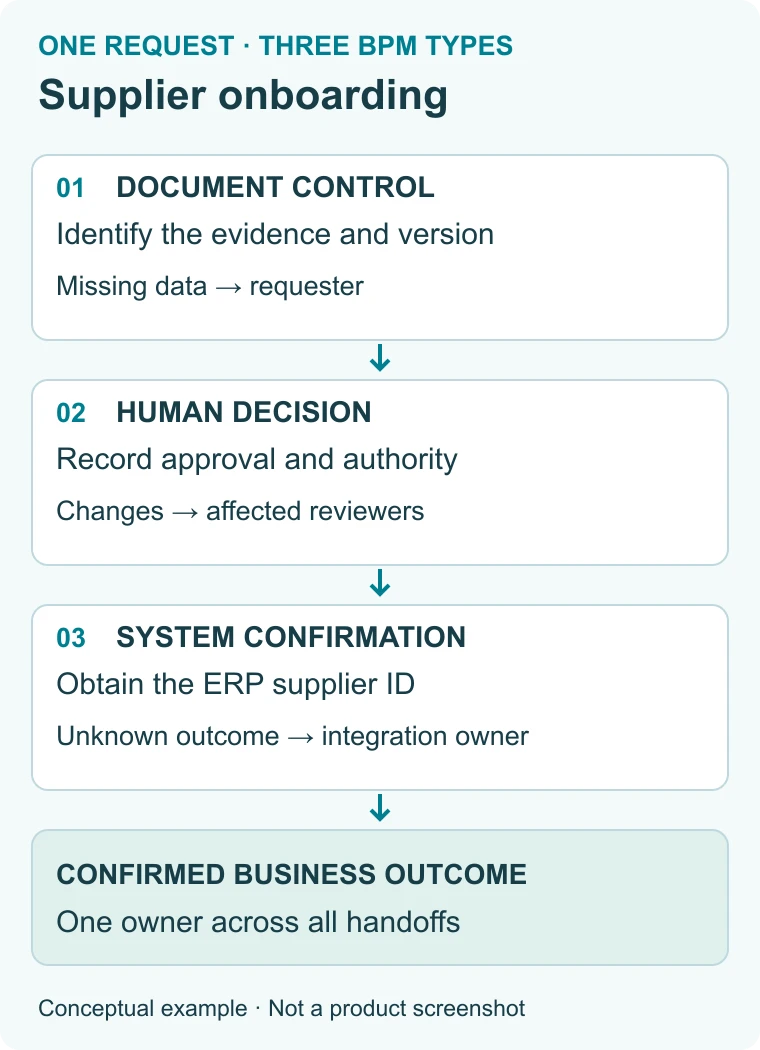
1. Establish one request and its documents
The requester supplies the business reason, supplier identity, required fields, and supporting documents. The process assigns a request identifier. The procurement coordinator checks completeness and identifies the document version being reviewed. Missing information goes back to the requester without creating a second request.
This is primarily document-centric work. The control is a traceable relationship between the request, its evidence, and the review status. File storage alone does not provide that relationship.
2. Record an accountable decision
The designated approver receives the checked information and records approval, rejection, or a request for changes. The authority rule determines the approver; absence triggers reassignment to an authorized substitute. If the underlying proposal changes, the coordinator identifies which approvals need to be repeated.
This is primarily human-centric work. The control is an attributable decision about the identified request and evidence. A reminder should help the owner act without changing the decision status.
3. Confirm the system outcome
After approval, the integration submits the necessary data to the ERP. The process stores the response and resulting supplier identifier. If validation fails, the integration owner receives an actionable error and routes any business-data correction to procurement.
If the response times out, the request enters an “outcome unknown” state. The integration owner checks whether the supplier already exists using the supported correlation or lookup mechanism. Only then does the process safely resume, retry, or require manual reconciliation. Approval alone does not close the request.
This is primarily integration-centric work. The control is confirmation that the receiving system achieved the intended result. The integration must also define how access is restricted and how unnecessary sensitive data is excluded from logs.
4. Keep one owner across all three
A process owner is accountable for the end-to-end outcome; the procurement coordinator, approver, and integration owner remain responsible for their steps. Shared request identifiers connect the evidence across those steps. Cancellation after the ERP record has been created needs a defined follow-up action in the ERP, because canceling a workflow does not automatically undo an external action.
The lesson is practical: a process can be human-centric at its decision point, document-centric in its evidence handling, and integration-centric at completion. Labeling the whole process with one type should never hide an uncontrolled handoff.
Measure outcomes without hiding unresolved work
Select metrics that expose the failure mode you are trying to fix. The definitions below are proposed measurement rules for the supplier example, not industry benchmarks. Record the cohort, time zone, working calendar, and treatment of canceled requests before comparing periods.
| Measure | Definition | What it reveals |
|---|---|---|
| End-to-end completion time | Confirmed business completion time minus initial submission time; report the median for completed requests. | How long the requester waited for a usable result. |
| Approval queue time | Decision time minus time the complete request became available to the approver. | Waiting around the human decision. This is not hands-on effort. |
| First-pass completion rate | Completed requests with no return for correction ÷ all completed requests in the defined cohort × 100. | Whether speed came with avoidable rework. |
| On-time completion rate | Requests completed by their due time ÷ all requests whose due time has passed in the cohort × 100. | Service performance, including overdue requests still open. |
| Unresolved integration outcomes | Count of requests awaiting confirmation or reconciliation at a stated observation time, with the age of each. | Whether systems are leaving business outcomes uncertain. |
Worked calculation: suppose 20 requests have reached their due times. Eighteen are complete: 17 finished on time and one finished late. Two remain open and overdue. The on-time completion rate is 17 ÷ 20 × 100 = 85%. Dividing by only the 18 completed requests would produce 94.4% and hide the two unresolved commitments.
Suppose 15 of those 18 completed requests needed no return for correction. First-pass completion is 15 ÷ 18 × 100 = 83.3%, rounded to one decimal place. Its denominator differs deliberately: it describes the completed subset. These are invented teaching numbers, not measured CMW Lab results or performance targets.
Compare like with like. If a new process starts its clock only after documents are complete while the old process started at initial submission, the apparent time improvement may come from excluding preparation work. Preserve both timestamps so you can report customer waiting and internal processing separately.
Implement the controls, then evaluate the software
Each BPM type needs a repeatable improvement cycle: understand the current process, design its controls, test them, run the process, and review observed results. Revisit the design when the evidence shows a bottleneck or a recurring exception.
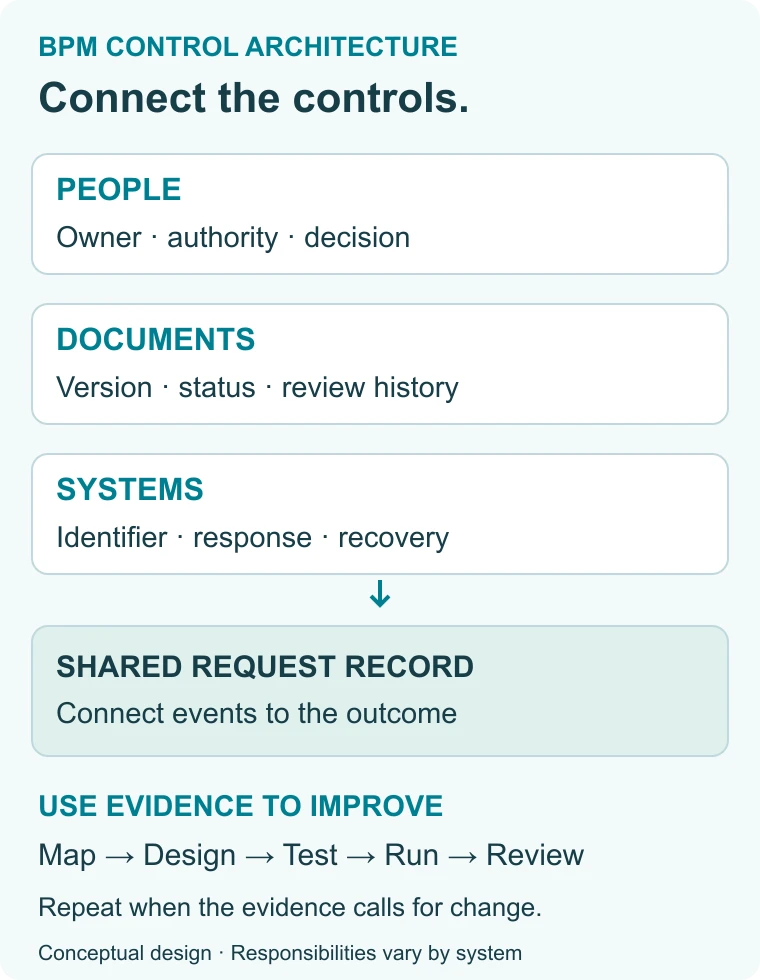
Business Process Model and Notation (BPMN) 2.0.2, published by the Object Management Group, provides a common notation for process diagrams. Use a model to discuss responsibilities and alternate paths, and verify what the selected execution system supports. A drawing alone does not implement access rules, integrations, or reliable recovery.
For a software demonstration, bring one representative request and ask the team to show the following:
- Human work: assign, claim, reassign, return, and complete a task while preserving its history.
- Document work: identify the reviewed version and show what happens when it changes after approval.
- Integration work: show success, a rejected request, an ambiguous timeout, and recovery without an unintended duplicate.
- Governance: demonstrate who can change rules and how a changed process version affects work already in progress.
- Monitoring: find a delayed request, identify its current owner, and follow its events across the process.
Some controls may be configured in a BPMS; others may belong in a document repository, integration service, or system of record. Record which component is responsible. Low-code tools can simplify configuration, but permissions, exception handling, and deployment choices still require deliberate design.
For a more detailed selection exercise, the workflow automation checklist covers routing, rules, visibility, and implementation questions.
A CMW Lab customer example: replacing spreadsheet-based claims tracking
CMW Lab’s published customer case collection describes Anthem replacing cumbersome Excel files with CMW Tracker for healthcare claims management. The described change brought claims tracking, performance indicators, and document management into an automated workflow solution.
The reported outcome is qualitative: the case describes easier tracking of handling effectiveness and service quality. It does not provide a baseline-and-final cycle-time dataset, so this guide assigns no percentage improvement to the implementation.
Viewed through the framework above, the case illustrates the relationship between document handling and visibility into ongoing work. The public summary does not describe the integration architecture, so it cannot establish how external-system confirmation or recovery was implemented.
For a process spanning these coordination needs, CMW Lab’s current business process management software page describes CMW Platform capabilities for BPMN modeling, task routing, process monitoring, and integration through an open API and OData. Evaluate the controls your process needs against the specific configuration and connected systems.
Practical next step: take one delayed request, mark its decision, document, and system handoffs, and use the comparison table to identify the missing control. Then explore the platform with that request as your demonstration scenario.
Frequently asked questions
What are the three main types of BPM?
The three commonly described types are human-centric, document-centric, and integration-centric BPM. They emphasize people’s decisions, controlled documents, and interactions between applications, respectively. Use the categories to identify the controls a process needs. A single process can use all three, so choosing a dominant type does not eliminate the other requirements.
How are BPM types different from types of business processes?
BPM types describe coordination needs, while process categories describe the purpose of the work. Operational processes deliver the organization’s core outcomes; supporting processes enable that work; management processes direct and oversee it. Any of those categories can involve human decisions, document handling, and system integration. The two classifications should be used together rather than substituted for one another.
Can human-centric BPM include automation?
Yes. Human-centric BPM can automate assignment, reminders, information gathering, and routine routing while leaving a decision to a person. The design should identify which actions follow a reliable rule and which require judgment. It should also define delegation and escalation without treating silence, absence, or an expired deadline as approval.
Is document-centric BPM the same as document storage?
No. Document storage keeps files; document-centric BPM organizes the work performed on and around them. That includes responsibility for review, the version under consideration, approval status, and handling of subsequent changes. A repository can support the process, but the process must still define when a document is ready for its intended use and what evidence establishes that status.
Which BPM type is best for an organization?
The appropriate emphasis depends on the process and its failure points. Start with human-centric controls when decisions lack clear ownership, document-centric controls when versions and review status cause confusion, or integration-centric controls when applications leave actions unconfirmed. Apply additional controls wherever needed. There is no universal ranking that makes one type appropriate for every process.
How this guide was prepared: definitions were checked against the linked sources, and product statements were checked against CMW Lab’s public documentation. The diagnostic, tables, diagrams, supplier scenario, and calculation are editorial teaching assets. The customer example is attributed to its published source.
By Pavel · Last reviewed: September 15, 2026
A request can spend minutes being worked on and hours waiting in an inbox. Workflow automation software can move it to the next person, check required information, and flag a missed deadline. The useful starting point is a specific handoff that needs fixing—and a clear definition of what should happen when the normal route fails.
What is workflow automation? Workflow automation is the use of software to perform defined tasks and move work between people or systems when specified events and conditions occur. It can validate submissions, assign tasks, route approvals, send notifications, and record outcomes. People still define the rules, handle exceptions, and make decisions that require judgment. Effective automation connects each action to an accountable owner and an observable result.
Key takeaways
- Automate a defined process with clear inputs, owners, decision rules, and completion criteria.
- A workflow can combine automated actions with human decisions; it does not need to run entirely without people.
- Measure waiting time as well as working time before choosing an automation target.
- Test missing information, absent approvers, duplicate events, and failed integrations before rollout.
- Evaluate software by running a representative request through it, including recovery and reporting.
How workflow automation works
An automated workflow starts with an event, evaluates relevant conditions, and performs an action. For example, submitting an equipment request can trigger a check for required information. A complete request goes to the authorized approver; an incomplete request returns to the requester with a specific explanation.
Automation may execute only part of the process. Software can assign an approval task and record its outcome while a manager decides whether the purchase is justified. This distinction is consistent with IBM’s explanation of workflow automation: software may execute all or part of a process, and artificial intelligence is not required.
Workflow automation, workflow management, and BPM
Workflow management covers the design, coordination, measurement, and improvement of work. Automation implements selected actions within that arrangement. Choosing an approval rule is a management decision; applying that rule to each incoming request is a candidate for automation. See our separate introduction to workflow management for the broader concept.
Business process management (BPM) addresses how an organization designs and improves its business processes. Workflow automation is one implementation tool within that broader practice. A diagram alone does not execute work, and an automated task alone does not establish that the whole process is effective.
The Agency for Healthcare Research and Quality’s workflow assessment toolkit describes work across people and organizations, including sequential and simultaneous activities. That perspective helps avoid a common modeling mistake: showing only what happens in the application while omitting the physical work or conversation needed to complete a request.
Define the operating model before configuring software
Use this worksheet to turn a rough process idea into something a team can test.
| Element | Decision to make | Equipment request example |
|---|---|---|
| Trigger | What starts one new instance? | An employee submits a request with a unique identifier. |
| Inputs | What information is required? | Item, business reason, department, delivery location, and required date. |
| Tasks | Which steps are automated or assigned to people? | Validate the form, request approval, allocate equipment, and confirm receipt. |
| Rules | What determines the next step? | Route by department and approval authority; return incomplete submissions. |
| Roles | Who owns work and exceptions? | Requester, approver, fulfillment team, and process owner. |
| Outputs | What proves the work is complete? | Receipt confirmed, or a documented rejection or cancellation. |
| Exceptions | What needs a recovery route? | Missing data, an unavailable approver, no stock, or a failed system update. |
Method: This operating model is an editorial design aid developed for this guide. It is not a certification standard or a description of a preconfigured CMW Lab application.
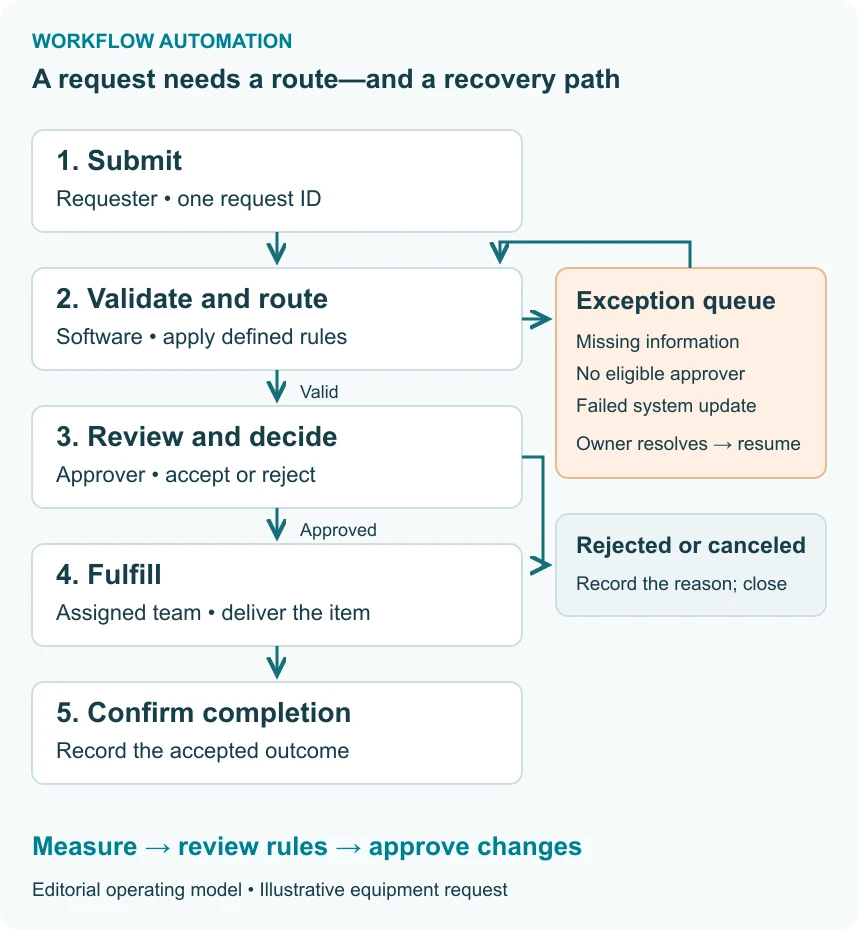
Keep the process owner separate from the current task assignee. The assignee handles a work item. The process owner maintains the rules, reviews performance, and resolves gaps that individual assignees cannot fix.
Four workflow automation examples
The following examples are illustrative process designs. They show what can be automated and what still needs a decision; they are not customer results or promises of functionality in every software package.
1. Finance: invoice approval
Trigger: An invoice is received with a supplier reference and amount. Route: Validate required fields, check for a possible duplicate, and assign review according to the organization’s approval policy. Human decision: Resolve disputed charges or missing supporting information. Completion: Record the approval outcome and a confirmed handoff to the payment process.
An approved invoice is not necessarily a paid invoice. Keep those states separate. If the payment-system update fails, retain the approval record and assign the integration exception instead of silently marking the invoice as paid.
2. HR: employee onboarding
Trigger: HR confirms an accepted offer and start date. Route: Create the required HR, IT, facilities, and manager tasks. Run independent tasks in parallel. Human decision: Confirm role-specific equipment and access requirements. Completion: Verify the organization’s required readiness checks.
A changed start date should update outstanding work without creating a second employee record. A canceled hire needs a cancellation route, including review of access or equipment already provisioned. The workflow owner must define which tasks are required before the overall request can close.
3. Marketing: campaign approval
Trigger: A campaign owner submits a version of the proposed material. Route: Assign brand, budget, and any required specialist reviews. Human decision: Approve the content or request changes. Completion: Record approval of the specific version that will be released.
An approval of yesterday’s draft should not authorize today’s revised claim automatically. Decide which changes require another review, keep the approved version identifiable, and prevent a late response from approving an obsolete draft.
4. IT and operations: equipment requests
Trigger: An employee requests equipment. Route: Validate the request, determine the approver, assign fulfillment, and notify the requester of progress. Human decision: Approve the need or propose an acceptable substitute. Completion: Confirm delivery or record the reason the request could not be fulfilled.
If the approver is absent, escalation should lead to a designated substitute with the required authority. Sending more reminders to an unattended inbox does not resolve the bottleneck. The next section shows how to measure this workflow.
Benefits of workflow automation—and how to measure them
Automation can reduce repeated data entry, make task ownership visible, and shorten handoffs. Treat each expected benefit as a hypothesis to test against the current process.
For example, mandatory fields may reduce incomplete submissions, but an unnecessarily long form can discourage use. Automatic routing may reduce dispatch time while leaving an understaffed fulfillment queue untouched. Access rules and history can support a control, but software alone does not establish regulatory compliance.
A workflow KPI dictionary
A key performance indicator (KPI) needs a defined start, finish, population, and time basis. The following definitions form a consistent measurement method for this guide. They are not universal benchmark targets.
| Metric | Formula or counting rule | Measurement note |
|---|---|---|
| Cycle time | Completion timestamp − submission timestamp | Use the same outcome and calendar before and after automation. Report median and a tail measure, such as the 90th percentile. |
| Waiting time | Total time in defined waiting states | Separate queues, requester delays, and external delays. For a sequential case with exhaustive time logging, cycle time − active time gives waiting time. |
| SLA attainment | Requests completed by their deadline ÷ all requests due in the period × 100% | Include requests that are overdue and still open. Define cancellation and pause rules before measuring. |
| Rework rate | Completed requests with at least one return for correction ÷ all completed requests in the period × 100% | Count each request once; track the number of correction loops separately. |
| Backlog | Requests still open at a stated snapshot time | Break out age, owner, and state. A total alone can hide a small group of very old requests. |
| Handoffs | Transfers between defined responsible teams within each request | Count functional transfers consistently. A status update or automated message is not necessarily a handoff. |
Method: Use event timestamps and agreed state definitions. Distinguish elapsed time from business hours. For parallel tasks, do not subtract the sum of everyone’s working hours from elapsed cycle time: those hours may overlap. Measure waiting states or the relevant execution path instead.
A service-level agreement (SLA) establishes an agreed service commitment. An internal target can use similar measurement rules, but label it accurately if no agreement exists. For either, specify when the clock starts, which calendar applies, and whether any waiting states pause it.
Worked example: where an equipment request loses time
Assume one request follows a sequential route on a single working day. All active and waiting intervals are recorded; there are no breaks, overlapping tasks, or paused clocks.
| Event or interval | Time | Active work | Waiting |
|---|---|---|---|
| Request submitted; waiting for validation | 9:00–9:30 a.m. | 0 minutes | 30 minutes |
| Intake validates the request | 9:30–9:45 a.m. | 15 minutes | 0 minutes |
| Waiting for the approver | 9:45–10:00 a.m. | 0 minutes | 15 minutes |
| Manager reviews and approves | 10:00–10:15 a.m. | 15 minutes | 0 minutes |
| Waiting for fulfillment | 10:15 a.m.–3:15 p.m. | 0 minutes | 300 minutes |
| Fulfillment delivers equipment and confirms completion | 3:15–3:30 p.m. | 15 minutes | 0 minutes |
| Total | 9:00 a.m.–3:30 p.m. | 45 minutes | 345 minutes |
Cycle time is 390 minutes: 45 minutes of active work plus 345 minutes of waiting. The two functional handoffs are intake to the approver and the approver to fulfillment. This counting rule excludes the initial submission and final notification.
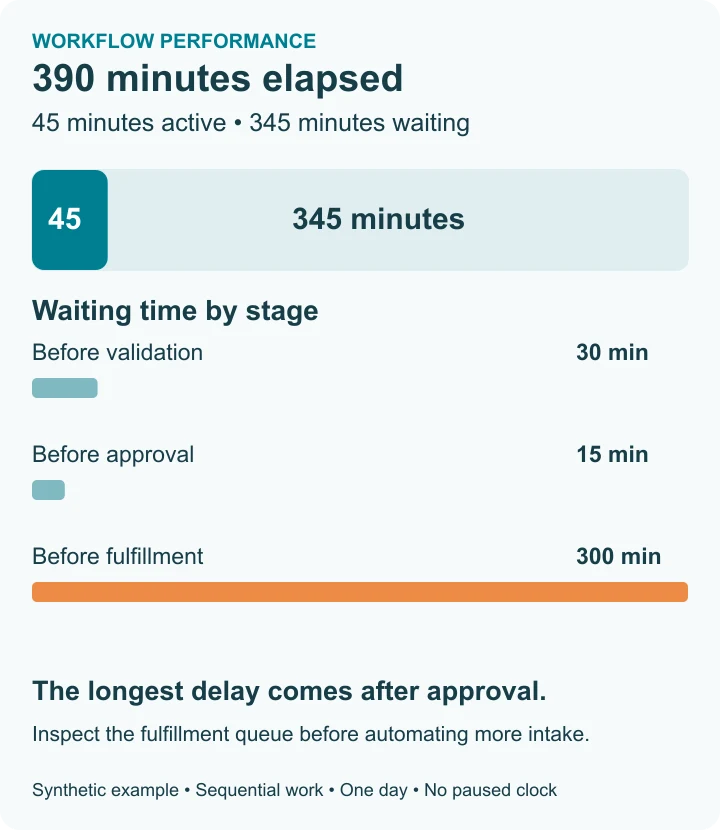
Automating intake might help, but the largest delay in this case occurs after approval. Investigate availability, assignment, and fulfillment capacity before promising that a faster form will solve the problem. Compare a representative group of requests before and after the change, using the same measurement boundaries.
For a separate SLA example, suppose 10 requests are due this week: eight finish on time, one finishes late, and one remains overdue. Attainment is 8 ÷ 10 × 100% = 80%. Excluding the open request would conceal a missed deadline.
How to implement workflow automation
Start with one repeatable process that has a clear owner and a measurable problem. Expand after the team can operate and recover that process reliably.
1. Establish the baseline and boundaries
Review actual completed and open requests with the people who handle them. Include rejected cases and exceptions. Record the current steps, elapsed time, rework, and manual transfers. Define the outcome you want to improve: faster approval, fewer incomplete requests, or more reliable delivery.
Choose one start event and one finish condition. If the requester needs delivered equipment, measuring only time to approval understates their experience. Agree on the decision authority before configuring the route.
2. Map the route and exceptions
Identify inputs, roles, decisions, dependencies, and recovery paths. Our workflow modeling guide explains how to make a useful diagram. When a standardized notation is appropriate, use the Object Management Group’s Business Process Model and Notation (BPMN) 2.0.2. A simpler flowchart may be sufficient for a small approval process.
Ask what happens when no rule matches, a required person is unavailable, or a request changes after approval. Give each exception a visible state, an owner, and an allowed next action.
3. Configure a bounded first version
Build the form, roles, route, conditions, and notifications for that process. Maintain a unique request identifier across connected systems. Decide which system owns each important field and how corrections are reconciled.
Low-code tools can make configuration more accessible, but integrations, permissions, and business rules still need validation. A visual designer reduces some implementation effort; it does not remove the need for process ownership.
4. Test normal work and recovery
Use representative scenarios in a safe test environment. Test a complete request, a rejection, a return for correction, an absent approver, and a failed handoff to another system. Confirm that unauthorized users cannot view or approve restricted requests.
Include a duplicate-event test: deliver the same request event twice and verify that the design prevents an unintended second order or task. This is an acceptance criterion for the implementation, not a claim that every workflow tool handles duplicates automatically.
5. Train the people who will run it
Show requesters what a complete submission looks like. Show assignees how to accept, reject, delegate, and escalate work. Give the process owner a way to inspect exceptions and identify requests that need attention.
Define a fallback for an outage, including how work recorded outside the application will be reconciled afterward. Roll out to a manageable group and collect feedback from both frequent and occasional users.
6. Compare results and govern changes
Compare the agreed KPIs with the baseline. Check whether reduced dispatch time has moved the bottleneck elsewhere. Review incomplete and abandoned requests as well as successful ones.
For each rule change, record its owner, reason, and effective date. Decide how requests already in progress will behave. A change to approval authority should not silently erase the policy under which an earlier decision was made.
Eight software features to check before you buy
Use the same request and exception scenarios in every demonstration. These checks preserve the practical purpose of a feature checklist while producing evidence you can compare.
| Check | What to ask the vendor to demonstrate |
|---|---|
| 1. Visual workflow design | Build a route with a decision, a return for correction, and an understandable version history. |
| 2. Usable forms | Submit and correct the request on desktop and mobile; demonstrate required fields and clear validation messages. |
| 3. Suitable deployment and access | Explain cloud or on-premises options, supported access methods, operational responsibilities, and recovery arrangements. |
| 4. Deadlines and SLA visibility | Show how deadlines, working calendars, pauses, and overdue requests appear to users and managers. |
| 5. Targeted notifications | Notify the person who must act, escalate to a substitute, and avoid repeated alerts after the issue is resolved. |
| 6. Reporting and usable history | Trace one request and reproduce a KPI from its recorded events; show how data can be exported. |
| 7. Parallel work and completion rules | Start independent tasks together and show what happens when one is rejected, canceled, or delayed. |
| 8. Role-based access | Demonstrate the requester, approver, administrator, and restricted-user views, including a denied action. |
Method: This checklist evaluates observable behavior. A feature label is not a pass. Record the configuration, limitations, and evidence from each demonstration; do not combine unweighted scores into a claim that one product is universally best.
Treat integration as an end-to-end check across the eight features. An application programming interface (API) connects software systems, but its availability alone does not establish a working integration. Test field mapping, authentication, failure recovery, duplicate prevention, and the confirmation that the destination system accepted the change.
Price the implementation as well as the subscription. Include configuration, integration, migration, training, support, and ongoing administration. Confirm licensing and limits against a written offer for your intended use; generic category prices are a poor basis for a business case.
Where AI belongs in an automated workflow
Artificial intelligence (AI) may help interpret unstructured input, suggest a category, or draft a response. Those outputs need a defined role in the process. For example, an AI-generated summary can assist an approver without becoming an approval itself.
Separate suggestions from actions that commit the organization. Decide what requires verification, which information the system may use, and who handles an uncertain or incorrect result. The NIST AI Risk Management Framework provides a voluntary framework for managing AI risks; it does not certify a workflow implementation.
A deterministic rule is often sufficient for a known threshold or routing table. Select the mechanism that fits the decision, and test it against the process requirements.
CMW Lab experience: keep people responsible for the process
In her article about automation and managers’ roles, Anastasia Chumakova—identified there as a Product Marketing Analyst and Workflow Automation Expert at Comindware—writes:
“Workflow automation logic also comes from the manager”
This previously published perspective addresses a practical misconception: software can apply a routing rule, but someone still needs to decide whether that rule fits the work.
CMW Lab’s published Hertz case illustrates the coordination problem. Before: different finance and location-management units used separate Excel files. Change: Hertz selected a cloud-delivered CMW Tracker solution for capital expenditure approval work, seeking shared access to projects and flexibility for field employees. Evidence boundary: the public summary documents the problem and solution choice, but it does not quantify the resulting reduction in approval time.
The relevant implementation lesson is to connect the request, decision, owner, and outcome in one traceable process. Faster software actions alone are not evidence of a faster business result.
Frequently asked questions
What is workflow automation software?
Workflow automation software performs defined actions and routes work according to configured events and rules. It can connect forms, tasks, approvals, notifications, and records across a process. Some steps remain human decisions. Evaluate the software by testing your actual route, exceptions, permissions, and reporting requirements rather than assuming that every product supports the same behavior.
How is workflow automation different from workflow management?
Workflow automation executes selected tasks and handoffs; workflow management establishes and improves how the work should run. Management includes ownership, decision authority, measurement, and change control. A team can manage a workflow manually before automating it. It also needs to keep managing the workflow after software begins assigning tasks or applying rules.
Which workflow should a business automate first?
Start with a repeatable workflow that has a clear owner, stable decision rules, and a measurable problem. Review enough real requests to understand normal work and exceptions. A process with missing ownership or constantly disputed rules needs design work first. Select a bounded pilot whose users can test the result and provide useful feedback.
Which KPIs show whether workflow automation is working?
Measure cycle time, waiting time, deadline attainment, rework, backlog, and handoffs where they relate to your objective. Define the population, timestamps, and calendar consistently. Include overdue open work in deadline reporting. Compare equivalent periods or request groups, and check quality alongside speed so faster closure does not conceal rejected, incomplete, or prematurely closed requests.
Does workflow automation require AI or eliminate human approval?
Workflow automation does not require AI, and it can retain human approval at any necessary decision point. Rules can validate fields, route work, and trigger reminders. If AI supplies a recommendation or draft, decide how it will be checked before it affects a consequential action. The process owner remains responsible for defining that boundary.
Put one process through a realistic evaluation
Bring a real form, its approval rules, a difficult exception, and one KPI to a software discussion. Ask the team to show submission, assignment, decision, recovery, completion, and reporting for that same request.
Explore CMW Tracker workflow software to evaluate its published capabilities for visual workflow design, forms, business rules, and reporting against your process. For the broader implementation context, see how CMW Lab approaches workflow automation.
How this guide was prepared
This guide combines current public product information, primary reference sources, a previously published CMW Lab expert perspective, and an editorial operating model. The equipment request, KPI calculations, and evaluation checklist are reproducible examples, not customer benchmarks. Product capabilities should be confirmed for the proposed configuration during evaluation.
 We are proud to announce that CMW Platform has been recognized as the #1 Business Process Management (BPM) software in the 2025 Info-Tech Data Quadrant Report, published by SoftwareReviews. The annual BPM category report, based on verified user reviews and in-depth research, placed CMW Platform at the top of the quadrant thanks to outstanding customer satisfaction and product capabilities. CMW Platform scored an impressive 9.1 out of 10 composite satisfaction score, outperforming 20 other BPM solutions. CMW Platform also received a 91% satisfaction rating for Process Management features, the highest among all evaluated vendors, confirming its strength in enabling seamless process automation and optimization. In addition to feature excellence, CMW Platform leads in categories such as:
- Business Value Created – 90%
- Ease of Implementation – 88%
- Product Strategy and Innovation – 89%
- Usability and Intuitiveness – 88%
Ready to see why we’re #1? Request a demo and start transforming your business processes today.
The combination of rapid maintenance and complex business workflows can prove to be challenging for firms today. As a resolution, RPA has now made it easier to automate repeatable processes, however, gaining efficiency, scalability and strategic value has never been this difficult. This is now solved through a new concept, Intelligent Automation or IA.
(more…)Ensuring compliance in healthcare is a complex, high-stakes challenge. Strict regulations like HIPAA, the Anti-Kickback Statute, and Stark Law demand precision, with non-compliance leading to hefty fines, legal repercussions, and reputational damage. But what if you could use automation strategically in such a way that it allows you navigate through the ‘how to not get into prison’ maze like a walk in the park? Well, the answer is strategic automation. This guide provides automation solutions applicable to compliance in healthcare, like a vital compliance automation process roadmap for 2025 and beyond. The areas that will be focused include the advantages of healthcare compliance automation, the steps that must be taken, case study presentations, and the advanced systems that are changing the meaning of automation. Selecting an automation solution for healthcare compliance will ensure that your institution is compliant, operational, and protected all at the same time, which is especially helpful when having to automate compliance for telemedicine with its peculiar complications.
(more…)