Project Initiation: Steps, a Decision Record, and a Worked Example
November 23, 2026
Project initiation establishes the need, intended outcome, high-level scope, and authority for a project or a defined first stage. Its useful output is a decision people can act on, with the assumptions and limits of that decision still visible.
Work through the steps below using a fictional equipment-loan proposal. The aim is to authorize the right next action while keeping unconfirmed dependencies out of the promised result.
Table of Contents
1. State the need and separate it from the proposed solution
Illustrative project proposal: an operations team wants a shared request service for borrowing equipment at one office. Today, different teams keep separate spreadsheets. The proposed outcome is a visible request, handover, and return status with a named service owner. This is a fictional design exercise, not a customer implementation.
Begin with the observed problem and the result the sponsor wants to improve. A proposed shared application is a possible response; it is not the business need itself. Identify who owns the current service and who will recognize whether the proposed change is useful.
For this example, confirm which teams lose visibility of loans, handovers, or returns and what information they use today. Keep a proposed benefit distinguishable from an observed result. The initiation decision should show what evidence supports the need and what remains an assumption.
2. Build the evidence needed for this authorization
The following record is an original working aid. It can sit within a business case, project charter, initiation document, or another format your organization uses. Its purpose is to make the decision and its basis clear, not to introduce another document that repeats the same information.
| Record item | Question to answer | Evidence or owner to identify |
|---|---|---|
| Need and expected outcome | What problem is worth addressing, and how would a useful result be recognized? | Business owner and observations supporting the need. |
| Proposed scope | What is included, excluded, or still undecided? | Identified proposal version and the owner of each open boundary. |
| Sponsor and decision authority | Who can authorize this stage, and who owns the intended outcome? | Named roles and the applicable decision route. |
| Stakeholders | Who is affected or needs to contribute to the decision? | Relevant business, delivery, technical, and operational representatives. |
| Feasibility and assumptions | What must be true for the proposal to work, and what is still unconfirmed? | Supporting findings, assumptions, and an owner for each investigation. |
| Resources and constraints | What capacity, timing, funding, or dependencies constrain the next stage? | Responsible owners and the basis of provisional estimates. |
| Risks and open conditions | What could prevent progress, and what must be resolved before later work? | Named owners, required evidence, and review points. |
| Decision and next action | Proceed, investigate further, defer, or stop—and with what limits? | Decision maker, time, proposal version, conditions, and next accountable owner. |
3. Resolve the proposal into a bounded decision
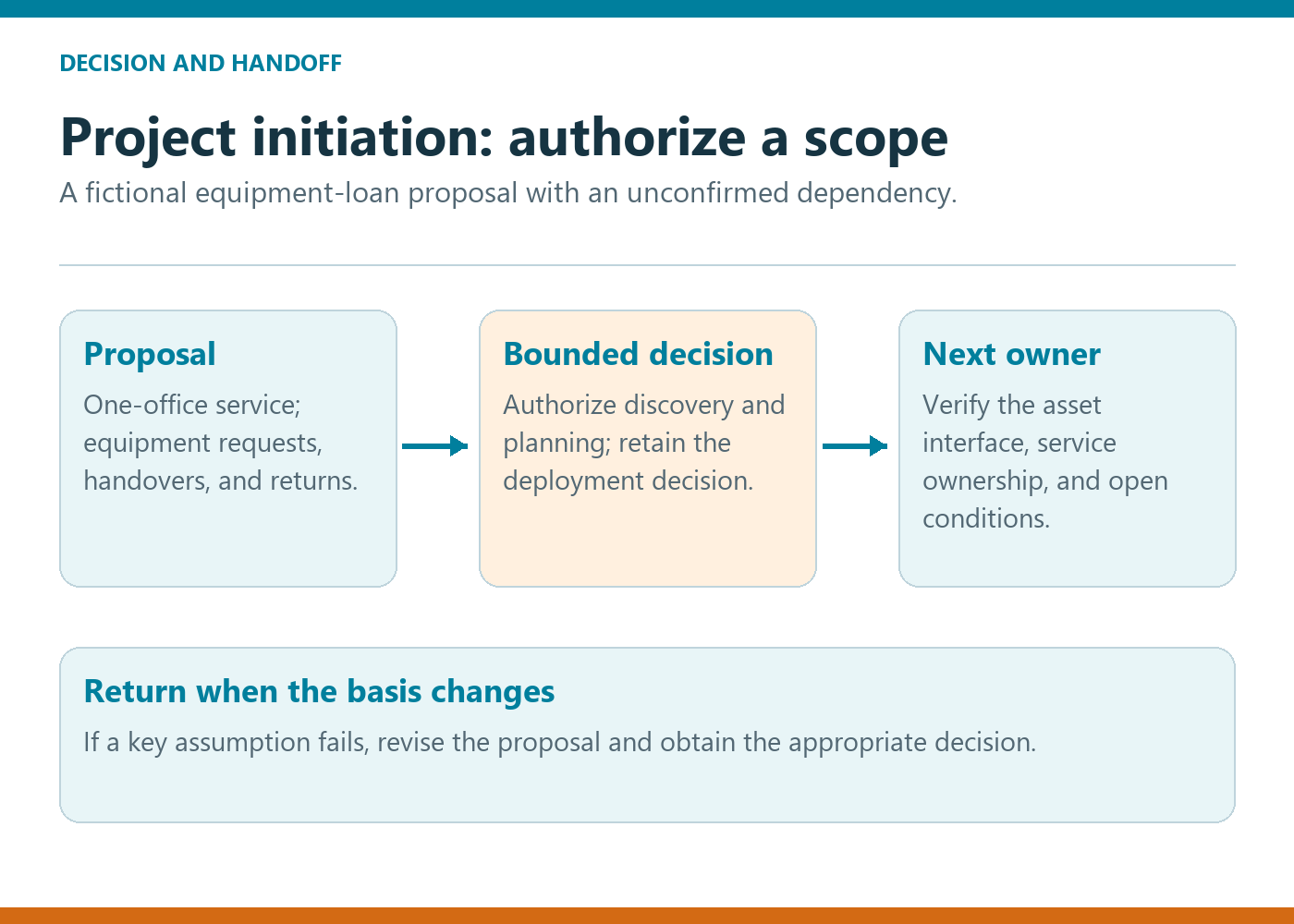
The initial scope covers a limited pilot. It excludes buying new equipment, charging employees, and replacing the organization’s asset records. The team has not yet confirmed whether the existing asset system can provide the required availability information.
The sponsor therefore needs a bounded decision. Authorizing a short discovery and planning activity can be different from authorizing full deployment. Record that distinction so a positive response to the idea does not silently become permission for the whole implementation.
Example decision record — fictional
- Authorize: discovery and planning for the equipment-loan service at one office.
- Retain for a later decision: deployment and any expansion beyond the agreed pilot.
- Technical condition: an assigned technical owner must confirm the asset interface, data authority, and failure behavior.
- Operating condition: the sponsor must identify the service owner and the capacity needed to support it.
- Decision evidence: retain the proposal version, authorized decision maker, decision date, limits, and next review point.
The record gives the next owner work to do without claiming that the asset connection or final design is already proven. If the investigation changes a major assumption, bring the revised proposal back to the appropriate decision point.
4. Distinguish the authorization from the delivery plan
Initiation establishes the purpose, broad boundaries, stakeholders, and basis for proceeding. Planning develops how authorized work will be delivered: tasks, dependencies, resources, timing, and controls. Organizations may combine or revisit parts of this work rather than following one fixed sequence.
ActiveCollab’s initiation guide separates the initial project decision from detailed planning. Its staged approach is one possible model. Agree your organization’s decision points instead of assuming every project must use the same documents or number of phases.
A kickoff meeting helps people align, but holding a meeting is not evidence that the right person authorized the scope. Likewise, an approved idea is not necessarily permission to begin every implementation activity or incur every proposed cost.
PMI’s project-charter guidance describes the charter as the sponsor or initiator’s authorization for the project and the project manager’s use of organizational resources. Record what authority is actually granted; a meeting or a positive response to an idea does not establish it by itself.
A business case explains the reason for a proposed investment of effort and resources. A project charter commonly records the project’s purpose and authorization. A plan develops the work needed to deliver the agreed scope. Terminology and approval requirements differ between organizations.
Kissflow’s initiation guide discusses the business case, feasibility, stakeholders, and charter. Treat these as questions the team must answer, rather than a requirement to create several overlapping files. State which record is authoritative and how revisions are identified.
Keep an assumption distinguishable from a verified fact. If an integration is believed to be available, name who will confirm it and what evidence is required. Do not let repeated copying into a presentation turn that assumption into an apparent commitment.
5. Carry conditions through review and into planning
A practical route can collect the proposal, check completeness, gather the required reviews, record a decision, and assign the next action. Keep “returned for information,” “deferred,” and “rejected” distinguishable. They imply different responsibilities and possible next steps.
If the proposal changes after review, make the difference visible and apply the organization’s rule for another decision. A decision record should refer to an identifiable scope and version. An approval without that connection is difficult to interpret later.
A review timeout should identify an owner for follow-up. It should not automatically count as consent. If the decision is conditional, record who verifies the condition and which later action depends on it.
Give the planning owner the authorized scope, assumptions, constraints, unresolved questions, and decision evidence. Check that the proposed plan addresses the conditions before the project moves further. New information may justify revisiting initiation rather than proceeding with an obsolete proposal.
6. Reopen the decision when its basis changes
In the equipment-loan example, discovery may show that live availability cannot be obtained in the proposed way. The team can investigate another supported design, narrow the intended pilot, or recommend deferring it. Explain how each choice changes the earlier proposal before treating it as approved work.
Compare the revised scope, assumptions, resource needs, and operating responsibilities with the recorded authorization. Assign the required new decision to the appropriate role. This is different from quietly changing a task list while everyone continues to refer to an obsolete proposal.
For the next stage, see the project planning overview. CMW Lab’s workflow builder describes forms, steps, data, and business rules that can be evaluated for coordinating proposal reviews and decisions. Verify the required authority, access, evidence, and exception behavior in the proposed configuration.
Try CMW Lab with an initiation proposal and its review conditions.

About the author
Pavel Grebeshkov
Pavel Grebeshkov has more than 15 years of experience in IT projects. His background includes CMO roles at CMW Lab and Familoop, bringing a marketing perspective to the needs of business software buyers and vendors.
He is the CEO of Softosaur, a platform for the B2B software and IT community. His articles on the CMW Lab blog focus on workflows, business processes, and the practical questions teams face when evaluating business software.