Purchase Order vs Invoice: Differences and a Partial-Delivery Example
November 23, 2026
A purchase order records what the buyer orders; an invoice records what the supplier bills. Agreement between their numbers still leaves a separate question: what was received?
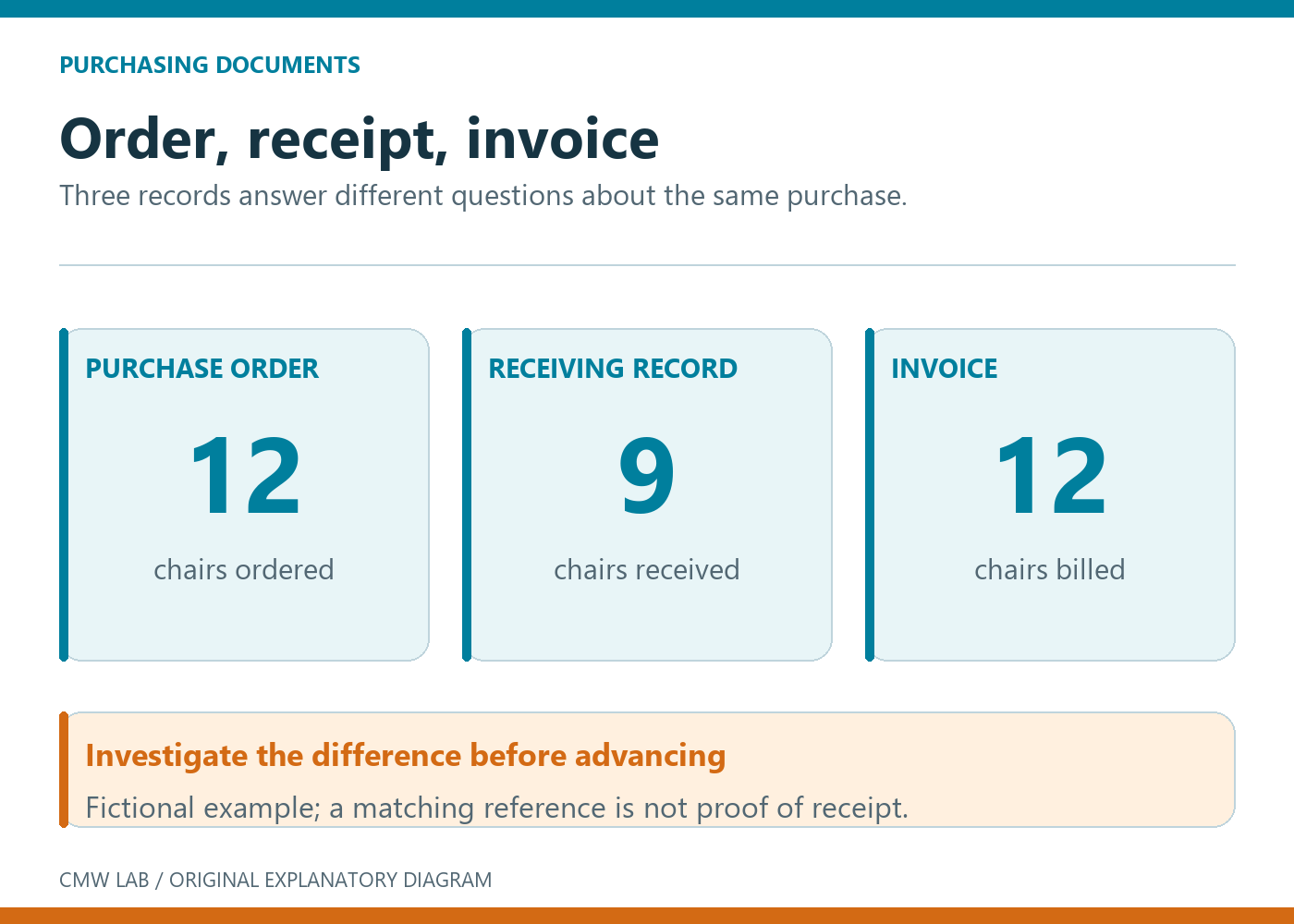
Follow a fictional purchase of twelve chairs where nine arrive and twelve are billed. This walkthrough shows how the order, receiving record, and invoice support different parts of the investigation.
Table of Contents
Read the purchase in three records
The purchase order: what the buyer ordered
The order identifies twelve chairs of the specified model and the applicable terms. Check the order version and line that the invoice references. The PO was issued by the buyer; it does not by itself establish what arrived.
The receiving record: what was confirmed
The receiving record says nine chairs arrived and three remain outstanding. Identify whether this is a partial delivery, an error, or another agreed arrangement, and who can confirm the evidence.
The invoice: what the supplier billed
The supplier’s invoice lists twelve chairs. Establish whether the billing basis explains the difference from the receiving record, whether another delivery is expected, or whether a correction is needed.
The PO and invoice may agree with one another while the delivery evidence differs. The team needs to establish whether the billing is consistent with the arrangement, whether another delivery is expected, or whether a correction is needed.
Record who resolves that question and which evidence they used. A status such as “quantity difference under review” is more informative than silently changing a received quantity to make the documents match. The authorized next action follows the organization’s rules for that case.
Keep the identifiers and versions in the evidence pack
The invoice number and PO number normally identify different records. Preserve both, together with the supplier and relevant line references. One order can be associated with several deliveries or invoices, so a shared PO number alone may not identify the precise item being reviewed.
If an order changes, retain a way to distinguish the earlier version from the revised one. A reviewer should be able to tell which terms applied to the invoice under review. Replacing an attachment without recording the change can make an earlier decision difficult to interpret.
Use a consistent link between records rather than relying only on similar file names. Where the data lives in several systems, establish which system owns the order, receiving record, invoice, and workflow status. The guide to systems of record explains that authority boundary.
A purchase order (PO) is issued by the buyer to communicate an order and its relevant details. An invoice is issued by the supplier to request payment under the applicable billing arrangement. Procurify’s comparison explains this buyer-versus-supplier distinction.
Document names and fields vary between organizations. Define what your records mean rather than treating a file name as proof of its status. In particular, an order, an invoice, a receiving record, and a payment record are different pieces of evidence.
In a PO-based purchasing route, a team identifies a need, obtains the required internal authorization, and issues the order to the supplier. Fulfillment and billing then produce additional records that refer back to that order.
The sequence and timing depend on the arrangement. Billing can relate to a delivery, service period, or another agreed stage. Use the relevant terms and evidence for that purchase instead of assuming every invoice must follow one identical delivery pattern.
A purchase requisition is an internal request to buy something; a purchase order communicates the resulting order to the supplier. The broader guide to procurement covers the surrounding process. This comparison focuses on the order and billing records that participants need to keep connected.
Record the question before assigning the next action
- Identity: does the record identify the intended supplier, buyer, invoice, and related order where applicable?
- Scope: do the items, service period, quantities, and billing basis correspond to the relevant purchase?
- Evidence: is the required receipt, acceptance, or other supporting information available?
- Differences: who investigates a missing reference, changed order, duplicate submission, or unexplained amount?
- Decision: which authorized role determines the next action, and where is that outcome recorded?
These are workflow design questions, not a universal payment checklist. For example, a non-PO invoice may be a permitted exception in one organization and require a different route in another. Define the route explicitly so the absence of a PO is handled deliberately.
Matching compares relevant records and identifies agreements or differences. Approval is a decision by a role permitted to authorize a specified action. A comparison that finds no difference does not automatically establish that every required decision has been made.
Likewise, an approval without a clear reference to the supporting records may not explain what was reviewed. State which checks and decisions are required for this request type and preserve the evidence needed to understand them.
For the detailed routing topic, see the existing invoice approval process guide. This article does not replace that implementation guide or a complete accounts payable procedure.
Walk the exception to its owner
When evaluating workflow support, start with one order and its related records. Test a normal case, a partial delivery, a changed order, a missing PO reference, and a repeated invoice submission. Check which person receives the exception and how the record explains its resolution.
The record should explain which document or confirmation was missing, who investigated it, and the authorized next action. When evaluating the CMW workflow builder, use those references and outcomes to test the route instead of relying on a generic completed status.
Use a partial delivery and its linked documents to evaluate CMW Lab.

About the author
Pavel Grebeshkov
Pavel Grebeshkov has more than 15 years of experience in IT projects. His background includes CMO roles at CMW Lab and Familoop, bringing a marketing perspective to the needs of business software buyers and vendors.
He is the CEO of Softosaur, a platform for the B2B software and IT community. His articles on the CMW Lab blog focus on workflows, business processes, and the practical questions teams face when evaluating business software.