Process Governance: Ownership, Change Rules, and a Practical Framework
November 23, 2026
Adding two required fields to a translation form changes more than the form: someone must authorize the new rule, decide what happens to open requests, and own the release. Process governance defines those decision rights, process ownership, standards, and review responsibilities. Use the fictional change record below as a small operating model.
Table of Contents
Put the proposed intake change on one record
Illustrative example: a marketing operations team accepts translation requests. Reviewers often return submissions because the intended audience and destination are missing. The team proposes adding those fields and a completeness check. This is a fictional design, not a customer case or a measured result.
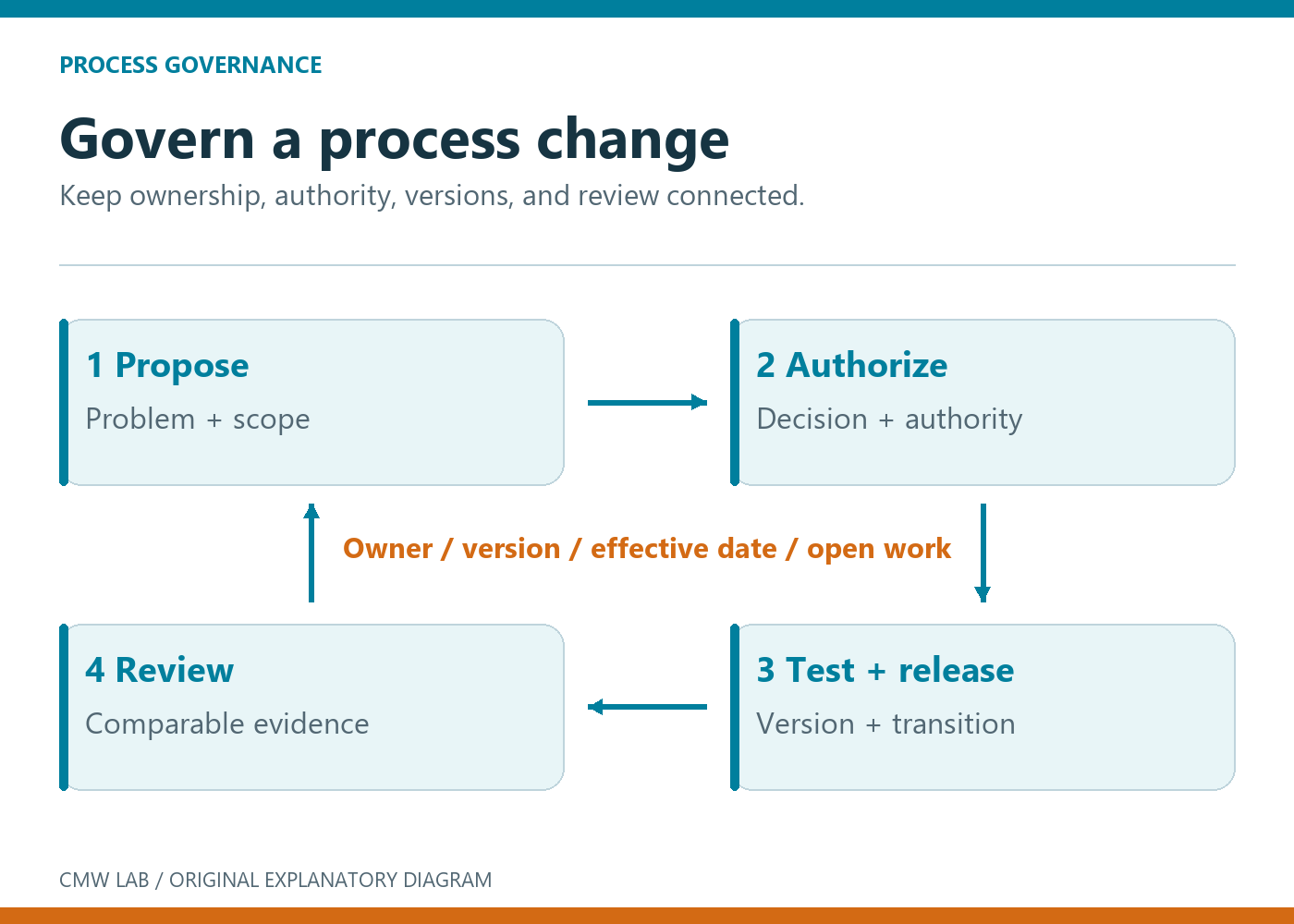
| Decision | Responsible role | Evidence to retain |
|---|---|---|
| Confirm the problem and scope | Process owner with requesters and reviewers | Examples of missing information and the proposed intake change |
| Agree on the new rule | Authorized change decision-maker | Accepted fields, permitted exceptions, and effective version |
| Test the behavior | Assigned implementer and service users | Complete, incomplete, returned, and already-open request outcomes |
| Release and communicate | Named release owner | Release reference, updated instructions, and transition decision |
| Review the effect | Process owner | Comparable return rates, waiting time, and unresolved issues |
Open requests need an explicit decision. The team might ask for the missing information when it is needed rather than automatically rejecting every item submitted under the old form. The chosen treatment should match the business need and be communicated to the people handling those items.
Resolve four decisions before the form goes live
Who owns the result across teams?
Describe the process boundary, intended outcome, participating teams, and dependencies. Give the owner a way to resolve cross-team issues or escalate them to someone who can. Naming an owner without time, information, or decision rights leaves responsibility difficult to exercise.
A specialist can maintain the documentation while the process owner remains accountable for the operating design. The system administrator may implement an authorized change without becoming the business decision-maker. Record these distinctions when the same person fills several roles.
Who can authorize the change?
Define which changes are local, which require consultation, and which need an explicit decision. A wording correction may have a different route from changing eligibility, required information, a handoff, or the definition of completion.
For a proposed change, record its purpose, affected teams, expected behavior, tests, release owner, and fallback. Decide how open items will be treated. A new route can work for new submissions while existing items need a separate transition rule.
Which version applies to open work?
Keep an identifiable current version of the process description and its related instructions. Useful fields include the owner, scope, version, effective date, change summary, approval reference, and next review condition.
A central process repository can make approved material easier to find, but central storage alone does not make a document current. Identify which version is in use, retain the relevant history, and prevent an outdated copy from being presented as the active instruction.
The separate guide to process vs procedure explains why changing the route and changing task instructions may require different updates. Keep their references connected.
Who owns the response when the change fails?
If the change produces unexpected returns, the release owner needs a defined response. That could mean correcting an instruction, temporarily using an agreed exception, or restoring the previous rule. Record the decision instead of making a silent edit to the live process.
Name the release owner and the fallback in the record so that the response has a responsible decision-maker.
Use the same record at three levels of responsibility
It helps to distinguish three responsibilities. The terms can overlap between organizations, so state the scope of each role rather than relying on its label.
- Process governance: Who may decide how this process operates and changes? Evidence: Ownership, change authority, standards, and review decisions.
- Process management: How should the process be designed, measured, and improved? Evidence: Process definition, improvement work, and performance reviews.
- Process execution: What must happen to this particular item now? Evidence: Assignments, decisions, status, and completion records.
Someone performing a task may identify a valuable improvement without having authority to release it to every team. Equally, a governing group needs input from the people doing the work. Separate the right to propose a change from the right to approve and implement it.
The guide to workflow vs process explains the difference between an overall business outcome and the task routes used to produce it. Governance concerns the decisions about those arrangements, not another way to draw the same route.
Nintex’s process governance overview describes a framework for developing, running, monitoring, and refining processes. In practice, governance should help people answer a small set of recurring questions:
- Who is accountable for the result across departmental handoffs?
- Which changes can a team make locally, and which affect other owners?
- Which process description and operating instructions are current?
- Who decides when a requirement conflicts with capacity or another process?
- What evidence shows whether the process is working as intended?
These questions connect strategy to everyday decisions. For example, a team may want faster responses, but adding an automatic deadline does not decide who handles overdue work or whether the change is acceptable to the receiving team.
Review the effect and close the next decision
Choose measures that correspond to the process outcome. For the translation example, a return rate can show incomplete intake, but it does not show whether the translated work met the requester’s need. Consider fulfillment time, rework, unresolved exceptions, and outcome acceptance together.
Agree on the reporting population and time boundaries before comparing versions. Separate open work from completed work and distinguish request types. A shorter average time after a change may reflect a different workload rather than an improvement caused by the new rule.
Use a recurring review or a clear trigger, such as a material policy change or repeated exception. A review should end with an action, an owner, a date, or a documented decision to leave the process unchanged. Holding a meeting is not itself evidence that the process is governed effectively.
A central team can maintain shared standards while local owners decide service-specific details. A more decentralized approach can give teams flexibility but needs explicit boundaries for changes that affect others. Choose the arrangement from the decisions and dependencies, rather than assuming one structure suits every organization.
Watch for warning signs: several “current” versions, an owner unable to resolve a recurring issue, changes without a transition plan, or reports that no one uses to make a decision. Correct the operating gap before adding more documentation.
Software support should make the authorized version, transition decision, and unresolved work visible. Use the CMW workflow builder overview to frame questions about those controls in the proposed deployment.
Review an authorized process change and its transition rules in a CMW Lab trial.

About the author
Pavel Grebeshkov
Pavel Grebeshkov has more than 15 years of experience in IT projects. His background includes CMO roles at CMW Lab and Familoop, bringing a marketing perspective to the needs of business software buyers and vendors.
He is the CEO of Softosaur, a platform for the B2B software and IT community. His articles on the CMW Lab blog focus on workflows, business processes, and the practical questions teams face when evaluating business software.