Low-code commonly combines visual configuration with supported programming extensions. No-code aims to cover supported use cases through configuration. The useful comparison is what happens when a real requirement reaches the edge of the available components.
Use the same training request, exception cases, and maintenance questions to compare both approaches. A label alone does not establish who can support the application or whether a required integration works.

Test one training request before choosing a label
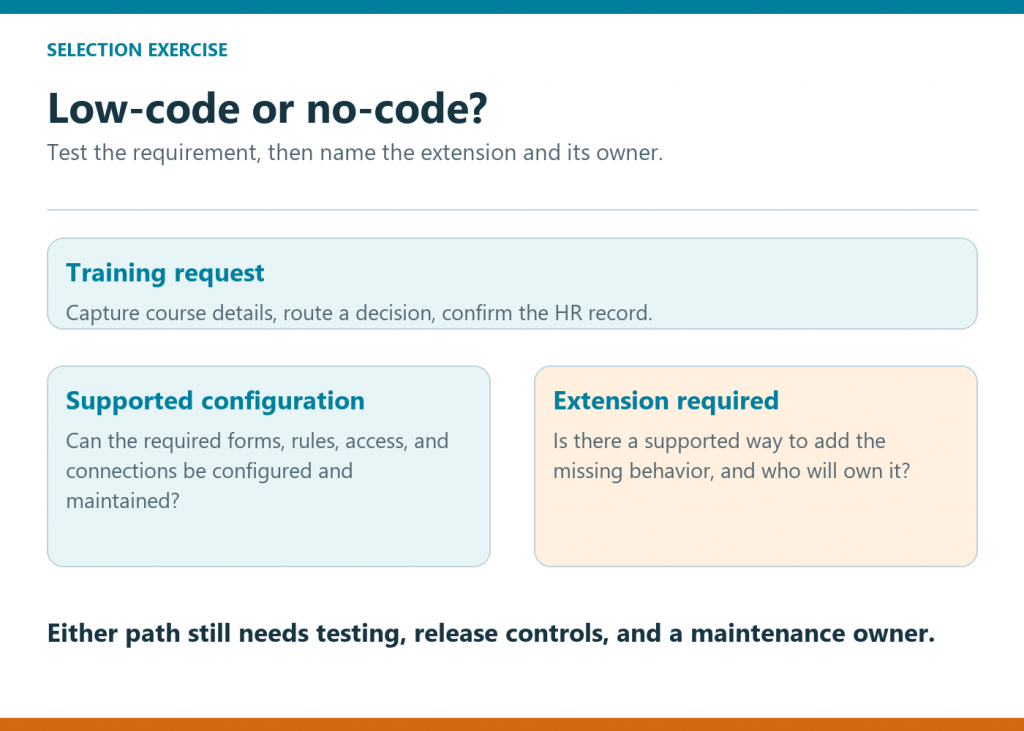
Illustrative selection exercise: an organization wants employees to request a training course, obtain a manager’s decision, and record the approved request in an HR system. This is a fictional evaluation scenario, not a customer implementation or a claim about a particular connector.

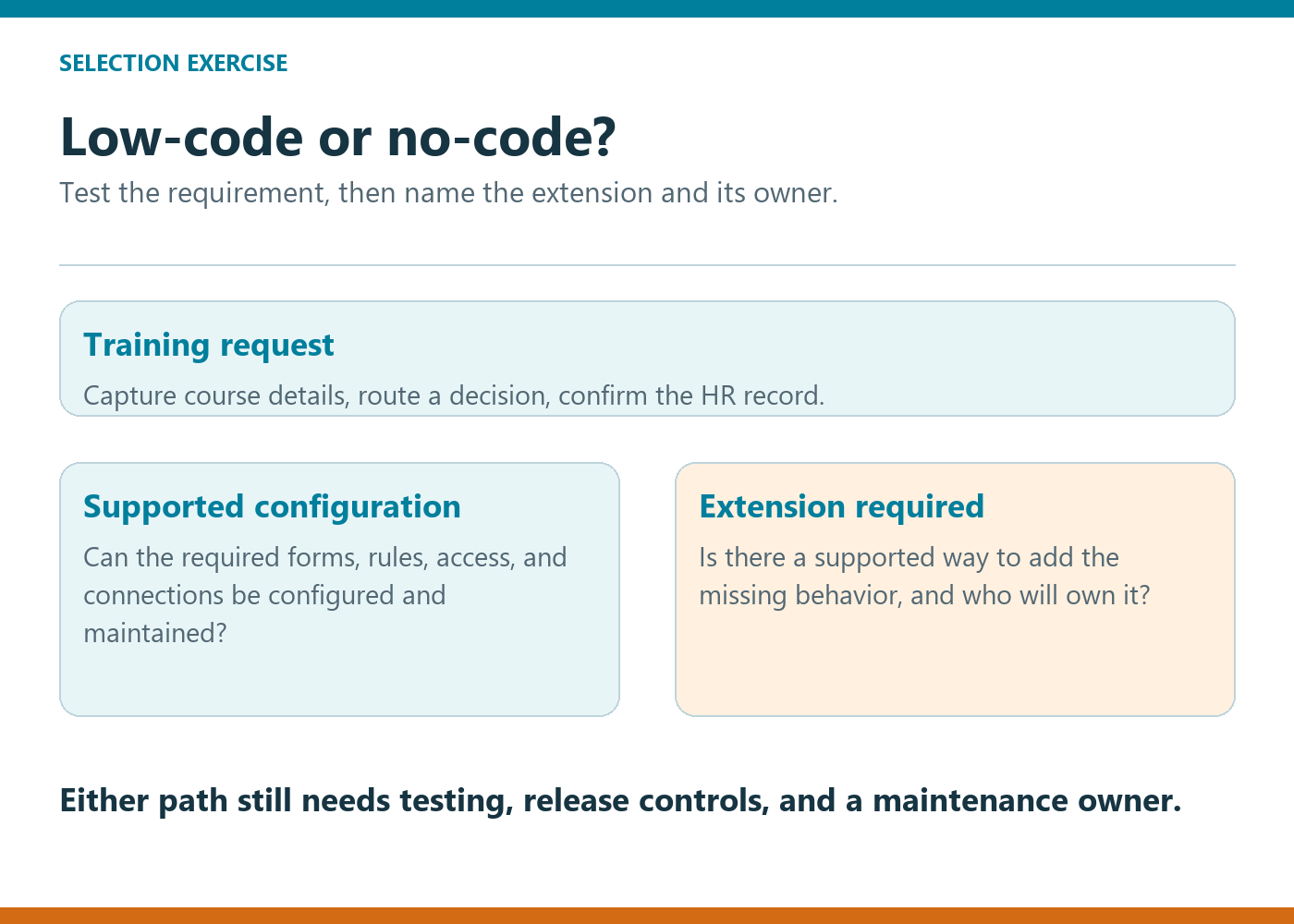
Begin with a normal request. The maker defines the required course information and the decision route. The reviewer must be able to see what was requested and return missing information. An approved task should remain distinguishable from confirmation that the HR system accepted the record.
Then test the exceptions below on each proposed solution. Record what can be configured, what needs an extension or external service, and who will support it. Do not give a solution credit for a behavior demonstrated only in a presentation.
| Test | Evidence to request | Decision it informs |
|---|---|---|
| Required course information is missing. | A clear validation or return path, with the requester able to correct the item. | Whether ordinary intake and rework fit the configuration model. |
| The manager is unavailable. | The permitted reassignment or escalation route and the responsible owner. | Whether the required authority rules can be implemented. |
| The course or cost changes after approval. | The approved version remains identifiable and the change follows the agreed review rule. | Whether a simple status field is sufficient for the real decision process. |
| The HR system response is uncertain. | A way to establish the actual result before a potentially duplicate retry. | What integration and recovery work needs specialist ownership. |
| A maker changes the live route. | A controlled test and release, including the treatment of requests already in progress. | Whether the maintenance and governance model fits the organization. |
| The organization needs to move or retire the application. | Usable data exports and a documented account of configuration and external dependencies. | What transition work and platform dependence remain. |
Find the boundary between configuration and extension
IBM’s comparison describes both approaches as ways to abstract development through visual building tools, with different extension paths. Actual products overlap. A platform may support a no-code route for one application and need specialist work for another.
Keep supported behavior in configuration
Suppose the proposed tool can capture the course information, resolve the permitted reviewer, and return an incomplete request using its supported components. That part of the example can be evaluated as a configuration task. Keep the configured rule and the evidence of its behavior together.
A no-code route can fit when the complete required behavior is covered and the team can maintain it. Check permissions, exceptions, and connections rather than extrapolating from a working form.
Name the extension when configuration stops short
If the HR system needs behavior that the standard connection cannot express, identify the missing operation precisely. A supported extension might be available; an external service or another design might be needed. Establish the permitted approach before committing to it.
A low-code route can fit when those extensions are supported and the organization can own them. More extension options also mean more components to review and maintain. Some requirements will still be better served by a different application or conventional development.
Assign the work across makers and developers
A business specialist may understand the approval rules better than a developer. A developer may be needed to connect a system, implement a supported extension, or investigate a difficult failure. Neither responsibility disappears because a product is described as no-code.
Appian’s comparison points out that low-code does not always require coding. It is more useful to identify the work a specific requirement needs than to assume that every low-code task belongs to a programmer.
Microsoft’s Power Apps co-development guidance describes teams combining business and technical participants. That is a product-specific collaboration model, rather than proof that every visual development tool offers the same controls or extension facilities.
A formula, rule, or visual branch still expresses logic. Someone must understand its inputs, test its boundaries, and maintain it when the business requirement changes. “No manual programming for this step” is a narrower claim than “no technical responsibility for the application.”
Record the selection and the cost of keeping it running
For each important requirement, record the demonstrated behavior, the configuration or extension needed, the evidence still missing, and the person responsible for support. A requirement marked unverified should remain visible in the decision rather than becoming an assumed feature.
Compare the effort to build, test, deploy, operate, and change the application. Include licenses, required components, integrations, access administration, and support. A quick prototype does not establish the cost of maintaining a production service.
Identify what the platform owns and what the team must own. Record the configuration version, supported extensions, data sources, credentials managed by the authorized team, and recovery responsibilities. Test the effect of a platform update or a changed external interface on the important workflow paths.
For the broader low-code context, see how low-code supports business change. This comparison focuses on choosing an approach, rather than replacing that overview or a product specification.
CMW Lab’s workflow builder describes visual steps, forms, data, and business rules. Use the same request, exceptions, and change scenario to evaluate a proposed configuration. Confirm the integration and support responsibilities separately.
Try CMW Lab with a workflow and its exception cases.


About the author
Pavel Grebeshkov
Pavel Grebeshkov has more than 15 years of experience in IT projects. His background includes CMO roles at CMW Lab and Familoop, bringing a marketing perspective to the needs of business software buyers and vendors.
He is the CEO of Softosaur, a platform for the B2B software and IT community. His articles on the CMW Lab blog focus on workflows, business processes, and the practical questions teams face when evaluating business software.